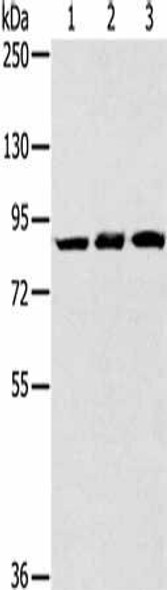
The SYTL5 Polyclonal Antibody (PAC017183) is an essential tool for researchers studying the SYTL5 protein, which plays a key role in vesicle trafficking and membrane fusion processes. This antibody, generated in rabbits, exhibits high specificity and sensitivity when interacting with human samples, making it suitable for use in Western blot experiments. By binding to the SYTL5 protein, this antibody enables precise detection and analysis in various cell types, making it an invaluable asset for investigations in cell biology and neurobiology research.SYTL5, also known as synaptotagmin-like protein 5, is a crucial player in intracellular membrane trafficking events, facilitating the fusion of vesicles with target membranes.
Its involvement in these processes highlights its importance in cellular communication and neurotransmitter release mechanisms, leading to its recognition as a potential target for studies related to neurological disorders and synaptic function. Unraveling the functions of SYTL5 is essential in uncovering novel therapeutic strategies that manipulate membrane fusion events for therapeutic benefit.
Antibody Name:
SYTL5 Antibody (PACO17183)
Antibody SKU:
PACO17183
Size:
50ul
Host Species:
Rabbit
Tested Applications:
ELISA, IHC
Recommended Dilutions:
ELISA:1:2000-1:5000, IHC:1:25-1:100
Species Reactivity:
Human, Mouse, Rat
Immunogen:
Fusion protein of human SYTL5
Form:
Liquid
Storage Buffer:
-20°C, pH7.4 PBS, 0.05% NaN3, 40% Glycerol
Purification Method:
Antigen affinity purification
Clonality:
Polyclonal
Isotype:
IgG
Conjugate:
Non-conjugated
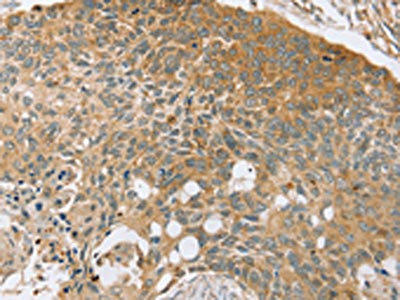
The image on the left is immunohistochemistry of paraffin-embedded Human esophagus cancer tissue using PACO17183(SYTL5 Antibody) at dilution 1/50, on the right is treated with fusion protein. (Original magnification: x200).
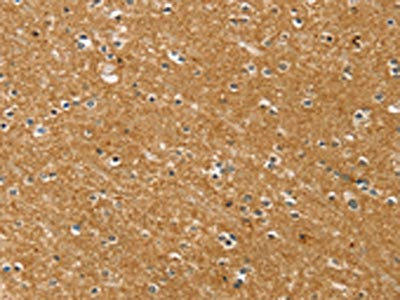
The image on the left is immunohistochemistry of paraffin-embedded Human brain tissue using PACO17183(SYTL5 Antibody) at dilution 1/50, on the right is treated with fusion protein. (Original magnification: x200).
Background:
The protein encoded by this gene belongs to the synaptotagmin-like (Slp) protein family, which contains a unique homology domain at the N-terminus, referred to as the Slp homology domain (SHD). The SHD functions as a binding site for Rab27A, which plays a role in protein transport. Expression of this gene is restricted to placenta and liver, suggesting that it might be involved in Rab27A-dependent membrane trafficking in specific tissues.
Synonyms:
synaptotagmin-like 5
UniProt Protein Function:
SYTL5: May act as Rab effector protein and play a role in vesicle trafficking. Binds phospholipids. 2 isoforms of the human protein are produced by alternative splicing.Protein type: Unknown functionChromosomal Location of Human Ortholog: Xp21.1Cellular Component: plasma membraneMolecular Function: calcium ion binding; calcium-dependent phospholipid binding; clathrin binding; protein binding; syntaxin bindingBiological Process: calcium ion-dependent exocytosis of neurotransmitter; regulation of calcium ion-dependent exocytosis; vesicle fusion
UniProt Protein Details:
NCBI Summary:
The protein encoded by this gene belongs to the synaptotagmin-like (Slp) protein family, which contains a unique homology domain at the N-terminus, referred to as the Slp homology domain (SHD). The SHD functions as a binding site for Rab27A, which plays a role in protein transport. Expression of this gene is restricted to placenta and liver, suggesting that it might be involved in Rab27A-dependent membrane trafficking in specific tissues. Alternatively spliced transcript variants encoding different isoforms have been found for this gene. [provided by RefSeq, Sep 2009]