The TNFRSF25 Antibody (CAB14261) is a high-quality antibody developed for reliable detection and analysis of target proteins. This antibody, produced in rabbits, has a high degree of specificity for human samples and has been rigorously tested for use in Western blot applications. By binding to the TNFRSF25 protein, this antibody enables precise detection and analysis in a wide range of cell types, making it an invaluable asset for studies in immunology and cancer research.
This antibody is validated for use in WB, ELISA, IF-P applications and has demonstrated reactivity against Human, Mouse, Rat samples.
Product Name:
TNFRSF25 Antibody
SKU:
CAB14261
Size:
20μL, 100μL
Reactivity:
Human, Mouse, Rat
Conjugate:
Unconjugated
Immunogen:
Recombinant protein (or fragment).This information is considered to be commercially sensitive.
Cell Membrane, Secreted, Single-Pass Type I Membrane Protein.
Calculated MW:
45kDa
Observed MW:
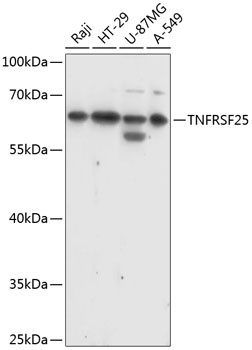
60kDa
The protein encoded by this gene is a member of the TNF-receptor superfamily. This receptor is expressed preferentially in the tissues enriched in lymphocytes, and it may play a role in regulating lymphocyte homeostasis. This receptor has been shown to stimulate NF-kappa B activity and regulate cell apoptosis. The signal transduction of this receptor is mediated by various death domain containing adaptor proteins. Knockout studies in mice suggested the role of this gene in the removal of self-reactive T cells in the thymus. Multiple alternatively spliced transcript variants of this gene encoding distinct isoforms have been reported, most of which are potentially secreted molecules. The alternative splicing of this gene in B and T cells encounters a programmed change upon T-cell activation, which predominantly produces full-length, membrane bound isoforms, and is thought to be involved in controlling lymphocyte proliferation induced by T-cell activation.
Purification Method
Affinity purification
Gene ID
8718
RRID
AB_2761123
Buffer Information
Store at -20℃. Avoid freeze / thaw cycles. Buffer: PBS with 0.01% thimerosal,50% glycerol,pH7.3.
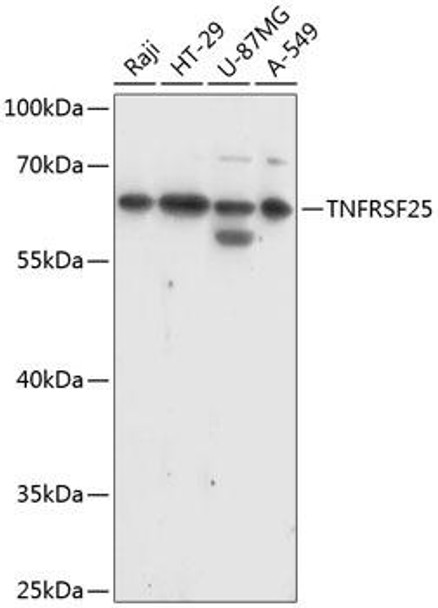
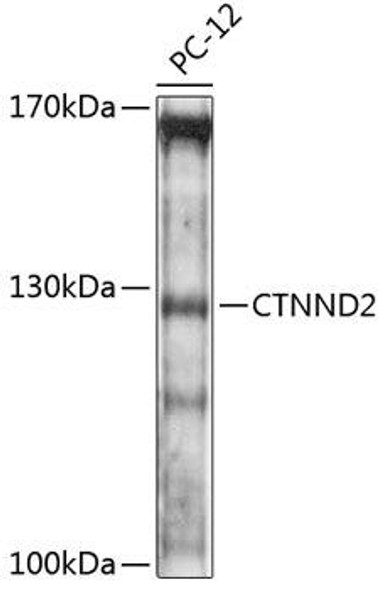
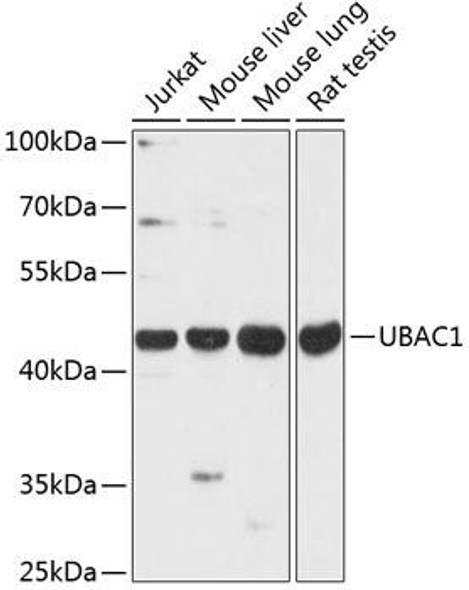
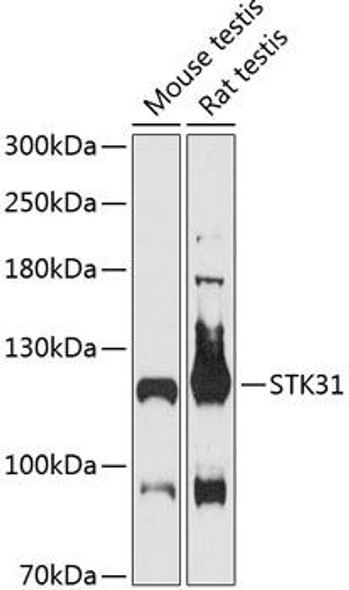
Western blot analysis of various lysates using TNFRSF25 Rabbit pAb (CAB14261) at 1:1000 dilution. Secondary antibody: HRP-conjugated Goat anti-Rabbit IgG (H+L) (CABS014) at 1:10000 dilution. Lysates/proteins: 25μg per lane. Blocking buffer: 3% nonfat dry milk in TBST. Detection: ECL Basic Kit (AbGn00020). Exposure time: 60s.
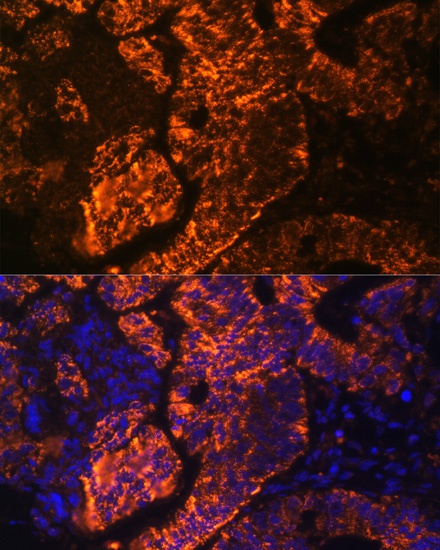
Immunofluorescence analysis of paraffin-embedded human colon carcinoma using TNFRSF25 Rabbit pAb (CAB14261) at dilution of 1:100. Secondary antibody: Cy3-conjugated Goat anti-Rabbit IgG (H+L) (CABS007) at 1:500 dilution. Blue: DAPI for nuclear staining.