The TTC5 Antibody (CAB13232) is a high-quality antibody developed for reliable detection and analysis of target proteins. This antibody, generated in rabbits, exhibits high specificity and sensitivity for detecting human TTC5 protein in Western blot experiments. By specifically binding to the TTC5 protein, this antibody allows for precise identification and analysis in a wide range of cell types, making it an essential component in studies related to cell biology and molecular research.TTC5, also known as Tetratricopeptide Repeat Domain 5, is involved in multiple cellular functions, including protein-protein interactions and signal transduction pathways.
This antibody is validated for use in WB, ELISA applications and has demonstrated reactivity against Human, Mouse, Rat samples.
Product Name:
TTC5 Antibody
SKU:
CAB13232
Size:
20μL, 100μL
Reactivity:
Human, Mouse, Rat
Conjugate:
Unconjugated
Immunogen:
Recombinant protein (or fragment).This information is considered to be commercially sensitive.
Recommended starting concentration is 1 μg/mL. Please optimize the concentration based on your specific assay requirements.
Synonyms:
Strap, NEDCAFD, TTC5
Positive Sample:
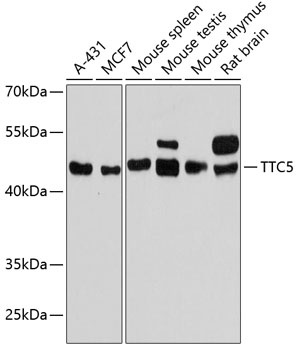
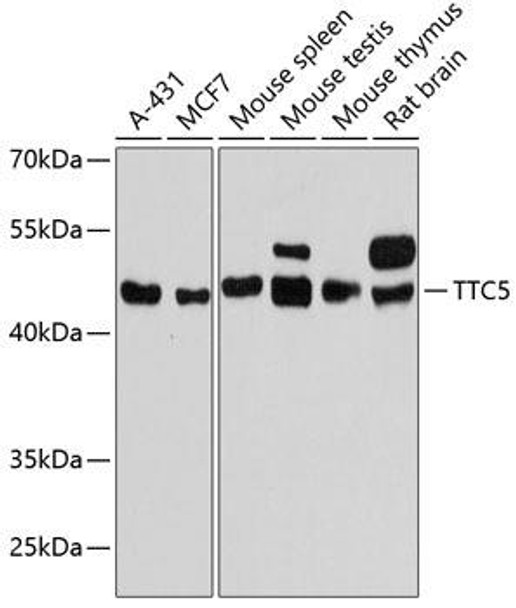
A-431, MCF7, Mouse spleen, Mouse testis, Mouse thymus, Rat brain
Cellular Localization:
Cytoplasm, Nucleus.
Calculated MW:
49kDa
Observed MW:
49kDa
Predicted to enable DNA binding activity and chromatin binding activity. Predicted to be involved in DNA repair. Predicted to act upstream of or within positive regulation of transcription by RNA polymerase II. Located in nucleoplasm.
Purification Method
Affinity purification
Gene ID
91875
RRID
AB_2760085
Buffer Information
Store at -20℃. Avoid freeze / thaw cycles. Buffer: PBS with 0.01% thimerosal,50% glycerol,pH7.3.
Western blot analysis of various lysates using TTC5 Rabbit pAb (CAB13232) at 1:3000 dilution. Secondary antibody: HRP-conjugated Goat anti-Rabbit IgG (H+L) (CABS014) at 1:10000 dilution. Lysates/proteins: 25μg per lane. Blocking buffer: 3% nonfat dry milk in TBST. Detection: ECL Basic Kit (AbGn00020). Exposure time: 90s.