The UACA Antibody (CAB9713) is a high-quality antibody developed for reliable detection and analysis of target proteins. This antibody, produced in rabbits, exhibits high specificity and sensitivity for detecting UACA in human samples, making it ideal for use in Western blotting and immunohistochemistry applications.UACA is known for its essential role in maintaining genomic stability and preventing the accumulation of DNA damage.
This antibody is validated for use in WB, ELISA applications and has demonstrated reactivity against Human, Mouse, Rat samples.
Product Name:
UACA Antibody
SKU:
CAB9713
Size:
20μL, 100μL
Reactivity:
Human, Mouse, Rat
Conjugate:
Unconjugated
Immunogen:
Recombinant protein (or fragment).This information is considered to be commercially sensitive.
Sequence:
MKSL KSRL RRQD VPGP ASSG AAAA SAHA ADWN KYDD RLMK AAER GDVE KVTS ILAK KGVN PGKL DVEG RSVF HVVT SKGN LECL NAIL IH
Tested Applications:
WBELISA
Recommended Dilution:
WB
1:500 - 1:2000
ELISA
Recommended starting concentration is 1 μg/mL. Please optimize the concentration based on your specific assay requirements.
Synonyms:
NUCLING, UACA
Positive Sample:
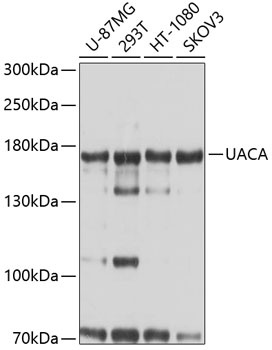
U-87MG, 293T, HT-1080, SKOV3
Cellular Localization:
Cytoplasm, Nucleus, Cytoskeleton.
Calculated MW:
163kDa
Observed MW:
162kDa
This gene encodes a protein that contains ankyrin repeats and coiled coil domains and likely plays a role in apoptosis. Studies in rodents have implicated the encoded protein in the stimulation of apoptosis and the regulation of mammary gland involution, in which the mammary gland returns to its pre-pregnant state. This protein has also been proposed to negatively regulate apoptosis based on experiments in human cell lines in which the protein was shown to interact with PRKC apoptosis WT1 regulator protein, also known as PAR-4, and inhibit translocation of the PAR-4 receptor. Autoantibodies to this protein have been identified in human patients with panuveitis and Graves' disease. Differential expression of this gene has been observed in various human cancers.
Purification Method
Affinity purification
Gene ID
55075
RRID
AB_2772768
Buffer Information
Store at -20℃. Avoid freeze / thaw cycles. Buffer: PBS containing 50% glycerol, preserved with proclin300 or sodium azide, pH 7.3.
Western blot analysis of various lysates using UACA Rabbit pAb (CAB9713) at 1:1000 dilution. Secondary antibody: HRP-conjugated Goat anti-Rabbit IgG (H+L) (CABS014) at 1:10000 dilution. Lysates/proteins: 25μg per lane. Blocking buffer: 3% nonfat dry milk in TBST. Detection: ECL Basic Kit (AbGn00020). Exposure time: 5s.