The UBQLN3 Antibody (CAB17697) is a high-quality antibody developed for reliable detection and analysis of target proteins. This rabbit-derived antibody has high specificity and sensitivity for UBQLN3 in human samples, making it ideal for use in Western blotting and other immunological studies.UBQLN3 is known to interact with various proteins involved in protein degradation pathways, making it a potential target for research into neurodegenerative diseases, such as Alzheimer's and Parkinson's disease.
This antibody is validated for use in WB, ELISA, IF-P applications and has demonstrated reactivity against Human, Mouse, Rat samples.
Product Name:
UBQLN3 Antibody
SKU:
CAB17697
Size:
20μL, 100μL
Reactivity:
Human, Mouse, Rat
Conjugate:
Unconjugated
Immunogen:
Recombinant protein (or fragment).This information is considered to be commercially sensitive.
Recommended starting concentration is 1 μg/mL. Please optimize the concentration based on your specific assay requirements.
Synonyms:
TUP-1, UBQLN3
Positive Sample:
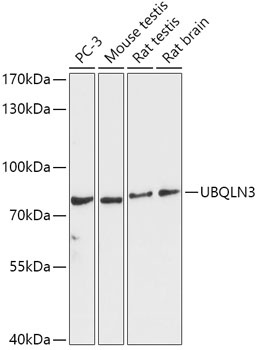
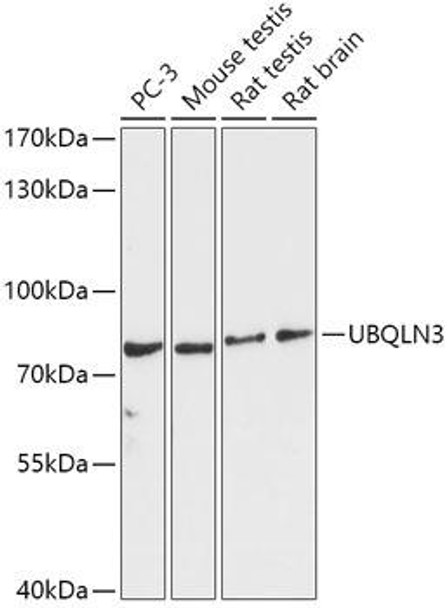
PC-3, Mouse testis, Rat testis, Rat brain
Cellular Localization:
Cytosol.
Calculated MW:
71kDa
Observed MW:
71kDa
This gene encodes a ubiquitin-like protein (ubiquilin) that shares a high degree of similarity with related products in yeast, rat and frog. Ubiquilins contain an N-terminal ubiquitin-like domain and a C-terminal ubiquitin-associated domain. They physically associate with both proteasomes and ubiquitin ligases, and are thus thought to functionally link the ubiquitination machinery to the proteasome to affect in vivo protein degradation. This gene is specifically expressed in the testis. It has been suggested that this gene may regulate cell-cycle progression during spermatogenesis, however, it has been shown that the ortholgous mouse gene is dispensable for embryonic development and spermatogenesis.
Purification Method
Affinity purification
Gene ID
50613
RRID
AB_2772791
Buffer Information
Store at -20℃. Avoid freeze / thaw cycles. Buffer: PBS with 0.01% thimerosal,50% glycerol,pH7.3.
Western blot analysis of various lysates using UBQLN3 Rabbit pAb (CAB17697) at 1:1000 dilution. Secondary antibody: HRP-conjugated Goat anti-Rabbit IgG (H+L) (CABS014) at 1:10000 dilution. Lysates/proteins: 25μg per lane. Blocking buffer: 3% nonfat dry milk in TBST. Detection: ECL Basic Kit (AbGn00020). Exposure time: 30s.
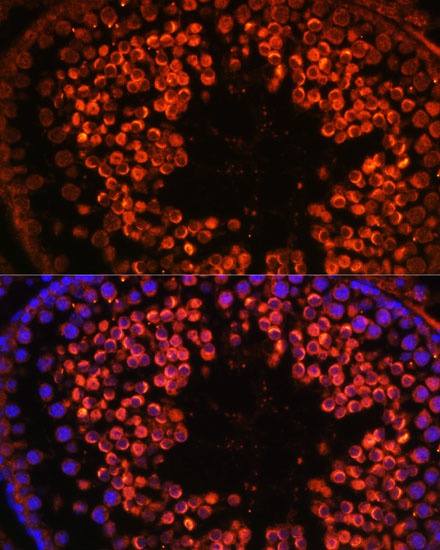
Immunofluorescence analysis of paraffin-embedded rat testis using UBQLN3 Rabbit pAb (CAB17697) at dilution of 1:100. Secondary antibody: Cy3-conjugated Goat anti-Rabbit IgG (H+L) (CABS007) at 1:500 dilution. Blue: DAPI for nuclear staining.