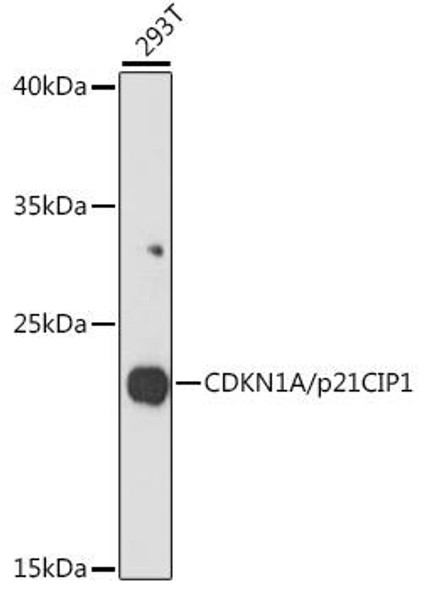
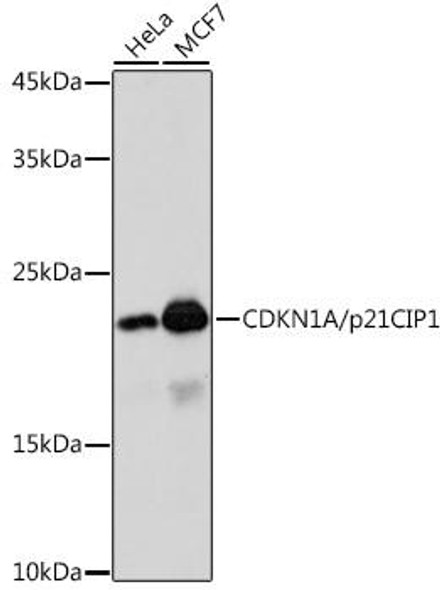
The CDKN1A Antibody (CAB20471) is a high-quality antibody developed for reliable detection and analysis of target proteins. This antibody, generated in rabbits, exhibits high reactivity with human samples and is validated for use in Western blot applications. By binding specifically to the CDKN1A protein, this antibody enables accurate detection and analysis in a variety of cell types, making it ideal for research in cancer biology and cell signaling pathways.CDKN1A, also known as p21, plays a crucial role in controlling cell proliferation and preventing the formation of tumors by inhibiting the activity of cyclin-dependent kinases.
This antibody is validated for use in WB, ELISA applications and has demonstrated reactivity against Mouse, Rat samples.
Product Name:
CDKN1A Antibody
SKU:
CAB20471
Size:
20μL, 100μL
Reactivity:
Mouse, Rat
Conjugate:
Unconjugated
Immunogen:
Recombinant protein (or fragment).This information is considered to be commercially sensitive.
Cytoplasm, Cytosol, Nuclear Body, Nucleolus, Nucleoplasm, Nucleus, Perinuclear Region Of Cytoplasm.
Calculated MW:
18kDa
Observed MW:
21kDa
This gene encodes a potent cyclin-dependent kinase inhibitor. The encoded protein binds to and inhibits the activity of cyclin-cyclin-dependent kinase2 or cyclin-dependent kinase4 complexes, and thus functions as a regulator of cell cycle progression at the G1 pahse. The expression of this gene is tightly controlled by the tumor suppressor protein p53, through which this protein mediates the p53-dependent cell cycle G1 phase arrest in response to a variety of stress stimuli. This protein can interact with proliferating cell nuclear antigen, a DNA polymerase accessory factor, and plays a regulatory role in S phase DNA replication and DNA damage repair. This protein was reported to be specifically cleaved by CASP3-like caspases, which thus leads to a dramatic activation of cyclin-dependent kinase2, and may be instrumental in the execution of apoptosis following caspase activation. Mice that lack this gene have the ability to regenerate damaged or missing tissue. Alternative splicing results in multiple transcript variants.
Purification Method
Affinity purification
Gene ID
12575
Buffer Information
Store at -20℃. Avoid freeze / thaw cycles. Buffer: PBS containing 50% glycerol, preserved with proclin300 or sodium azide, pH 7.3.
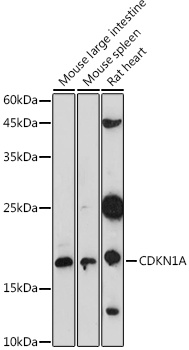
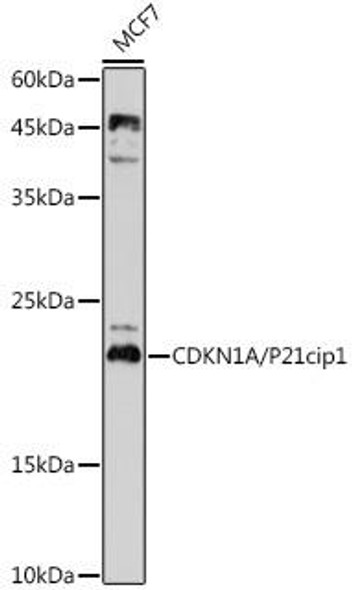
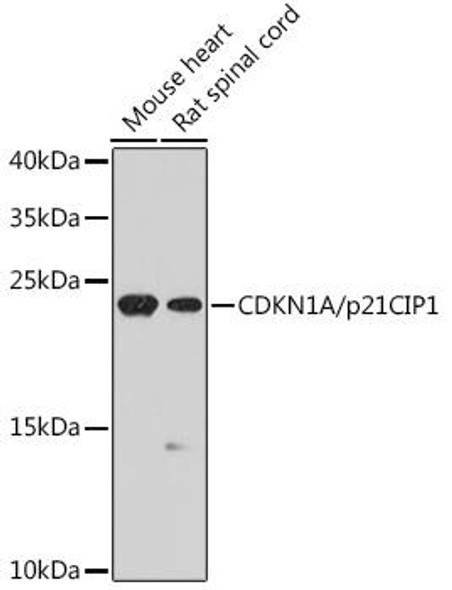
Western blot analysis of various lysates using CDKN1A Rabbit pAb (CAB20471) at 1:1000 dilution. Secondary antibody: HRP-conjugated Goat anti-Rabbit IgG (H+L) (CABS014) at 1:10000 dilution. Lysates/proteins: 25μg per lane. Blocking buffer: 3% nonfat dry milk in TBST. Detection: ECL Enhanced Kit (AbGn00021). Exposure time: 180s.