The GluR2+GluR3 Monoclonal Antibody (CAB2754) is a high-quality antibody developed for reliable detection and analysis of target proteins. This antibody, raised in rabbits, is highly specific and reacts with both human and mouse samples, making it versatile for a variety of experimental applications.The AMPA receptor is vital for synaptic plasticity, learning, and memory, and dysregulation of GluR2 and GluR3 subunits has been implicated in neurodegenerative disorders like Alzheimer's disease and epilepsy. This antibody binds specifically to GluR2 and GluR3 proteins, allowing for their detection and analysis in various cell types and tissues.
This antibody is validated for use in WB, IP, ELISA applications and has demonstrated reactivity against Mouse, Rat samples.
Product Name:
GluR2+GluR3 Monoclonal Antibody
SKU:
CAB2754
Size:
20μL, 100μL
Reactivity:
Mouse, Rat
Clone Number:
ARC2668
Conjugate:
Unconjugated
Immunogen:
Synthetic peptide. This information is considered to be commercially sensitive.
Asymmetric Synapse, Dendrite, Dendritic Spine, Excitatory Synapse, External Side Of Plasma Membrane, Plasma Membrane, Postsynapse, Postsynaptic Density, Postsynaptic Density Membrane, Postsynaptic Endocytic Zone.
Calculated MW:
98kDa
Observed MW:
98kDa
Glutamate receptors are the predominant excitatory neurotransmitter receptors in the mammalian brain and are activated in a variety of normal neurophysiologic processes. This gene product belongs to a family of glutamate receptors that are sensitive to alpha-amino-3-hydroxy-5-methyl-4-isoxazole propionate (AMPA), and function as ligand-activated cation channels. These channels are assembled from 4 related subunits, GRIA1-4. The subunit encoded by this gene (GRIA2) is subject to RNA editing (CAG->CGG; Q->R) within the second transmembrane domain, which is thought to render the channel impermeable to Ca(2+). Human and animal studies suggest that pre-mRNA editing is essential for brain function, and defective GRIA2 RNA editing at the Q/R site may be relevant to amyotrophic lateral sclerosis (ALS) etiology. Alternative splicing, resulting in transcript variants encoding different isoforms, (including the flip and flop isoforms that vary in their signal transduction properties), has been noted for this gene.Glutamate receptors are the predominant excitatory neurotransmitter receptors in the mammalian brain and are activated in a variety of normal neurophysiologic processes. These receptors are heteromeric protein complexes composed of multiple subunits, arranged to form ligand-gated ion channels. The classification of glutamate receptors is based on their activation by different pharmacologic agonists. The subunit encoded by this gene belongs to a family of AMPA (alpha-amino-3-hydroxy-5-methyl-4-isoxazole propionate)-sensitive glutamate receptors, and is subject to RNA editing (AGA->GGA; R->G). Alternative splicing at this locus results in different isoforms, which may vary in their signal transduction properties
Purification Method
Affinity purification
Gene ID
2891 2892
Buffer Information
Store at -20℃. Avoid freeze / thaw cycles. Buffer: PBS containing 50% glycerol and 0.05% BSA, preserved with proclin300 or sodium azide, pH 7.3.
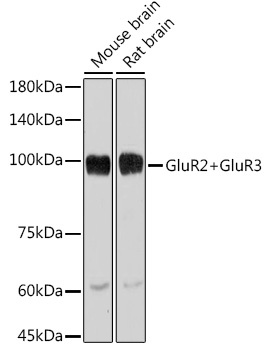
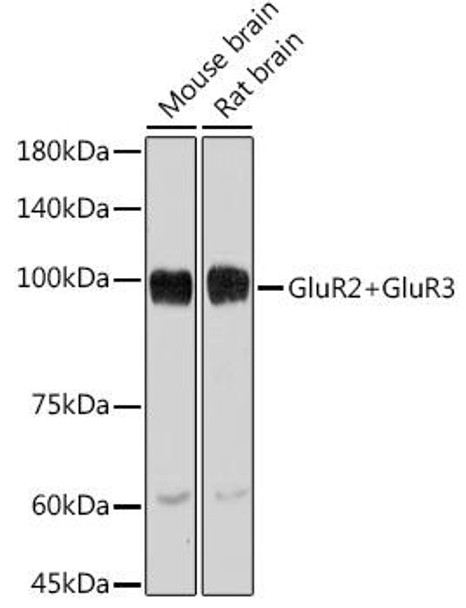
Western blot analysis of various lysates using GluR2+GluR3 Rabbit mAb (CAB2754) at 1:1000 dilution. Secondary antibody: HRP-conjugated Goat anti-Rabbit IgG (H+L) (CABS014) at 1:10000 dilution. Lysates/proteins: 25μg per lane. Blocking buffer: 3% nonfat dry milk in TBST. Detection: ECL Basic Kit (AbGn00020). Exposure time: 10s.
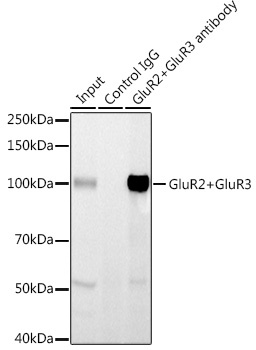
Immunoprecipitation analysis of 600 μg extracts of Mouse brain using 3 μg GluR2+GluR3 antibody (CAB2754). Western blot was performed from the immunoprecipitate using GluR2+GluR3 antibody (CAB2754) at a dilution of 1:1000.