The MRPS31 Monoclonal Antibody (CAB20932) is a high-quality antibody developed for reliable detection and analysis of target proteins. This antibody, produced in rabbits, exhibits high reactivity with human samples and is validated for use in Western blot applications. By binding specifically to the MRPS31 protein, it allows for accurate detection and analysis in various cell types, making it an essential asset for studies in molecular biology and mitochondrial research.MRPS31 is essential for the correct assembly and function of the mitochondrial ribosome, which is responsible for synthesizing proteins needed for mitochondrial function.
This antibody is validated for use in WB, ELISA applications and has demonstrated reactivity against Human, Mouse, Rat samples.
Product Name:
MRPS31 Monoclonal Antibody
SKU:
CAB20932
Size:
20μL, 100μL
Reactivity:
Human, Mouse, Rat
Clone Number:
ARC2914
Conjugate:
Unconjugated
Immunogen:
Synthetic peptide. This information is considered to be commercially sensitive.
Recommended starting concentration is 1 μg/mL. Please optimize the concentration based on your specific assay requirements.
Synonyms:
S31mt, IMOGN38, MRP-S31, MRPS31
Positive Sample:
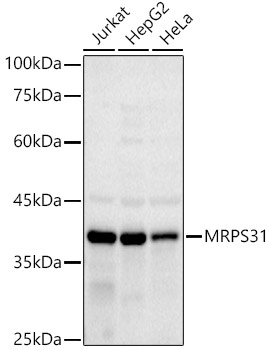
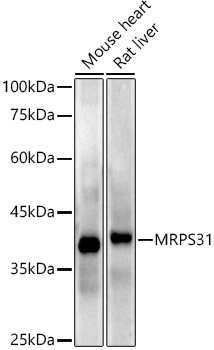
Jurkat, HepG2, HeLa, Mouse heart, Rat liver
Cellular Localization:
Mitochondrion.
Calculated MW:
45kDa
Observed MW:
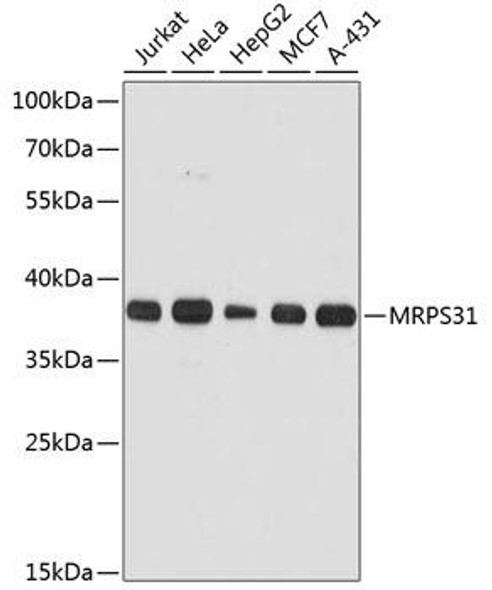
38kDa
Mammalian mitochondrial ribosomal proteins are encoded by nuclear genes and help in protein synthesis within the mitochondrion. Mitochondrial ribosomes (mitoribosomes) consist of a small 28S subunit and a large 39S subunit. They have an estimated 75% protein to rRNA composition compared to prokaryotic ribosomes, where this ratio is reversed. Another difference between mammalian mitoribosomes and prokaryotic ribosomes is that the latter contain a 5S rRNA. Among different species, the proteins comprising the mitoribosome differ greatly in sequence, and sometimes in biochemical properties, which prevents easy recognition by sequence homology. The 28S subunit of the mammalian mitoribosome may play a crucial and characteristic role in translation initiation. This gene encodes a 28S subunit protein that has also been associated with type 1 diabetes; however, its relationship to the etiology of this disease remains to be clarified. Pseudogenes corresponding to this gene have been found on chromosomes 3 and 13.
Purification Method
Affinity purification
Gene ID
10240
Buffer Information
Store at -20℃. Avoid freeze / thaw cycles. Buffer: PBS containing 50% glycerol and 0.05% BSA, preserved with proclin300 or sodium azide, pH 7.3.
Western blot analysis of various lysates using MRPS31 Rabbit mAb (CAB20932) at 1:1000 dilution. Secondary antibody: HRP-conjugated Goat anti-Rabbit IgG (H+L) (CABS014) at 1:10000 dilution. Lysates/proteins: 25μg per lane. Blocking buffer: 3% nonfat dry milk in TBST. Detection: ECL Basic Kit (AbGn00020). Exposure time: 180s.
Western blot analysis of various lysates using MRPS31 Rabbit mAb (CAB20932) at 1:1000 dilution. Secondary antibody: HRP-conjugated Goat anti-Rabbit IgG (H+L) (CABS014) at 1:10000 dilution. Lysates/proteins: 25μg per lane. Blocking buffer: 3% nonfat dry milk in TBST. Detection: ECL Enhanced Kit (AbGn00021). Exposure time: 180s.