The Rap1GAP Monoclonal Antibody (CAB3621) is a high-quality antibody developed for reliable detection and analysis of target proteins. This polyclonal antibody, produced in rabbits, is highly specific and reactive towards Rap1GAP in human samples, making it a valuable tool for Western blot applications.Rap1GAP is known to be a key regulator of Rap1, a small GTPase that plays a role in cell adhesion, cell migration, and cell proliferation. By targeting Rap1GAP with this antibody, researchers can investigate the function and regulation of Rap1 signaling pathways in various cell types, providing insights into mechanisms underlying processes such as cell adhesion and migration.
This antibody is validated for use in WB, IF/ICC, ELISA applications and has demonstrated reactivity against Human, Mouse, Rat samples.
Product Name:
Rap1GAP Monoclonal Antibody
SKU:
CAB3621
Size:
20μL, 100μL
Reactivity:
Human, Mouse, Rat
Clone Number:
ARC2058
Conjugate:
Unconjugated
Immunogen:
Synthetic peptide. This information is considered to be commercially sensitive.
This gene encodes a type of GTPase-activating-protein (GAP) that down-regulates the activity of the ras-related RAP1 protein. RAP1 acts as a molecular switch by cycling between an inactive GDP-bound form and an active GTP-bound form. The product of this gene, RAP1GAP, promotes the hydrolysis of bound GTP and hence returns RAP1 to the inactive state whereas other proteins, guanine nucleotide exchange factors (GEFs), act as RAP1 activators by facilitating the conversion of RAP1 from the GDP- to the GTP-bound form. In general, ras subfamily proteins, such as RAP1, play key roles in receptor-linked signaling pathways that control cell growth and differentiation. RAP1 plays a role in diverse processes such as cell proliferation, adhesion, differentiation, and embryogenesis. Alternative splicing results in multiple transcript variants encoding distinct proteins.
Purification Method
Affinity purification
Gene ID
5909
RRID
AB_2863102
Buffer Information
Store at -20℃. Avoid freeze / thaw cycles. Buffer: PBS containing 50% glycerol and 0.05% BSA, preserved with proclin300 or sodium azide, pH 7.3.
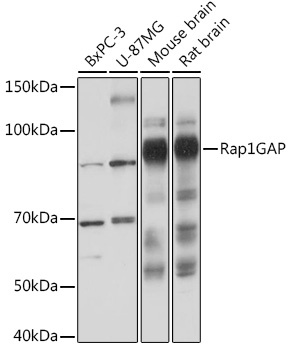
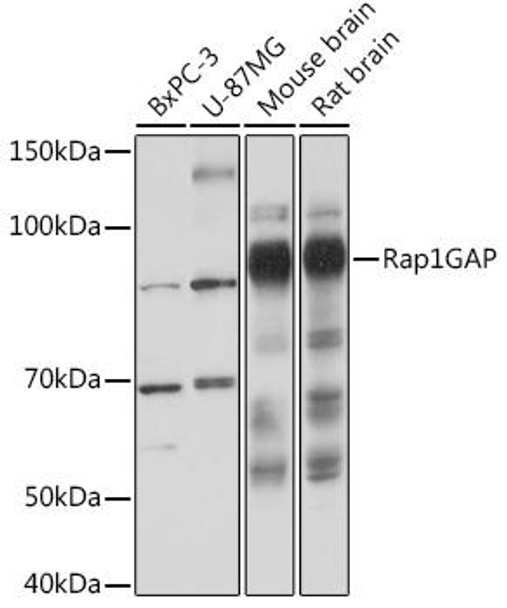
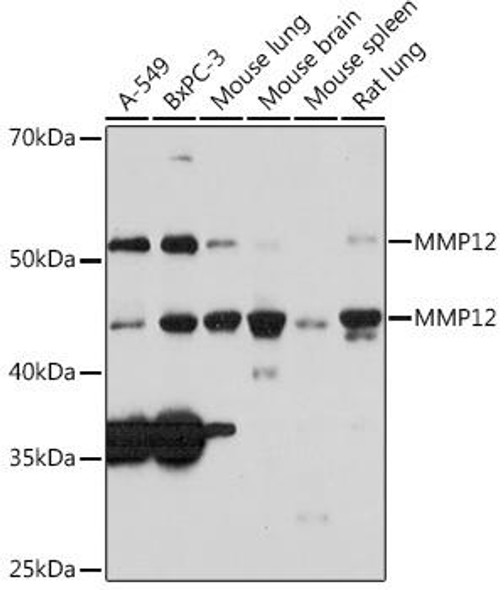
Western blot analysis of various lysates using Rap1GAP Rabbit mAb (CAB3621) at 1:1000 dilution. Secondary antibody: HRP-conjugated Goat anti-Rabbit IgG (H+L) (CABS014) at 1:10000 dilution. Lysates/proteins: 25μg per lane. Blocking buffer: 3% nonfat dry milk in TBST. Detection: ECL Basic Kit (AbGn00020). Exposure time: 3s.
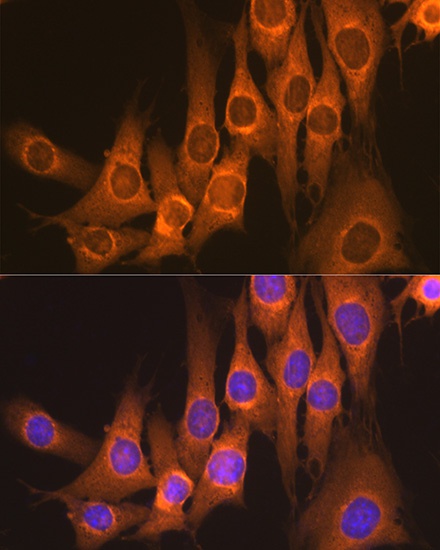
Immunofluorescence analysis of NIH-3T3 cells using Rap1GAP Rabbit mAb (CAB3621) at dilution of 1:100 (40x lens). Secondary antibody: Cy3-conjugated Goat anti-Rabbit IgG (H+L) (CABS007) at 1:500 dilution. Blue: DAPI for nuclear staining.