Description
ATP5L Antibody (CAB9178)
The ATP5L Antibody (CAB9178) is a high-quality antibody developed for reliable detection and analysis of target proteins. This antibody, derived from rabbits, exhibits high reactivity with human samples and has been validated for use in Western blotting applications.ATP5L is essential for maintaining mitochondrial function and ATP production, making it a key player in cellular metabolism and energy regulation. Research into ATP5L can provide insights into various physiological processes, including bioenergetics, cellular respiration, and mitochondrial dysfunction in diseases like cancer and neurodegenerative disorders.
This antibody is validated for use in WB, IF/ICC, ELISA applications and has demonstrated reactivity against Human, Mouse, Rat samples.
| Product Name: | ATP5L Antibody |
| SKU: | CAB9178 |
| Size: | 20μL, 100μL |
| Reactivity: | Human, Mouse, Rat |
| Conjugate: | Unconjugated |
| Immunogen: | Recombinant protein (or fragment).This information is considered to be commercially sensitive. | ||||||
| Sequence: | MAQF VRNL VEKT PALV NAAV TYSK PRLA TFWY YAKV ELVP PTPA EIPR AIQS LKKI VNSA QTGS FKQL TVKE AVLN GLVA TEVL MWFY VGEI IGKR GIIG YDV | ||||||
| Tested Applications: | WB IF/ICC ELISA | ||||||
| Recommended Dilution: |
| ||||||
| Synonyms: | ATP5L, ATP5JG |
| Positive Sample: | 293T, A-549, HepG2, HeLa, Mouse brain, Mouse liver, Rat brain, Rat kidney |
| Cellular Localization: | Mitochondrion, Mitochondrion Inner Membrane. |
| Calculated MW: | 11kDa |
| Observed MW: | 11kDa |
Mitochondrial ATP synthase catalyzes ATP synthesis, utilizing an electrochemical gradient of protons across the inner membrane during oxidative phosphorylation. It is composed of two linked multi-subunit complexes: the soluble catalytic core, F1, and the membrane-spanning component, Fo, which comprises the proton channel. The F1 complex consists of 5 different subunits (alpha, beta, gamma, delta, and epsilon) assembled in a ratio of 3 alpha, 3 beta, and a single representative of the other 3. The Fo seems to have nine subunits (a, b, c, d, e, f, g, F6 and 8). This gene encodes the g subunit of the Fo complex. Alternative splicing results in multiple transcript variants.
| Purification Method | Affinity purification |
| Gene ID | 10632 |
| RRID | AB_2768508 |
| Buffer Information | Store at -20℃. Avoid freeze / thaw cycles. Buffer: PBS with 0.01% thimerosal,50% glycerol,pH7.3. |
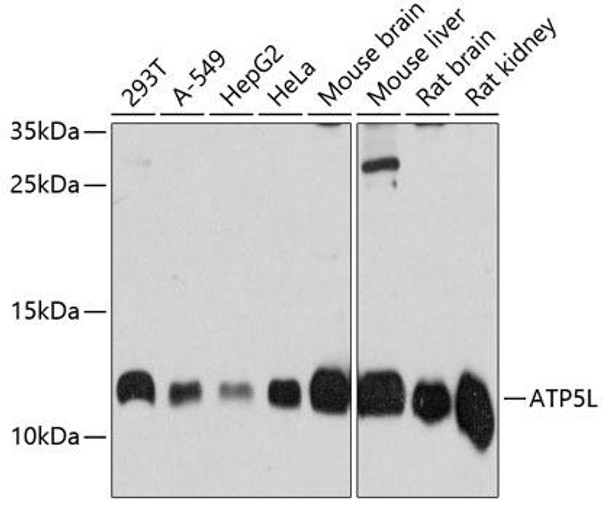
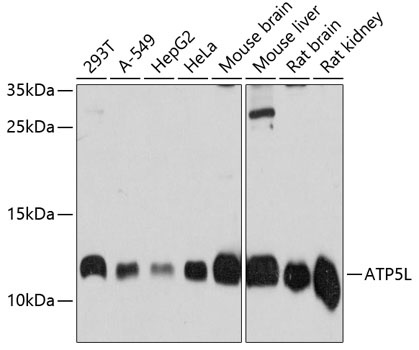 | Western blot analysis of various lysates using ATP5L Rabbit pAb (CAB9178) at 1:3000 dilution. Secondary antibody: HRP-conjugated Goat anti-Rabbit IgG (H+L) (CABS014) at 1:10000 dilution. Lysates/proteins: 25μg per lane. Blocking buffer: 3% nonfat dry milk in TBST. Detection: ECL Basic Kit (AbGn00020). Exposure time: 3s. |
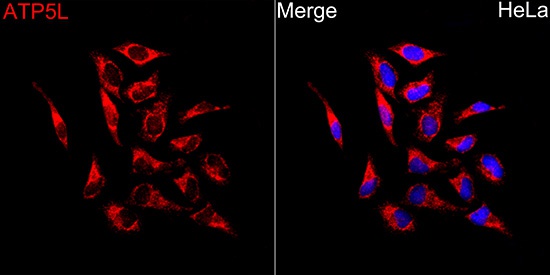 | Immunofluorescence analysis of HeLa cells using ATP5L Rabbit pAb(CAB9178) at a dilution of 1:100 (40x lens). Secondary antibody:Cy3 Goat Anti-Rabbit IgG (H+L)(CABS007) at 1:500 dilution. Blue: DAPI for nuclear staining. |
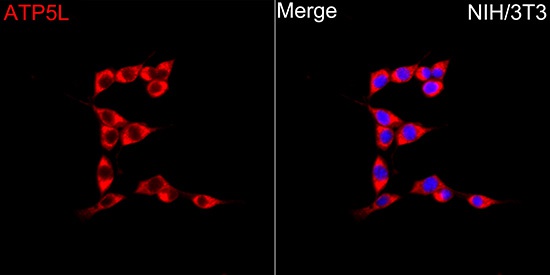 | Immunofluorescence analysis of NIH/3T3 cells using ATP5L Rabbit pAb(CAB9178) at a dilution of 1:100 (40x lens). Secondary antibody:Cy3 Goat Anti-Rabbit IgG (H+L)(CABS007) at 1:500 dilution. Blue: DAPI for nuclear staining. |
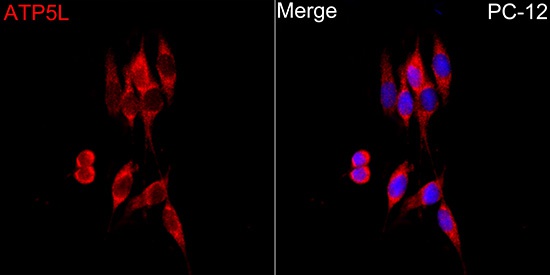 | Immunofluorescence analysis of PC-12 cells using ATP5L Rabbit pAb(CAB9178) at a dilution of 1:100 (40x lens). Secondary antibody:Cy3 Goat Anti-Rabbit IgG (H+L)(CABS007) at 1:500 dilution. Blue: DAPI for nuclear staining. |