Description
ATP6V0C Antibody (CAB16350)
The ATP6V0C Antibody (CAB16350) is a high-quality antibody developed for reliable detection and analysis of target proteins. This antibody, produced in rabbits, exhibits high specificity and sensitivity in detecting ATP6V0C in human samples, making it a reliable choice for Western blot analyses.ATP6V0C plays a key role in maintaining cellular pH balance and regulating endocytic and secretory pathways. Dysregulation of ATP6V0C has been linked to various diseases, including osteopetrosis and renal tubular acidosis.
This antibody is validated for use in WB, IF/ICC, ELISA applications and has demonstrated reactivity against Human, Mouse, Rat samples.
| Product Name: | ATP6V0C Antibody |
| SKU: | CAB16350 |
| Size: | 20μL, 100μL |
| Reactivity: | Human, Mouse, Rat |
| Conjugate: | Unconjugated |
| Immunogen: | Synthetic peptide. This information is considered to be commercially sensitive. | ||||||
| Sequence: | MSES KSGP EYAS FFAV MGAS AAMV FSAL GAAY GTAK SGTG IAAM SVMR PEQI MKSI IPVV MAGI IAIY GLVV AVLI ANSL NDDI SLYK SFLQ LGAG LSVG | ||||||
| Tested Applications: | WB IF/ICC ELISA | ||||||
| Recommended Dilution: |
| ||||||
| Synonyms: | ATPL, VATL, VPPC, Vma3, ATP6C, ATP6L, ATP6V0C |
| Positive Sample: | Mouse kidney, Rat brain |
| Cellular Localization: | Multi-Pass Membrane Protein, Vacuole Membrane. |
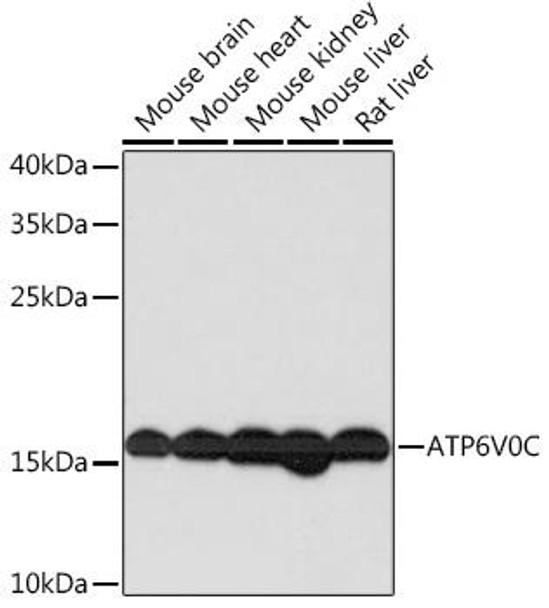
| Calculated MW: | 16kDa |
| Observed MW: | 16kDa |
This gene encodes a component of vacuolar ATPase (V-ATPase), a multisubunit enzyme that mediates acidification of eukaryotic intracellular organelles. V-ATPase dependent organelle acidification is necessary for such intracellular processes as protein sorting, zymogen activation, receptor-mediated endocytosis, and synaptic vesicle proton gradient generation. V-ATPase is composed of a cytosolic V1 domain and a transmembrane V0 domain. The V1 domain consists of three A and three B subunits, two G subunits plus the C, D, E, F, and H subunits. The V1 domain contains the ATP catalytic site. The V0 domain consists of five different subunits: a, c, c', c", and d. This gene encodes the V0 subunit c. Alternative splicing results in transcript variants. Pseudogenes have been identified on chromosomes 6 and 17.
| Purification Method | Affinity purification |
| Gene ID | 527 |
| RRID | AB_2768511 |
| Buffer Information | Store at -20℃. Avoid freeze / thaw cycles. Buffer: PBS containing 50% glycerol, preserved with proclin300 or sodium azide, pH 7.3. |
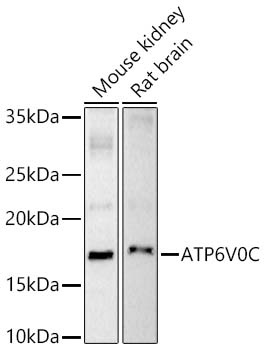 | Western blot analysis of various lysates using ATP6V0C Rabbit pAb (CAB16350) at 1:1000 dilution. Secondary antibody: HRP-conjugated Goat anti-Rabbit IgG (H+L) (CABS014) at 1:10000 dilution. Lysates / proteins: 25 μg per lane. Blocking buffer: 3 % nonfat dry milk in TBST. Detection: ECL Basic Kit (AbGn00020). Exposure time: 60s. |
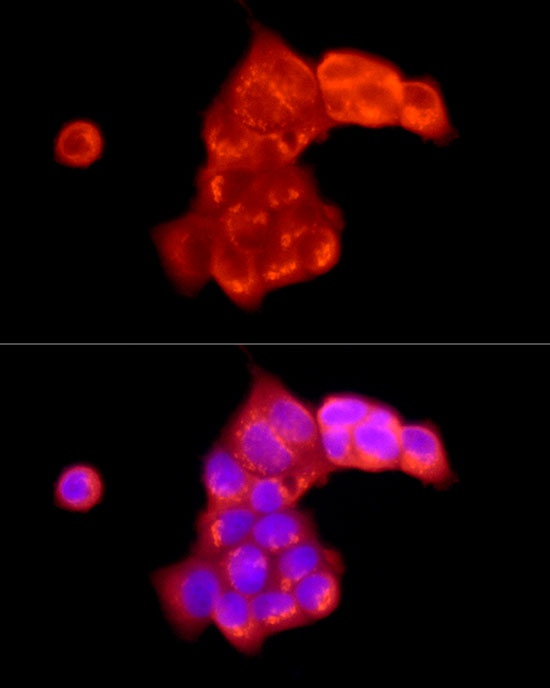 | Immunofluorescence analysis of MCF7 cells using ATP6V0C Rabbit pAb (CAB16350) at dilution of 1:100 (40x lens). Secondary antibody: Cy3-conjugated Goat anti-Rabbit IgG (H+L) (CABS007) at 1:500 dilution. Blue: DAPI for nuclear staining. |