
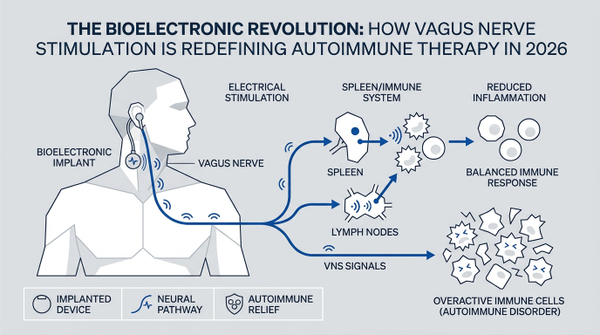
The Bioelectronic Revolution: How Vagus Nerve Stimulation is Redefining Autoimmune Therapy in 2026
Imagine a future where chronic autoimmune diseases, once managed by powerful pharmaceuticals with challenging side effects, are instead calmed by a gentle electrical pulse. This isn't science fiction; it's the burgeoning reality of bioelectronic medicine, a revolutionary field poised to redefine how we approach conditions like rheumatoid arthritis and lupus. In 2026, the vagus nerve, a crucial highway between brain and body, is emerging as the unexpected hero in this therapeutic revolution.
Introduction
For decades, autoimmune diseases have presented a formidable challenge to medical science. Conditions where the body's immune system mistakenly attacks its own tissues, such as rheumatoid arthritis, inflammatory bowel disease, and lupus, often necessitate lifelong treatment with immunosuppressants that can carry significant risks. However, a paradigm shift is underway, driven by a deeper understanding of the intricate connection between the nervous system and immune response. This understanding has paved the way for bioelectronic medicine, a novel approach that harnesses electrical signals to modulate biological processes. At its heart lies the vagus nerve, a key component of the autonomic nervous system, now recognized for its profound influence on inflammation and immunity. This blog post delves into how vagus nerve stimulation (VNS) is rapidly advancing, offering a promising, non-pharmacological alternative for autoimmune therapy.
Unveiling the Inflammatory Reflex: The Vagus Nerve's Hidden Power
The concept of the 'inflammatory reflex' has been a cornerstone in the development of bioelectronic medicine. This intrinsic neural pathway, primarily mediated by the vagus nerve, allows the brain to rapidly detect and regulate systemic inflammation. When the immune system is overactive, as in autoimmune diseases, this reflex can become dysregulated. Pioneering research has illuminated how stimulating the vagus nerve can activate this reflex, effectively dampening the inflammatory cascade by inhibiting cytokine production. This mechanism offers a targeted way to restore immune balance without the broad-spectrum immunosuppression often associated with conventional drug therapies. The implications are profound, suggesting a future where treatment is not just about suppressing symptoms, but about retraining the body's own regulatory systems to maintain health. Comprehensive review of neurostimulation immune mechanisms underscores the breadth of VNS applications in immune diseases.
Pivotal Trials Confirming VNS Efficacy in Rheumatoid Arthritis
The promise of vagus nerve stimulation is rapidly translating into tangible clinical evidence, particularly in the challenging landscape of rheumatoid arthritis (RA). Recent randomized controlled trials have provided compelling data on the therapeutic benefits of VNS. One such pivotal trial demonstrated the efficacy of vagus nerve-targeted neuromodulation in modulating systemic inflammation in RA patients, marking a significant step forward in validating this approach. Pivotal trial confirms neuroimmune modulation efficacy in RA. Furthermore, for patients with drug-refractory RA, where conventional treatments have failed, VNS has shown sustained safety and efficacy over long-term follow-up. This is particularly encouraging, as it offers hope to individuals who have exhausted other therapeutic avenues. Sustained efficacy in drug-refractory arthritis patients highlights the potential for VNS to fill a critical unmet need in autoimmune care.
Implantable vs. Non-Invasive: Expanding the Reach of Bioelectronic Therapy
The field of bioelectronic medicine is evolving rapidly, offering both implantable and non-invasive VNS technologies. Implantable devices, while requiring a surgical procedure, have demonstrated long-term clinical safety and feasibility in treating rheumatoid arthritis. These devices provide continuous, precise modulation of the vagus nerve, offering a consistent therapeutic effect. Implantable device shows long-term clinical safety in RA. Simultaneously, non-invasive approaches, such as transcutaneous auricular vagus nerve stimulation (taVNS), are gaining traction due to their ease of use and reduced risk. A randomized, multicentre, double-blind, sham-controlled trial specifically investigated taVNS in patients with erosive hand osteoarthritis, revealing its capacity to reduce erosive joint inflammation. Non-invasive stimulation reduces erosive joint inflammation, showcasing the versatility of VNS delivery methods. This dual approach ensures that VNS can be tailored to individual patient needs, expanding its accessibility and applicability across a broader spectrum of autoimmune conditions.
Beyond Rheumatoid Arthritis: A Broader Horizon for Autoimmune Conditions
While much of the groundbreaking research has focused on rheumatoid arthritis, the therapeutic potential of vagus nerve stimulation extends far beyond. A systematic review of VNS in autoimmune conditions has highlighted its capacity to activate the anti-inflammatory pathway, suggesting its relevance across a range of disorders. Systematic review highlights anti-inflammatory pathway activation. This broader applicability is driven by the fundamental role of the vagus nerve in modulating systemic inflammation, a common underlying factor in many autoimmune diseases. Ongoing research is actively exploring VNS for conditions like systemic lupus erythematosus, with protocols for systematic reviews and meta-analyses already in place to evaluate its efficacy and safety. The ability of neuroimmune modulation to drive non-invasive therapy success in neurological and psychiatric disorders further supports its potential in autoimmune contexts. Neuroimmune modulation drives non-invasive therapy success, indicating a promising future for VNS as a versatile therapeutic tool.
The Dawn of a New Era in Autoimmune Treatment
The year 2026 marks a pivotal moment in the evolution of autoimmune therapy. The bioelectronic revolution, spearheaded by advancements in vagus nerve stimulation, is offering a compelling alternative to traditional pharmaceutical interventions. By harnessing the body's innate inflammatory reflex, VNS provides a targeted, non-pharmacological approach to managing chronic autoimmune diseases. The growing body of evidence from rigorous clinical trials and systematic reviews underscores its efficacy and safety, not just in rheumatoid arthritis, but potentially across a wider spectrum of conditions. As research continues to unravel the intricate mechanisms of neuroimmune modulation, VNS stands poised to redefine patient care, offering renewed hope for millions living with autoimmune disorders and ushering in a new era of precision medicine.
References
- Tesser JRP, Crowley AR, et al. (2026). Vagus nerve-mediated neuroimmune modulation for rheumatoid arthritis: a pivotal randomized controlled trial.. Nat Med. 32(1):369-378. PMID: 41429981
- Courties A, Tuffet S, et al. (2026). Transcutaneous auricular vagus nerve stimulation versus sham stimulation in patients with erosive hand osteoarthritis (ESTIVAL): a randomised, multicentre, double-blind, sham-controlled trial.. Lancet Rheumatol. 8(2):e98-e107. PMID: 41380709
- Peterson D, Van Poppel M, et al. (2024). Clinical safety and feasibility of a novel implantable neuroimmune modulation device for the treatment of rheumatoid arthritis: initial results from the randomized, double-blind, sham-controlled RESET-RA study.. Bioelectron Med. 10(1):8. PMID: 38475923
- Lombo LE, Tejada-Perdomo JH, et al. (2025). Vagus Nerve Stimulation in Autoimmune Conditions: A Systematic Review.. ACR Open Rheumatol. 7(12):e70137. PMID: 41392619
- Gaylis NB, Sikes D, et al. (2025). Neuroimmune Modulation for Drug-Refractory Rheumatoid Arthritis: Long-Term Safety and Efficacy in Patients Enrolled in a Pilot Vagus Nerve Stimulation Study.. Rheumatol Ther. 12(6):1125-1136. PMID: 41071520
- Liu J, Zheng K, et al. (2025). Clinical applications and mechanisms of vagus nerve stimulation in the treatment of immune diseases: a review.. Int J Surg. 111(12):9496-9506. PMID: 40788025
- Zhang X, Zou Q, et al. (2026). Modulating neuroimmune function: The key in taVNS therapy for neurological and psychiatric disorders.. Curr Opin Pharmacol. 86:102601. PMID: 41505909
Recent Posts
-
The Bioelectronic Revolution: How Vagus Nerve Stimulation is Redefining Autoimmune Therapy in 2026
Imagine a future where chronic autoimmune diseases, once managed by powerful pharmaceuticals with c …25th Mar 2026 -
In Vivo CAR-T Engineering: The Dawn of Off-the-Shelf Immunotherapy
Imagine a future where cancer treatment isn't a grueling, months-long process involving cell extrac …25th Mar 2026 -
Immune Cell 'Bloodhounds': Engineering Metabolite-Sensing Receptors to Infiltrate Solid Tumors
Imagine an elite squad of soldiers sent to neutralize a hidden fortress, only to find themselves wa …25th Mar 2026