The Bmi1 Antibody (CAB0211) is a high-quality antibody developed for reliable detection and analysis of target proteins. This gene encodes a ring finger protein that is major component of the polycomb group complex 1 (PRC1). This complex functions through chromatin remodeling as an essential epigenetic repressor of multiple regulatory genes involved in embryonic development and self-renewal in somatic stem cells. This protein also plays a central role in DNA damage repair. This gene is an oncogene and aberrant expression is associated with numerous cancers and is associated with resistance to certain chemotherapies. A pseudogene of this gene is found on chromosome X. Read-through transcription also exists between this gene and the upstream COMM domain containing 3 (COMMD3) gene. RRID AB_2757025 Gene ID 648 Swiss Prot Synonym PCGF4; RNF51; FLVI2/BMI1; flvi-2/bmi-1; Bmi1
This antibody is validated for use in WB, IP, ELISA applications and has demonstrated reactivity against Human, Mouse, Rat samples.
Product Name:
Bmi1 Antibody
SKU:
CAB0211
Size:
100μL, 20μL
Reactivity:
Human, Mouse, Rat
Clone Number:
-
Conjugate:
Unconjugated
Immunogen:
Synthetic peptide. This information is considered to be commercially sensitive.
Tested Applications:
WBIPELISA
Recommended Dilution:
WB
1:500 - 1:2000
IP
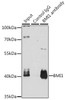
0.5μg-4μg antibody for 200μg-400μg extracts of whole cells
ELISA
Recommended starting concentration is 1 μg/mL. Please optimize the concentration based on your specific assay requirements.
Synonyms:
PCGF4, RNF51, FLVI2/BMI1, flvi-2/bmi-1, Bmi1
Positive Sample:
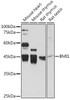
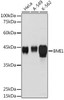
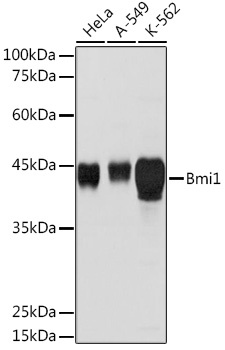
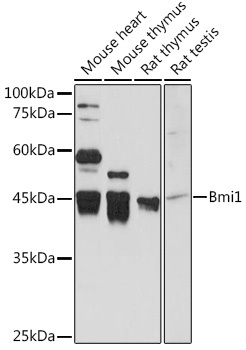
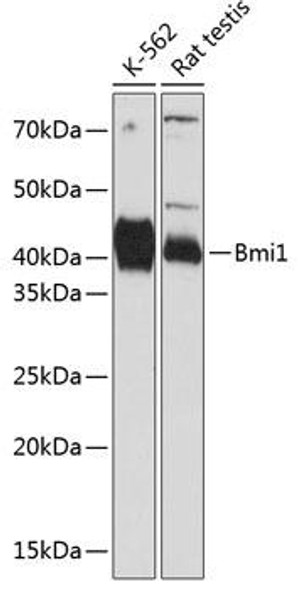
HeLa, A-549, K-562, Mouse heart, Mouse thymus, Rat thymus, Rat testis
Cellular Localization:
Cytoplasm, Nucleus.
Calculated MW:
37kDa
Observed MW:
43kDa
This gene encodes a ring finger protein that is major component of the polycomb group complex 1 (PRC1). This complex functions through chromatin remodeling as an essential epigenetic repressor of multiple regulatory genes involved in embryonic development and self-renewal in somatic stem cells. This protein also plays a central role in DNA damage repair. This gene is an oncogene and aberrant expression is associated with numerous cancers and is associated with resistance to certain chemotherapies. A pseudogene of this gene is found on chromosome X. Read-through transcription also exists between this gene and the upstream COMM domain containing 3 (COMMD3) gene. RRID AB_2757025 Gene ID 648 Swiss Prot Synonym PCGF4; RNF51; FLVI2/BMI1; flvi-2/bmi-1; Bmi1
Purification Method:
Affinity purification
Gene ID:
648
RRID:
AB_2757025
Buffer Information:
Store at -20℃. Avoid freeze / thaw cycles. Buffer: PBS containing 50% glycerol, preserved with proclin300 or sodium azide, pH 7.3.
Western blot analysis of various lysates using Bmi1 Rabbit pAb (CAB0211) at 1:5000 dilution. Secondary antibody: HRP-conjugated Goat anti-Rabbit IgG (H+L) (AS014) at 1:10000 dilution. Lysates/proteins: 25μg per lane. Blocking buffer: 3% nonfat dry milk in TBST. Detection: ECL Basic Kit (AbGn00020). Exposure time: 10s.
Western blot analysis of various lysates using Bmi1 Rabbit pAb (CAB0211) at 1:5000 dilution. Secondary antibody: HRP-conjugated Goat anti-Rabbit IgG (H+L) (AS014) at 1:10000 dilution. Lysates/proteins: 25μg per lane. Blocking buffer: 3% nonfat dry milk in TBST. Detection: ECL Basic Kit (AbGn00020). Exposure time: 90s.