Description
Carbonic Anhydrase 9 (CA9/G250) Monoclonal Antibody (CAB4934)
The Carbonic Anhydrase 9 (CA9/G250) Monoclonal Antibody (CAB4934) is a high-quality antibody developed for reliable detection and analysis of target proteins. This highly specific antibody, developed using rabbit monoclonal technology, is ideal for use in a variety of experimental applications, including immunohistochemistry and flow cytometry.CA9, also known as carbonic anhydrase IX, is a key player in tumor microenvironment regulation and has been implicated in promoting tumor growth and metastasis. The CA9 Rabbit Monoclonal Antibody (CAB4934) offers researchers a powerful tool for studying the expression and function of CA9 in cancer biology and other related fields.
This antibody is validated for use in WB, IHC-P, ELISA applications and has demonstrated reactivity against Human samples.
| Product Name: | Carbonic Anhydrase 9 (CA9/G250) Monoclonal Antibody |
| SKU: | CAB4934 |
| Size: | 20μL, 100μL |
| Reactivity: | Human |
| Clone Number: | ARC1275 |
| Conjugate: | Unconjugated |
| Immunogen: | Synthetic peptide. This information is considered to be commercially sensitive. | ||||||
| Sequence: | HSVQ LTLP PGLE MALG PGRE YRAL QLHL HWGA AGRP GSEH TVEG HRFP AEIH VVHL STAF ARVD EALG RPGG LAVL AAFL EEGP EENS AYEQ LLSR LEEI A | ||||||
| Tested Applications: | WB IHC-P ELISA | ||||||
| Recommended Dilution: |
| ||||||
| Synonyms: | MN, CAIX, Carbonic Anhydrase 9 (CA9/G250) |
| Positive Sample: | HT-29 |
| Cellular Localization: | Cell Membrane, Cell Projection, Nucleus, Single-Pass Type I Membrane Protein, Microvillus Membrane, Nucleolus. |
| Calculated MW: | 50kDa |
| Observed MW: | 30-60kDa |
Carbonic anhydrases (CAs) are a large family of zinc metalloenzymes that catalyze the reversible hydration of carbon dioxide. They participate in a variety of biological processes, including respiration, calcification, acid-base balance, bone resorption, and the formation of aqueous humor, cerebrospinal fluid, saliva, and gastric acid. They show extensive diversity in tissue distribution and in their subcellular localization. CA IX is a transmembrane protein and is one of only two tumor-associated carbonic anhydrase isoenzymes known. It is expressed in all clear-cell renal cell carcinoma, but is not detected in normal kidney or most other normal tissues. It may be involved in cell proliferation and transformation. This gene was mapped to 17q21.2 by fluorescence in situ hybridization, however, radiation hybrid mapping localized it to 9p13-p12.
| Purification Method | Affinity purification |
| Gene ID | 768 |
| RRID | AB_2863393 |
| Buffer Information | Store at -20℃. Avoid freeze / thaw cycles. Buffer: PBS containing 50% glycerol and 0.05% BSA, preserved with proclin300 or sodium azide, pH 7.3. |
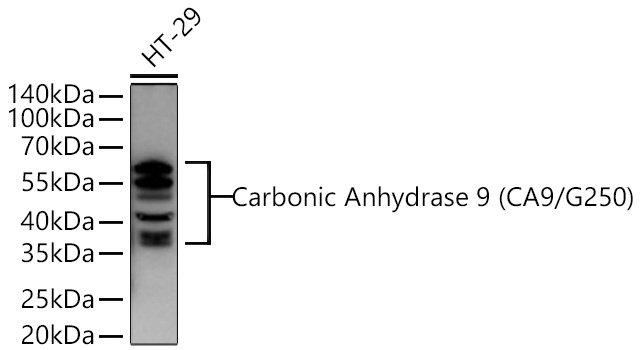 | Western blot analysis of lysates from HT-29 cells using Carbonic Anhydrase 9 (CA9/G250) Rabbit mAb (CAB4934) at 1:1000 dilution incubated overnight at 4℃. Secondary antibody: HRP-conjugated Goat anti-Rabbit IgG (H+L) (CABS014) at 1:10000 dilution. Lysates/proteins: 25 μg per lane. Blocking buffer: 3% nonfat dry milk in TBST. Detection: ECL Basic Kit (AbGn00020). Exposure time: 90s. |
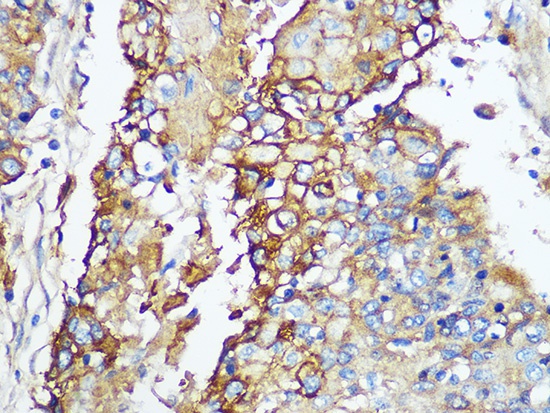 | Immunohistochemistry analysis of paraffin-embedded Human esophageal using Carbonic Anhydrase 9 (CA9/G250) Rabbit mAb (CAB4934) at dilution of 1:100 (40x lens). Microwave antigen retrieval performed with 0.01M PBS Buffer (pH 7.2) prior to IHC staining. |