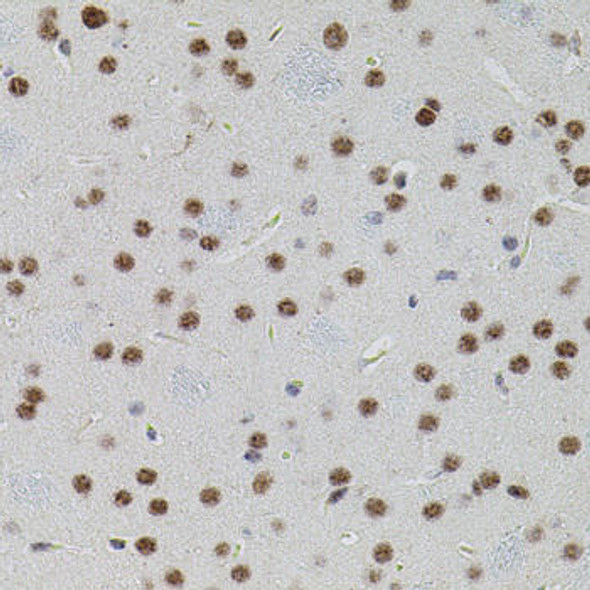
The CEP290 Antibody (CAB16147) is a high-quality antibody developed for reliable detection and analysis of target proteins. The antibody, generated in rabbits, exhibits high specificity and sensitivity for detecting CEP290 in human samples, making it ideal for use in Western blot and immunohistochemistry applications.CEP290 is a centrosomal protein essential for cilia formation and function, playing a critical role in various cellular processes such as cell division and signaling. Mutations in the CEP290 gene have been linked to a range of ciliopathies, including Joubert syndrome and Leber congenital amaurosis, highlighting the importance of understanding its function.
This antibody is validated for use in WB, ELISA applications and has demonstrated reactivity against Human samples.
Product Name:
CEP290 Antibody
SKU:
CAB16147
Size:
20μL, 100μL
Reactivity:
Human
Conjugate:
Unconjugated
Immunogen:
Recombinant protein (or fragment).This information is considered to be commercially sensitive.
This gene encodes a protein with 13 putative coiled-coil domains, a region with homology to SMC chromosome segregation ATPases, six KID motifs, three tropomyosin homology domains and an ATP/GTP binding site motif A. The protein is localized to the centrosome and cilia and has sites for N-glycosylation, tyrosine sulfation, phosphorylation, N-myristoylation, and amidation. Mutations in this gene have been associated with Joubert syndrome and nephronophthisis and the presence of antibodies against this protein is associated with several forms of cancer.
Purification Method
Affinity purification
Gene ID
80184
RRID
AB_2763594
Buffer Information
Store at -20℃. Avoid freeze / thaw cycles. Buffer: PBS with 0.01% thimerosal,50% glycerol,pH7.3.
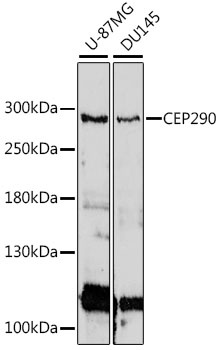
Western blot analysis of various lysates using CEP290 Rabbit pAb (CAB16147) at 1:1000 dilution. Secondary antibody: HRP-conjugated Goat anti-Rabbit IgG (H+L) (CABS014) at 1:10000 dilution. Lysates/proteins: 25μg per lane. Blocking buffer: 3% nonfat dry milk in TBST. Detection: ECL Basic Kit (AbGn00020). Exposure time: 30s.