The CHRNA7 Antibody (CAB1588) is a high-quality antibody developed for reliable detection and analysis of target proteins. This receptor plays a role in various physiological processes, including neurotransmission and inflammation regulation. Raised in rabbits, this antibody is highly specific and reactive with human samples, making it a reliable tool for Western blot applications. By binding to the CHRNA7 protein, researchers can easily detect and analyze its presence in different cell types. This makes the antibody invaluable for studies in neurobiology, immunology, and inflammatory research.The alpha-7 nicotinic acetylcholine receptor is of particular interest in the field of neuroscience, as it is implicated in various neurological disorders, including Alzheimer's disease, schizophrenia, and Parkinson's disease.
This antibody is validated for use in WB, IHC-P, IF/ICC, ELISA applications and has demonstrated reactivity against Human, Mouse, Rat samples.
Product Name:
CHRNA7 Antibody
SKU:
CAB1588
Size:
20μL, 100μL
Reactivity:
Human, Mouse, Rat
Conjugate:
Unconjugated
Immunogen:
Recombinant protein (or fragment).This information is considered to be commercially sensitive.
The nicotinic acetylcholine receptors (nAChRs) are members of a superfamily of ligand-gated ion channels that mediate fast signal transmission at synapses. The nAChRs are thought to be hetero-pentamers composed of homologous subunits. The proposed structure for each subunit is a conserved N-terminal extracellular domain followed by three conserved transmembrane domains, a variable cytoplasmic loop, a fourth conserved transmembrane domain, and a short C-terminal extracellular region. The protein encoded by this gene forms a homo-oligomeric channel, displays marked permeability to calcium ions and is a major component of brain nicotinic receptors that are blocked by, and highly sensitive to, alpha-bungarotoxin. Once this receptor binds acetylcholine, it undergoes an extensive change in conformation that affects all subunits and leads to opening of an ion-conducting channel across the plasma membrane. This gene is located in a region identified as a major susceptibility locus for juvenile myoclonic epilepsy and a chromosomal location involved in the genetic transmission of schizophrenia. An evolutionarily recent partial duplication event in this region results in a hybrid containing sequence from this gene and a novel FAM7A gene. Alternative splicing results in multiple transcript variants.
Purification Method
Affinity purification
Gene ID
1139
RRID
AB_2763309
Buffer Information
Store at -20℃. Avoid freeze / thaw cycles. Buffer: PBS containing 50% glycerol, preserved with proclin300 or sodium azide, pH 7.3.
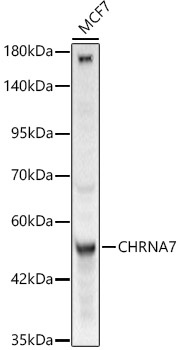
Western blot analysis of lysates from MCF7 cells using CHRNA7 Rabbit pAb (CAB1588) at 1:2000 dilution. Secondary antibody: HRP-conjugated Goat anti-Rabbit IgG (H+L) (CABS014) at 1:10000 dilution. Lysates/proteins: 25 μg per lane. Blocking buffer: 3% nonfat dry milk in TBST. Detection: ECL Basic Kit (AbGn00020). Exposure time: 120s.
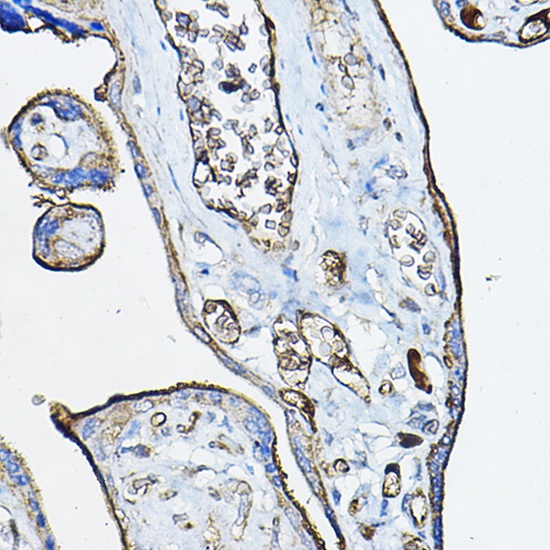
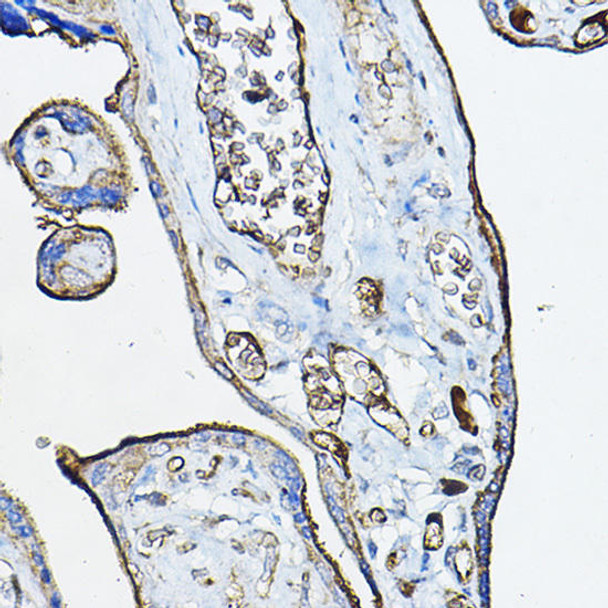
Immunohistochemistry analysis of paraffin-embedded Human placenta using CHRNA7 Rabbit pAb (CAB1588) at dilution of 1:100 (40x lens). Microwave antigen retrieval performed with 0.01M PBS Buffer (pH 7.2) prior to IHC staining.