The ERCC1 Monoclonal Antibody (CAB4971) is a high-quality antibody developed for reliable detection and analysis of target proteins. This antibody, developed using rabbit monoclonal technology, demonstrates high specificity and sensitivity for detecting ERCC1 in human samples. Validated for use in Western blot applications, this antibody effectively binds to ERCC1, facilitating precise detection and analysis in a variety of cell types.ERCC1 is a critical component of the nucleotide excision repair pathway, playing a vital role in maintaining genomic stability and protecting cells from DNA damage.
This antibody is validated for use in WB, ELISA applications and has demonstrated reactivity against Human samples.
Product Name:
ERCC1 Monoclonal Antibody
SKU:
CAB4971
Size:
20μL, 100μL
Reactivity:
Human
Clone Number:
ARC1241
Conjugate:
Unconjugated
Immunogen:
Recombinant protein (or fragment).This information is considered to be commercially sensitive.
Recommended starting concentration is 1 μg/mL. Please optimize the concentration based on your specific assay requirements.
Synonyms:
UV20, COFS4, RAD10, ERCC1
Positive Sample:
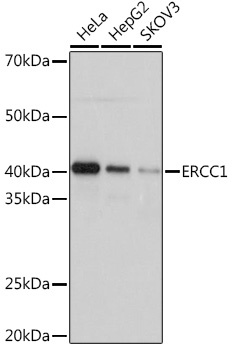
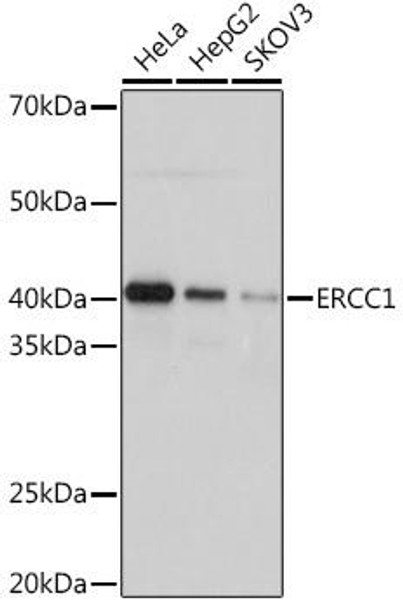
HeLa, HepG2, SKOV3
Cellular Localization:
Cytoplasm, Nucleus.
Calculated MW:
33kDa
Observed MW:
39kDa
The product of this gene functions in the nucleotide excision repair pathway, and is required for the repair of DNA lesions such as those induced by UV light or formed by electrophilic compounds including cisplatin. The encoded protein forms a heterodimer with the XPF endonuclease (also known as ERCC4), and the heterodimeric endonuclease catalyzes the 5' incision in the process of excising the DNA lesion. The heterodimeric endonuclease is also involved in recombinational DNA repair and in the repair of inter-strand crosslinks. Mutations in this gene result in cerebrooculofacioskeletal syndrome, and polymorphisms that alter expression of this gene may play a role in carcinogenesis. Multiple transcript variants encoding different isoforms have been found for this gene. The last exon of this gene overlaps with the CD3e molecule, epsilon associated protein gene on the opposite strand.
Purification Method
Affinity purification
Gene ID
2067
RRID
AB_2863401
Buffer Information
Store at -20℃. Avoid freeze / thaw cycles. Buffer: PBS containing 50% glycerol and 0.05% BSA, preserved with proclin300 or sodium azide, pH 7.3.
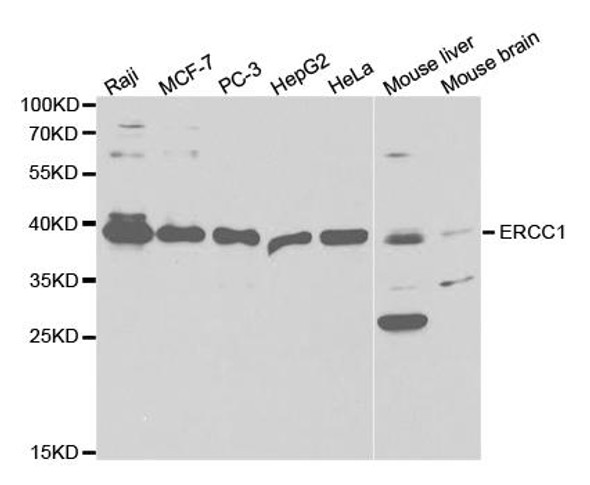
Western blot analysis of various lysates using ERCC1 Rabbit mAb (CAB4971) at 1:1000 dilution. Secondary antibody: HRP-conjugated Goat anti-Rabbit IgG (H+L) (CABS014) at 1:10000 dilution. Lysates/proteins: 25μg per lane. Blocking buffer: 3% nonfat dry milk in TBST. Detection: ECL Basic Kit (AbGn00020). Exposure time: 3s.