The FGB Antibody (CAB1401) is a high-quality antibody developed for reliable detection and analysis of target proteins. This antibody is produced in rabbits and has been shown to be highly reactive with human samples, making it ideal for use in various research applications.The FGB Polyclonal Antibody is specifically validated for use in Western blot applications, allowing researchers to detect and analyze the FGB protein in different cell types.
This antibody is validated for use in WB, IF/ICC, ELISA applications and has demonstrated reactivity against Human, Mouse, Rat samples.
Product Name:
FGB Antibody
SKU:
CAB1401
Size:
20μL, 100μL
Reactivity:
Human, Mouse, Rat
Conjugate:
Unconjugated
Immunogen:
Recombinant protein (or fragment).This information is considered to be commercially sensitive.
Recommended starting concentration is 1 μg/mL. Please optimize the concentration based on your specific assay requirements.
Synonyms:
HEL-S-78p, FGB
Positive Sample:
Mouse liver, Rat liver, Rat heart, HepG2
Cellular Localization:
Secreted.
Calculated MW:
56kDa
Observed MW:
56kDa
The protein encoded by this gene is the beta component of fibrinogen, a blood-borne glycoprotein comprised of three pairs of nonidentical polypeptide chains. Following vascular injury, fibrinogen is cleaved by thrombin to form fibrin which is the most abundant component of blood clots. In addition, various cleavage products of fibrinogen and fibrin regulate cell adhesion and spreading, display vasoconstrictor and chemotactic activities, and are mitogens for several cell types. Fibrinogen serves key roles in hemostasis and antimicrobial host defense. Mutations in this gene lead to several disorders, including afibrinogenemia, dysfibrinogenemia, hypodysfibrinogenemia and thrombotic tendency.
Purification Method
Affinity purification
Gene ID
2244
RRID
AB_2760864
Buffer Information
Store at -20℃. Avoid freeze / thaw cycles. Buffer: PBS with 0.09% Sodium azide,50% glycerol,pH7.3.
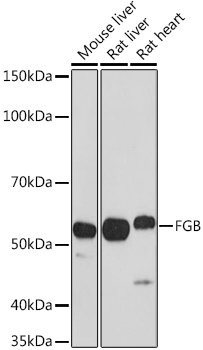
Western blot analysis of various lysates using FGB Rabbit pAb (CAB1401) at 1:1000 dilution. Secondary antibody: HRP-conjugated Goat anti-Rabbit IgG (H+L) (CABS014) at 1:10000 dilution. Lysates/proteins: 25μg per lane. Blocking buffer: 3% nonfat dry milk in TBST. Detection: ECL Basic Kit (AbGn00020). Exposure time: 10s.
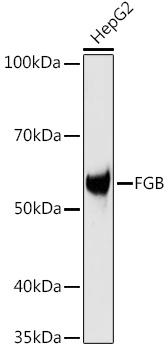
Western blot analysis of lysates from HepG2 cells, using FGB Rabbit pAb (CAB1401) at 1:1000 dilution. Secondary antibody: HRP-conjugated Goat anti-Rabbit IgG (H+L) (CABS014) at 1:10000 dilution. Lysates/proteins: 25μg per lane. Blocking buffer: 3% nonfat dry milk in TBST. Detection: ECL Basic Kit (AbGn00020). Exposure time: 10s.