

Description
HRP-conjugated Mouse anti GST-Tag mAb (CABE027)
The HRP-conjugated Mouse anti GST-Tag mAb (CABE027) is a high-quality antibody developed for reliable detection and analysis of target proteins. Glutathione S-transferases (GSTs) comprise a family of phase II detoxification isozymes that catalyze glutathione conjugation to electrophilic substrates across cytosolic, mitochondrial, and microsomal subfamilies. The GST fusion tag serves a dual purpose: enhancing solubility of fusion partners in bacterial expression systems while enabling affinity purification via glutathione-Sepharose chromatography.
This antibody is validated for use in WB applications and has demonstrated reactivity against Species independent samples.
| Product Name: | HRP-conjugated Mouse anti GST-Tag mAb |
| SKU: | CABE027 |
| Size: | 50μL, 100μL, 200μL |
| Reactivity: | Species independent |
| Clone Number: | AMC0513 |
| Conjugate: | HRP |
| Immunogen: | Recombinant protein (or fragment).This information is considered to be commercially sensitive. | ||
| Tested Applications: | WB | ||
| Recommended Dilution: |
| ||
| Synonyms: | GST, GST tag, GST-tag |
| Positive Sample: | Recombinant GST Protein |
| Calculated MW: | 26kDa |
| Observed MW: | 27kDa |
Glutathione S-transferases (GSTs), previously known as ligandins, comprise a family of eukaryotic and prokaryotic phase II metabolic isozymes best known for their ability to catalyze the conjugation of the reduced form of glutathione (GSH) to xenobiotic substrates for the purpose of detoxification. The GST family consists of three superfamilies: the cytosolic, mitochondrial, and microsomal—also known as MAPEG—proteins. Members of the GST superfamily are extremely diverse in amino acid sequence, and a large fraction of the sequences deposited in public databases are of unknown function. The Enzyme Function Initiative (EFI) is using GSTs as a model superfamily to identify new GST functions.A GST-tag is often used to separate and purify proteins that contain the GST-fusion protein. The tag is 220 amino acids (roughly 26 KDa) in size, which, compared to tags such as the Myc-tag or the FLAG-tag, is quite large. It can be fused to either the N-terminus or C-terminus of a protein. However, many commercially available sources of GST-tagged plasmids include a thrombin domain for cleavage of the GST tag during protein purification.
| Purification Method | Affinity purification |
| RRID | AB_2769865 |
| Buffer Information | Store at -20℃. Avoid freeze / thaw cycles. Buffer: PBS with 50% glycerol,pH7.3. |
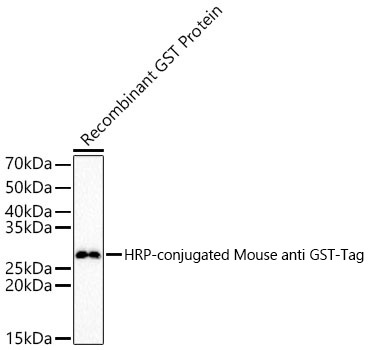 | Western blot analysis of recombinant GST Protein using HRP-conjugated Mouse anti GST-Tag mAb (CABE027) at 1:5000 dilution. Lysates/proteins: 20 ng per lane. Blocking buffer: 3% nonfat dry milk in TBST. Detection: ECL Basic Kit (AbGn00020). Exposure time: 60s. |


