The ORP150/GRP170/HSP12A Monoclonal Antibody (CAB1042) is a high-quality antibody developed for reliable detection and analysis of target proteins. This antibody, generated in rabbits, is highly specific and sensitive for detecting ORP150, GRP170, and HSP12A proteins in human samples. Validated for use in Western blot applications, this antibody allows for accurate detection and analysis of these stress-related proteins in a variety of cell types.ORP150, GRP170, and HSP12A are heat shock proteins that play crucial roles in cellular stress responses, including protein folding, stabilization, and degradation. These proteins are involved in maintaining cellular homeostasis under various stress conditions, making them important targets for research in fields such as cell biology, molecular biology, and cancer research.
This antibody is validated for use in WB, IHC-P, ELISA applications and has demonstrated reactivity against Human, Mouse, Rat samples.
Product Name:
ORP150/GRP170/HSP12A Monoclonal Antibody
SKU:
CAB1042
Size:
20μL, 100μL
Reactivity:
Human, Mouse, Rat
Clone Number:
ARC1857
Conjugate:
Unconjugated
Immunogen:
Recombinant protein (or fragment).This information is considered to be commercially sensitive.
The protein encoded by this gene belongs to the heat shock protein 70 family. This gene uses alternative transcription start sites. A cis-acting segment found in the 5' UTR is involved in stress-dependent induction, resulting in the accumulation of this protein in the endoplasmic reticulum (ER) under hypoxic conditions. The protein encoded by this gene is thought to play an important role in protein folding and secretion in the ER. Since suppression of the protein is associated with accelerated apoptosis, it is also suggested to have an important cytoprotective role in hypoxia-induced cellular perturbation. This protein has been shown to be up-regulated in tumors, especially in breast tumors, and thus it is associated with tumor invasiveness. This gene also has an alternative translation initiation site, resulting in a protein that lacks the N-terminal signal peptide. This signal peptide-lacking protein, which is only 3 amino acids shorter than the mature protein in the ER, is thought to have a housekeeping function in the cytosol. In rat, this protein localizes to both the ER by a carboxy-terminal peptide sequence and to mitochondria by an amino-terminal targeting signal. Alternative splicing results in multiple transcript variants.
Purification Method
Affinity purification
Gene ID
10525
RRID
AB_2861494
Buffer Information
Store at -20℃. Avoid freeze / thaw cycles. Buffer: PBS containing 50% glycerol and 0.05% BSA, preserved with proclin300 or sodium azide, pH 7.3.
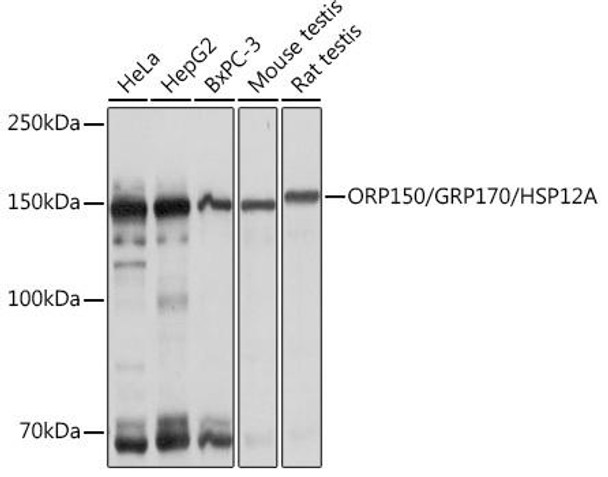
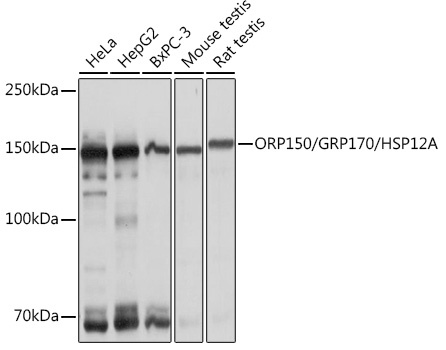
Western blot analysis of various lysates using ORP150/GRP170/HSP12A Rabbit mAb (CAB1042) at 1:1000 dilution. Secondary antibody: HRP-conjugated Goat anti-Rabbit IgG (H+L) (CABS014) at 1:10000 dilution. Lysates/proteins: 25μg per lane. Blocking buffer: 3% nonfat dry milk in TBST. Detection: ECL Basic Kit (AbGn00020). Exposure time: 1s.
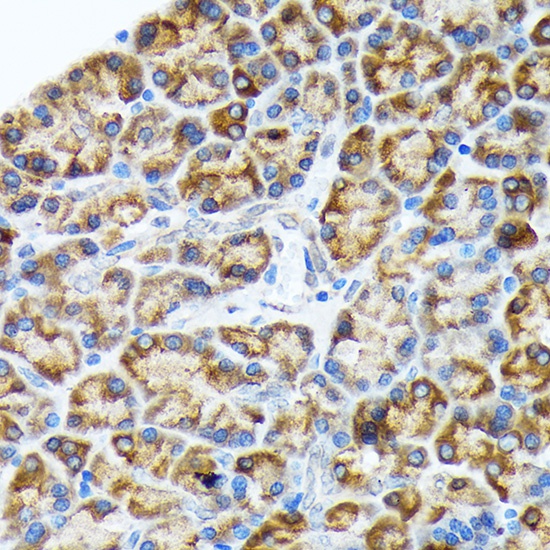
Immunohistochemistry analysis of paraffin-embedded Rat pancreas using ORP150/GRP170/HSP12A Rabbit mAb (CAB1042) at dilution of 1:100 (40x lens). Microwave antigen retrieval performed with 0.01M Tris/EDTA Buffer (pH 9.0) prior to IHC staining.