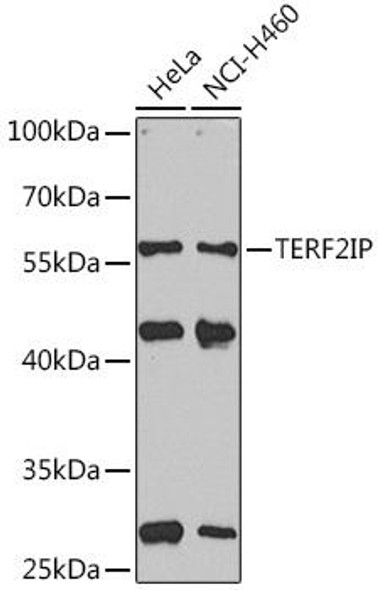
The KLRK1 Antibody (CAB6123) is a high-quality antibody developed for reliable detection and analysis of target proteins. Natural killer (NK) cells are lymphocytes that can mediate lysis of certain tumor cells and virus-infected cells without previous activation. They can also regulate specific humoral and cell-mediated immunity. NK cells preferentially express several calcium-dependent (C-type) lectins, which have been implicated in the regulation of NK cell function. The NKG2 gene family is located within the NK complex, a region that contains several C-type lectin genes preferentially expressed in NK cells. This gene encodes a member of the NKG2 family. The encoded transmembrane protein is characterized by a type II membrane orientation (has an extracellular C terminus) and the presence of a C-type lectin domain. It binds to a diverse family of ligands that include MHC class I chain-related A and B proteins and UL-16 binding proteins, where ligand-receptor interactions can result in the activation of NK and T cells. The surface expression of these ligands is important for the recognition of stressed cells by the immune system, and thus this protein and its ligands are therapeutic targets for the treatment of immune diseases and cancers. Read-through transcription exists between this gene and the upstream KLRC4 (killer cell lectin-like receptor subfamily C, member 4) family member in the same cluster. RRID AB_2766756 Gene ID 22914 Swiss Prot Synonym KLR; CD314; NKG2D; NKG2-D; D12S2489E; KLRK1
This antibody is validated for use in WB, ELISA applications and has demonstrated reactivity against Human, Mouse samples.
Product Name:
KLRK1 Antibody
SKU:
CAB6123
Size:
100μL, 20μL
Reactivity:
Human, Mouse
Clone Number:
-
Conjugate:
Unconjugated
Immunogen:
Recombinant protein (or fragment).This information is considered to be commercially sensitive.
Tested Applications:
WBELISA
Recommended Dilution:
WB
1:500 - 1:2000
ELISA
Recommended starting concentration is 1 μg/mL. Please optimize the concentration based on your specific assay requirements.
Synonyms:
KLR, CD314, NKG2D, NKG2-D, D12S2489E, KLRK1
Positive Sample:
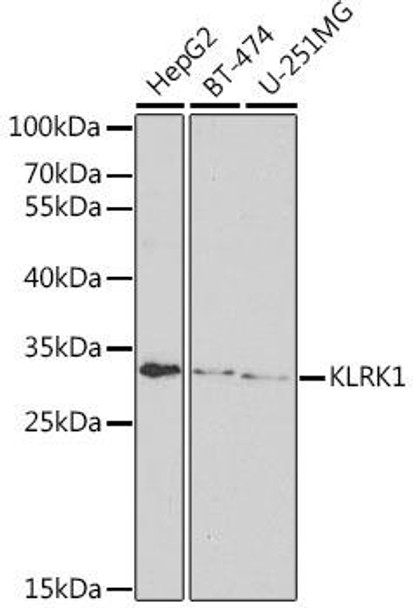
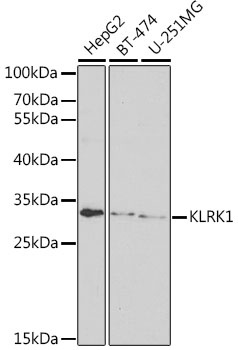
HepG2, BT-474, U-251MG
Cellular Localization:
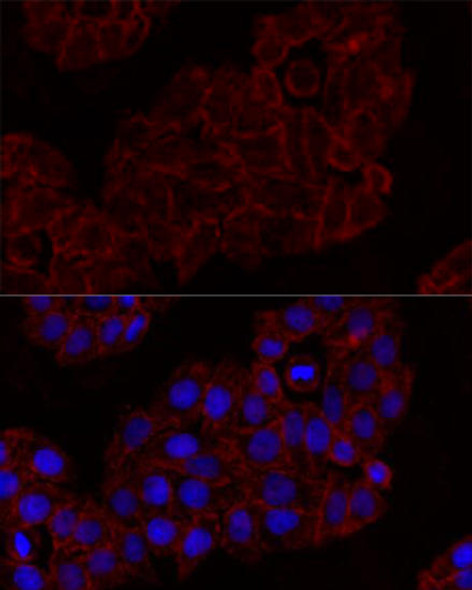
Cell Membrane, Single-Pass Type Ii Membrane Protein.
Calculated MW:
25kDa
Observed MW:
30kDa
Natural killer (NK) cells are lymphocytes that can mediate lysis of certain tumor cells and virus-infected cells without previous activation. They can also regulate specific humoral and cell-mediated immunity. NK cells preferentially express several calcium-dependent (C-type) lectins, which have been implicated in the regulation of NK cell function. The NKG2 gene family is located within the NK complex, a region that contains several C-type lectin genes preferentially expressed in NK cells. This gene encodes a member of the NKG2 family. The encoded transmembrane protein is characterized by a type II membrane orientation (has an extracellular C terminus) and the presence of a C-type lectin domain. It binds to a diverse family of ligands that include MHC class I chain-related A and B proteins and UL-16 binding proteins, where ligand-receptor interactions can result in the activation of NK and T cells. The surface expression of these ligands is important for the recognition of stressed cells by the immune system, and thus this protein and its ligands are therapeutic targets for the treatment of immune diseases and cancers. Read-through transcription exists between this gene and the upstream KLRC4 (killer cell lectin-like receptor subfamily C, member 4) family member in the same cluster. RRID AB_2766756 Gene ID 22914 Swiss Prot Synonym KLR; CD314; NKG2D; NKG2-D; D12S2489E; KLRK1
Purification Method:
Affinity purification
Gene ID:
22914
RRID:
AB_2766756
Buffer Information:
Store at -20℃. Avoid freeze / thaw cycles. Buffer: PBS containing 50% glycerol, preserved with proclin300 or sodium azide, pH 7.3.
Western blot analysis of various lysates using KLRK1 Rabbit pAb (CAB6123) at 1:1000 dilution. Secondary antibody: HRP-conjugated Goat anti-Rabbit IgG (H+L) (AS014) at 1:10000 dilution. Lysates/proteins: 25μg per lane. Blocking buffer: 3% nonfat dry milk in TBST. Detection: ECL Basic Kit (AbGn00020). Exposure time: 90s.