The Cytokeratin 13 (KRT13) Monoclonal Antibody (CAB0411) is a high-quality antibody developed for reliable detection and analysis of target proteins. This antibody, generated in rabbits, exhibits high specificity and sensitivity towards human samples, making it a reliable choice for immunohistochemistry and immunofluorescence applications.Cytokeratin 13 is a member of the cytokeratin family, which are intermediate filament proteins found in epithelial cells. It is particularly expressed in certain types of epithelial tissues, such as the oral mucosa and esophageal epithelium. The expression of cytokeratin 13 can be altered in various disease states, including cancer, making it a useful biomarker for diagnostic and research purposes.
This antibody is validated for use in WB, IHC-P, ELISA, IF-P applications and has demonstrated reactivity against Human, Mouse, Rat samples.
Product Name:
Cytokeratin 13 (KRT13) Monoclonal Antibody
SKU:
CAB0411
Size:
20μL, 100μL
Reactivity:
Human, Mouse, Rat
Clone Number:
ARC1824
Conjugate:
Unconjugated
Immunogen:
Synthetic peptide. This information is considered to be commercially sensitive.
Sequence:
LTGN EKIT MQNL NDRL ASYL EKVR ALEE ANAD LEVK IRDW HLKQ SPAS PERD YSPY YKTI EELR DKIL TATI ENNR VILE IDNA RLAA DDFR LKYE NELA L
Tested Applications:
WBIHC-PELISAIF-P
Recommended Dilution:
WB
1:5000 - 1:20000
IF-P
1:100 - 1:1000
IHC-P
1:500 - 1:2000
ELISA
Recommended starting concentration is 1 μg/mL. Please optimize the concentration based on your specific assay requirements.
The protein encoded by this gene is a member of the keratin gene family. The keratins are intermediate filament proteins responsible for the structural integrity of epithelial cells and are subdivided into cytokeratins and hair keratins. Most of the type I cytokeratins consist of acidic proteins which are arranged in pairs of heterotypic keratin chains. This type I cytokeratin is paired with keratin 4 and expressed in the suprabasal layers of non-cornified stratified epithelia. Mutations in this gene and keratin 4 have been associated with the autosomal dominant disorder White Sponge Nevus. The type I cytokeratins are clustered in a region of chromosome 17q21.2. Alternative splicing of this gene results in multiple transcript variants; however, not all variants have been described.
Purification Method
Affinity purification
Gene ID
3860
RRID
AB_2861460
Buffer Information
Store at -20℃. Avoid freeze / thaw cycles. Buffer: PBS containing 50% glycerol and 0.05% BSA, preserved with proclin300 or sodium azide, pH 7.3.
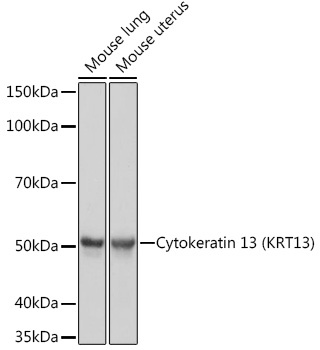
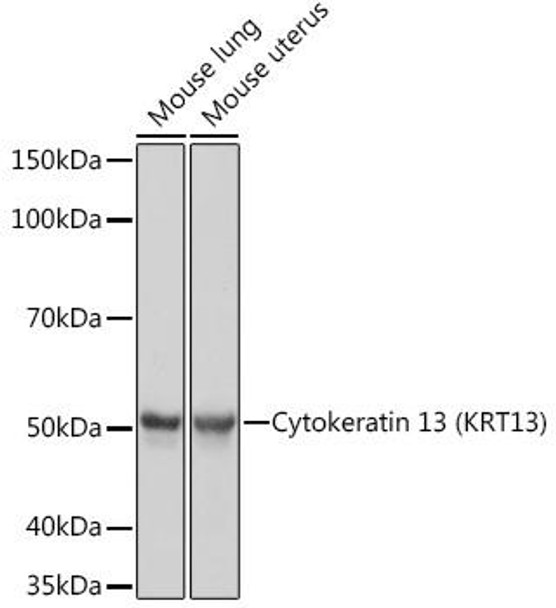
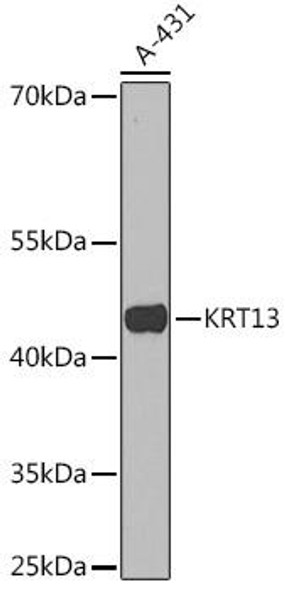
Western blot analysis of various lysates using Cytokeratin 13 (KRT13) (KRT13) Rabbit mAb (CAB0411) at 1:1000 dilution. Secondary antibody: HRP-conjugated Goat anti-Rabbit IgG (H+L) (CABS014) at 1:10000 dilution. Lysates/proteins: 25μg per lane. Blocking buffer: 3% nonfat dry milk in TBST. Detection: ECL Basic Kit (AbGn00020). Exposure time: 1s.
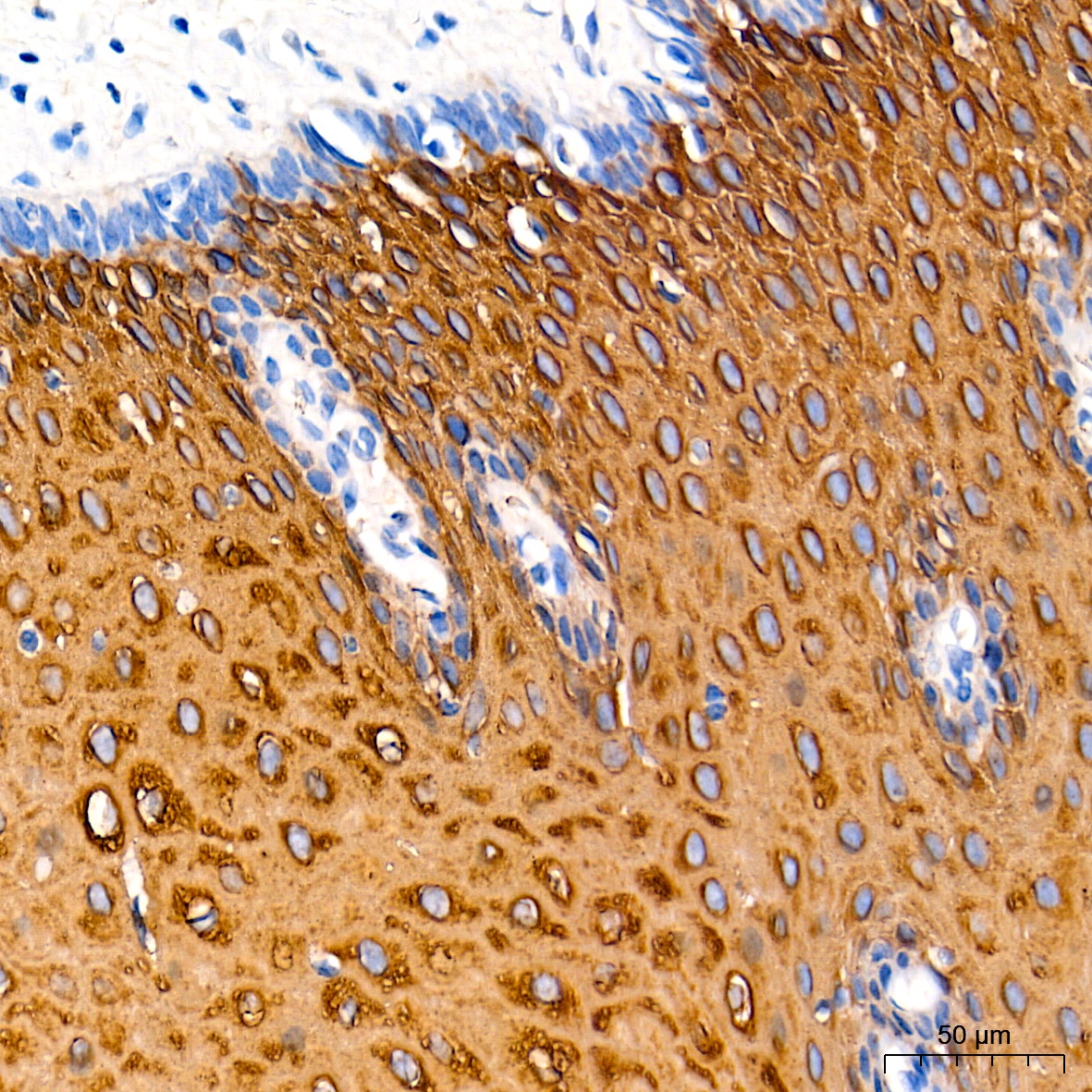
Immunohistochemistry analysis of paraffin-embedded Human esophagus tissue using Cytokeratin 13 (KRT13) Rabbit mAb (CAB0411) at a dilution of 1:1000 (40x lens). High pressure antigen retrieval performed with 0.01M Tris-EDTA Buffer (pH 9.0) prior to IHC staining.
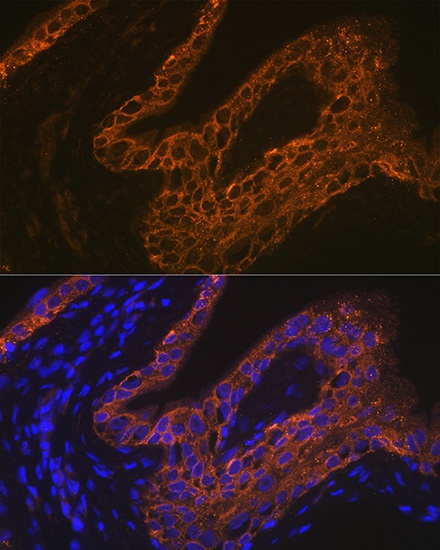
Immunofluorescence analysis of paraffin-embedded rat bladder using Cytokeratin 13 (KRT13) (KRT13) Rabbit mAb (CAB0411) at dilution of 1:100 (40x lens). Secondary antibody: Cy3-conjugated Goat anti-Rabbit IgG (H+L) (CABS007) at 1:500 dilution. Blue: DAPI for nuclear staining.
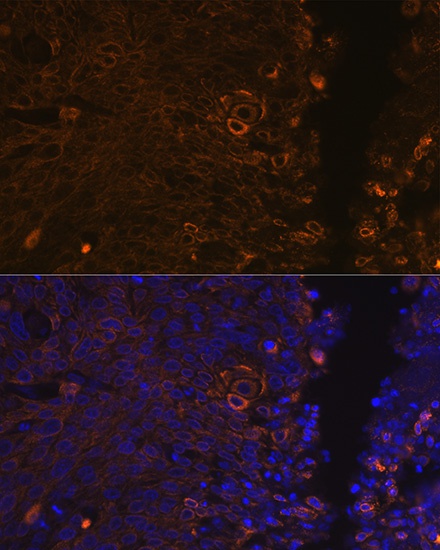
Immunofluorescence analysis of paraffin-embedded human cervix cancer using Cytokeratin 13 (KRT13) (KRT13) Rabbit mAb (CAB0411) at dilution of 1:100 (40x lens). Secondary antibody: Cy3-conjugated Goat anti-Rabbit IgG (H+L) (CABS007) at 1:500 dilution. Blue: DAPI for nuclear staining.