The Anti-FLAG (DDDDK) Magnetic Beads (CABE037) is a high-quality antibody developed for reliable detection and analysis of target proteins. This antibody, derived from mouse, is highly specific and sensitive, allowing for accurate detection and purification of tagged proteins in various biological samples.The DDDDK tag, also known as the FLAG tag, is commonly used in protein research for easy identification and isolation of recombinant proteins.
This antibody is validated for use in IP applications and has demonstrated reactivity against Species independent samples.
Product Name:
Anti-FLAG (DDDDK) Magnetic Beads
SKU:
CABE037
Size:
100μL, 200μL
Reactivity:
Species independent
Clone Number:
AMC0515
Conjugate:
Magnetic Beads
Immunogen:
Synthetic peptide. This information is considered to be commercially sensitive.
Sequence:
DYKD DDDK
Tested Applications:
IP
Recommended Dilution:
IP
,30ul antibody (bead slurry) for 200μg-400μg extracts of whole cells
FLAG-tag, or FLAG octapeptide, or FLAG epitope, is a polypeptide protein tag that can be added to a protein using recombinant DNA technology, having the sequence motif DYKDDDDK. It has been used for studying proteins in living cells and for protein purification by affinity chromatography. It has been used to separate recombinant, overexpressed protein from wild-type protein expressed by the host organism. It can also be used in the isolation of protein complexes with multiple subunits, because its mild purification procedure tends not to disrupt such complexes. It has been used to obtain proteins of sufficient purity and quality to carry out 3D structure determination by x-ray crystallography.A FLAG-tag can be used in many different assays that require recognition by an antibody. If there is no antibody against a given protein, adding a FLAG-tag to a protein allows the protein to be studied with an antibody against the FLAG sequence. Examples are cellular localization studies by immunofluorescence or detection by SDS PAGE protein electrophoresis and Western blotting.
Purification Method
Affinity purification
RRID
AB_2863786
Buffer Information
Store at 4℃ Avoid freeze / thaw cycles. Buffer: PBS, preserved with proclin300 or sodium azide, pH 7.3.
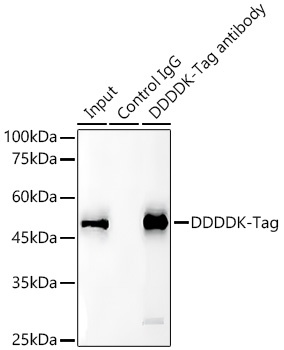
Immunoprecipitation analysis of 300 ug extract cell lysate from 293T cells transfected with GSK3B expression vector containing a C-terminal DDDDK-Tag (1x) with 30uL Magnetic Beads-conjugated Mouse anti DDDDK-tag mAb antibody(CABE037). Magnetic Beads-conjugated mouse IgG isotype control pAb (AC044N) was used as a negative control. Western blot was performed from the immunoprecipitate using Rabbit anti DDDDK-Tag mAb antibody (AE092) at 1:10000 dilution.
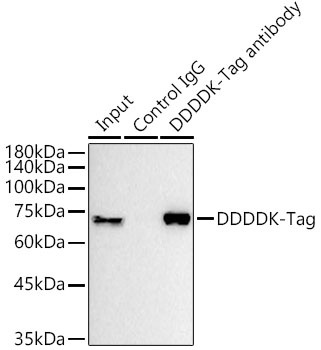
Immunoprecipitation analysis of 600ug extract cell lysate from 293T transfected with SERPINB1 expression vector containing a N-terminal DDDDK-Tag (1x) with 30ul Magnetic Beads-conjugated Mouse anti DDDDK-Tag antibody (CABE037). Magnetic Beads-conjugated mouse IgG isotype control pAb (AC044N) was used as a negative control. Western blot was performed from the immunoprecipitate using Rabbit anti DDDDK-Tag mAb antibody (AE092) at 1:5000 dilution.