The Phospho-ACLY-S455 Antibody (CABP0779) is a high-quality antibody developed for reliable detection and analysis of target proteins. ACLY is a key enzyme involved in fatty acid synthesis and is regulated by phosphorylation at various sites, including S455. This antibody, raised in rabbits, exhibits high specificity for human samples and is validated for use in Western blot applications.Phosphorylation of ACLY at S455 has been implicated in various cellular processes, including lipid metabolism and cell proliferation. This antibody enables the detection and analysis of phosphorylated ACLY in different cell types, making it suitable for research in metabolism, cell signaling, and cancer biology.
This antibody is validated for use in WB, IHC-P, IP, ELISA applications and has demonstrated reactivity against Human, Mouse, Rat samples.
Product Name:
Phospho-ACLY-S455 Antibody
SKU:
CABP0779
Size:
20μL, 100μL
Reactivity:
Human, Mouse, Rat
Conjugate:
Unconjugated
Immunogen:
Synthetic peptide. This information is considered to be commercially sensitive.
Sequence:
RTAS FS
Tested Applications:
WBIHC-PIPELISA
Recommended Dilution:
WB
1:100 - 1:500
IHC-P
1:50 - 1:100
IP
0.5μg-4μg antibody for 200μg-400μg extracts of whole cells
ELISA
Recommended starting concentration is 1 μg/mL. Please optimize the concentration based on your specific assay requirements.
Synonyms:
ACL, ATPCL, CLATP, Phospho-ACLY-S455
Positive Sample:
C6 treated with Insulin, NIH/3T3 treated with Insulin, HeLa treated with Insulin
Cellular Localization:
Cytoplasm.
Calculated MW:
121kDa
Observed MW:
125kDa
ATP citrate lyase is the primary enzyme responsible for the synthesis of cytosolic acetyl-CoA in many tissues. The enzyme is a tetramer (relative molecular weight approximately 440,000) of apparently identical subunits. It catalyzes the formation of acetyl-CoA and oxaloacetate from citrate and CoA with a concomitant hydrolysis of ATP to ADP and phosphate. The product, acetyl-CoA, serves several important biosynthetic pathways, including lipogenesis and cholesterogenesis. In nervous tissue, ATP citrate-lyase may be involved in the biosynthesis of acetylcholine. Multiple transcript variants encoding distinct isoforms have been identified for this gene.
Purification Method
Affinity purification
Gene ID
47
RRID
AB_2770895
Buffer Information
Store at -20℃. Avoid freeze / thaw cycles. Buffer: PBS containing 50% glycerol, preserved with proclin300 or sodium azide, pH 7.3.
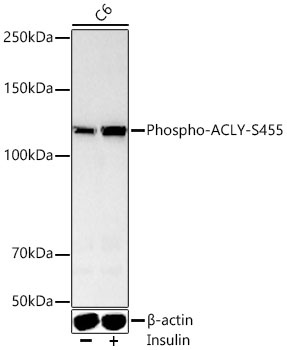
Western blot analysis of lysates from C6 cells using Phospho-ACLY-S455 Rabbit pAb (CABP0779) at 1:400 dilution. C6 cells were treated with Insulin (100 ng/mL) at 37℃ for 30 minutes after serum-starvation overnight. Secondary antibody: HRP-conjugated Goat anti-Rabbit IgG (H+L) (CABS014) at 1:10000 dilution. Lysates/proteins: 25 μg per lane. Blocking buffer: 3% nonfat dry milk in TBST. Detection: ECL Basic Kit (AbGn00020). Exposure time: 60s.
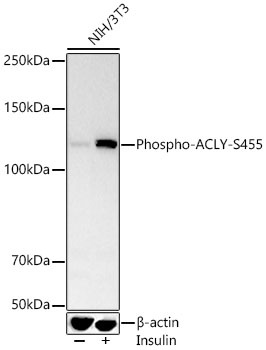
Western blot analysis of lysates from NIH/3T3 cells using Phospho-ACLY-S455 Rabbit pAb (CABP0779) at 1:400 dilution. NIH/3T3 cells were treated with Insulin (200 nM) at 37℃ for 30 minutes after serum-starvation overnight. Secondary antibody: HRP-conjugated Goat anti-Rabbit IgG (H+L) (CABS014) at 1:10000 dilution. Lysates/proteins: 25 μg per lane. Blocking buffer: 3% nonfat dry milk in TBST. Detection: ECL Basic Kit (AbGn00020). Exposure time: 60s.
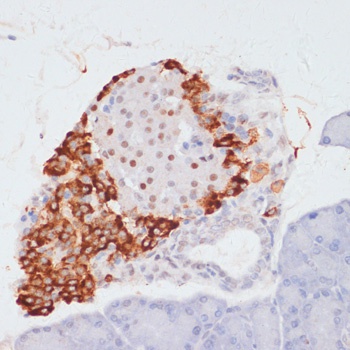
Immunohistochemistry analysis of paraffin-embedded Rat pancreas using Phospho-ACLY-S455 Rabbit pAb (CABP0779) at dilution of 1:100 (40x lens). Microwave antigen retrieval performed with 0.01M Tris/EDTA Buffer (pH 9.0) prior to IHC staining.
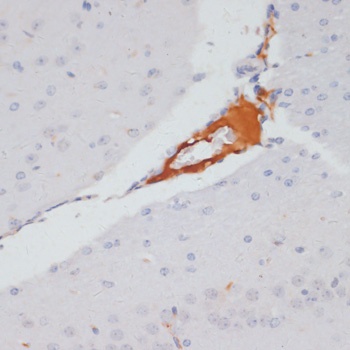
Immunohistochemistry analysis of paraffin-embedded Mouse brain using Phospho-ACLY-S455 Rabbit pAb (CABP0779) at dilution of 1:100 (40x lens). Microwave antigen retrieval performed with 0.01M Tris/EDTA Buffer (pH 9.0) prior to IHC staining.
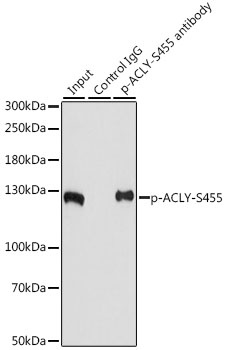
Immunoprecipitation analysis of 200 μg extracts of NIH/3T3 cells, using 3 μg Phospho-ACLY-S455 pAb (CABP0779). Western blot was performed from the immunoprecipitate using Phospho-ACLY-S455 pAb (CABP0779) at a dilution of 1:1000. NIH/3T3 cells were treated with Insulin (100 nM) at 37℃ for 10 minutes after serum-starvation overnight.