The Phospho-MRE11 (Ser676) Polyclonal Antibody (CABP1514) is a high-quality antibody developed for reliable detection and analysis of target proteins. This antibody, produced in rabbits, is highly specific for human samples and is optimized for use in Western blot applications. It binds specifically to the phosphorylated form of MRE11 at serine 676, allowing for precise detection and analysis in various cell types.MRE11 is a crucial component of the MRN complex, which plays a central role in the detection and repair of DNA double-strand breaks. Phosphorylation of MRE11 at serine 676 is known to regulate its function in DNA repair pathways, making this antibody a valuable tool for studying the mechanisms of genomic stability and DNA damage response.
This antibody is validated for use in WB applications and has demonstrated reactivity against Human samples.
Product Name:
Phospho-MRE11 (Ser676) Polyclonal Antibody
SKU:
CABP1514
Size:
20μL, 100μL
Reactivity:
Human
Conjugate:
Unconjugated
Immunogen:
Synthetic peptide. This information is considered to be commercially sensitive.
This gene encodes a nuclear protein involved in homologous recombination, telomere length maintenance, and DNA double-strand break repair. By itself, the protein has 3' to 5' exonuclease activity and endonuclease activity. The protein forms a complex with the RAD50 homolog; this complex is required for nonhomologous joining of DNA ends and possesses increased single-stranded DNA endonuclease and 3' to 5' exonuclease activities. In conjunction with a DNA ligase, this protein promotes the joining of noncomplementary ends in vitro using short homologies near the ends of the DNA fragments. This gene has a pseudogene on chromosome 3. Alternative splicing of this gene results in two transcript variants encoding different isoforms.
Purification Method
Affinity purification
Gene ID
4361
Buffer Information
Store at -20℃. Avoid freeze / thaw cycles. Buffer: PBS containing 50% glycerol, preserved with proclin300 or sodium azide, pH 7.3.
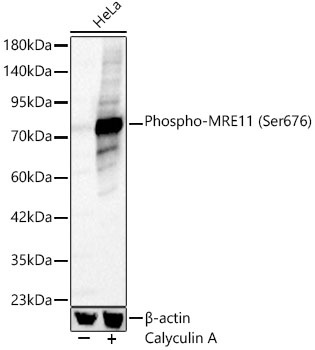
Western blot analysis of lysates from HeLa cells using Phospho-MRE11 (Ser676) Rabbit pAb (CABP1514) at 1:800 dilution. HeLa cells were treated with Calyculin A (200 nM) at 37℃ for 18 hours after serum-starvation overnight. Secondary antibody: HRP-conjugated Goat anti-Rabbit IgG (H+L) (CABS014) at 1:10000 dilution. Lysates/proteins: 25 μg per lane. Blocking buffer: 3% nonfat dry milk in TBST. Detection: ECL Basic Kit (AbGn00020). Exposure time: 1s.