Description
Phospho-RPA2-T21 Monoclonal Antibody (CABP1040)
The Phospho-RPA2-T21 Monoclonal Antibody (CABP1040) is a high-quality antibody developed for reliable detection and analysis of target proteins. RPA2 is a critical component of the DNA damage response pathway, playing a key role in DNA replication and repair processes. This antibody, produced in rabbits, is highly specific for the phosphorylated form of RPA2 at threonine 21 in human samples. It has been validated for use in Western blot applications, enabling researchers to detect and analyze the phosphorylation status of RPA2 in various cell types.
This antibody is validated for use in WB, ELISA applications and has demonstrated reactivity against Human, Rat samples.
| Product Name: | Phospho-RPA2-T21 Monoclonal Antibody |
| SKU: | CABP1040 |
| Size: | 20μL, 100μL |
| Reactivity: | Human, Rat |
| Clone Number: | ARC1586 |
| Conjugate: | Unconjugated |
| Immunogen: | Synthetic peptide. This information is considered to be commercially sensitive. | ||||
| Sequence: | GYTQ S | ||||
| Tested Applications: | WB ELISA | ||||
| Recommended Dilution: |
| ||||
| Synonyms: | REPA2, RPA32, RP-A p32, RP-A p34, Phospho-RPA2-T21 |
| Positive Sample: | C6 treated with Calyculin A |
| Cellular Localization: | Nucleus, Pml Body. |
| Calculated MW: | 29kDa |
| Observed MW: | 32kDa/36kDa |
This gene encodes a subunit of the heterotrimeric Replication Protein A (RPA) complex, which binds to single-stranded DNA (ssDNA), forming a nucleoprotein complex that plays an important role in DNA metabolism, being involved in DNA replication, repair, recombination, telomere maintenance, and co-ordinating the cellular response to DNA damage through activation of the ataxia telangiectasia and Rad3-related protein (ATR) kinase. The RPA complex protects single-stranded DNA from nucleases, prevents formation of secondary structures that would interfere with repair, and co-ordinates the recruitment and departure of different genome maintenance factors. The heterotrimeric complex has two different modes of ssDNA binding, a low-affinity and high-affinity mode, determined by which oligonucleotide/oligosaccharide-binding (OB) domains of the complex are utilized, and differing in the length of DNA bound. This subunit contains a single OB domain that participates in high-affinity DNA binding and also contains a winged helix domain at its carboxy terminus, which interacts with many genome maintenance protein. Post-translational modifications of the RPA complex also plays a role in co-ordinating different damage response pathways.
| Purification Method | Affinity purification |
| Gene ID | 6118 |
| RRID | AB_2863917 |
| Buffer Information | Store at -20℃. Avoid freeze / thaw cycles. Buffer: PBS containing 50% glycerol and 0.05% BSA, preserved with proclin300 or sodium azide, pH 7.3. |
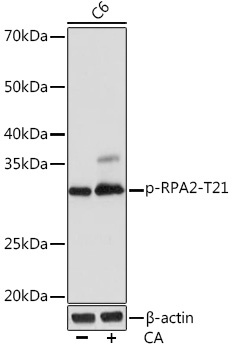 | Western blot analysis of lysates from C6 cells, using Phospho-RPA2-T21 Rabbit mAb (CABP1040) at 1:1000 dilution. C6 cells were treated with Calyculin A (100 nM) at 37℃ for 30 minutes after serum-starvation overnight. Secondary antibody: HRP-conjugated Goat anti-Rabbit IgG (H+L) (CABS014) at 1:10000 dilution. Lysates/proteins: 25μg per lane. Blocking buffer: 3% BSA. Detection: ECL Basic Kit (AbGn00020). Exposure time: 10s. |