Description
Phospho-STAT5A-Y694 Antibody (CABP0138)
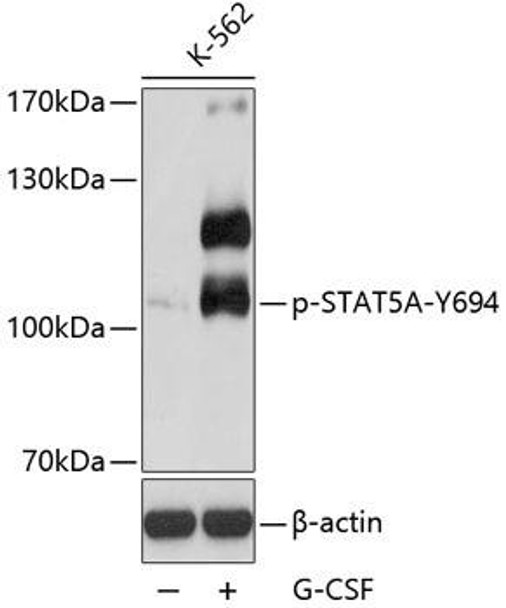
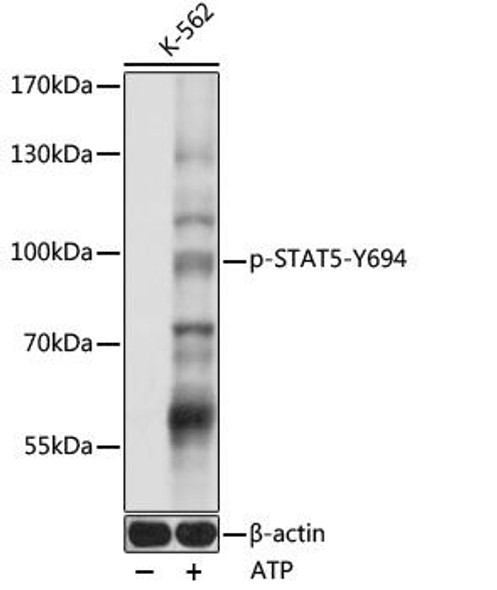
The Phospho-STAT5A-Y694 Antibody (CABP0138) is a high-quality antibody developed for reliable detection and analysis of target proteins. This antibody, produced in rabbits, is highly specific to human samples and has been extensively validated for use in Western blot applications. By recognizing the phosphorylated form of STAT5A, this antibody enables the detection and quantification of activated STAT5A in various cell types, providing crucial insights into signal transduction pathways involved in immune response and cell proliferation.STAT5A is a crucial player in cellular signaling pathways that regulate processes such as cell growth, differentiation, and survival.
This antibody is validated for use in WB, ELISA applications and has demonstrated reactivity against Human samples.
| Product Name: | Phospho-STAT5A-Y694 Antibody |
| SKU: | CABP0138 |
| Size: | 20μL, 100μL |
| Reactivity: | Human |
| Conjugate: | Unconjugated |
| Immunogen: | Synthetic peptide. This information is considered to be commercially sensitive. | ||||
| Sequence: | DGYV K | ||||
| Tested Applications: | WB ELISA | ||||
| Recommended Dilution: |
| ||||
| Synonyms: | MGF, STAT5, Phospho-STAT5A-Y694 |
| Positive Sample: | TF-1 treated with G-CSF |
| Cellular Localization: | Cytoplasm, Nucleus. |
| Calculated MW: | 91kDa |
| Observed MW: | 90kDa |
The protein encoded by this gene is a member of the STAT family of transcription factors. In response to cytokines and growth factors, STAT family members are phosphorylated by the receptor associated kinases, and then form homo- or heterodimers that translocate to the cell nucleus where they act as transcription activators. This protein is activated by, and mediates the responses of many cell ligands, such as IL2, IL3, IL7 GM-CSF, erythropoietin, thrombopoietin, and different growth hormones. Activation of this protein in myeloma and lymphoma associated with a TEL/JAK2 gene fusion is independent of cell stimulus and has been shown to be essential for tumorigenesis. The mouse counterpart of this gene is found to induce the expression of BCL2L1/BCL-X(L), which suggests the antiapoptotic function of this gene in cells. Alternatively spliced transcript variants have been found for this gene.
| Purification Method | Affinity purification |
| Gene ID | 6776 |
| RRID | AB_2771574 |
| Buffer Information | Store at -20℃. Avoid freeze / thaw cycles. Buffer: PBS with 0.09% Sodium azide,50% glycerol,pH7.3. |
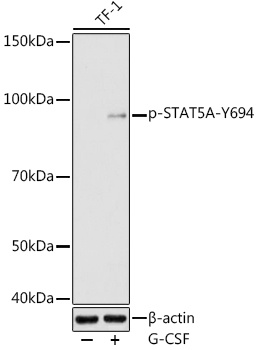 | Western blot analysis of lysates from TF-1 cells, using Phospho-STAT5A-Y694 Rabbit pAb (CABP0138) at 1:1000 dilution. TF-1 cells were treated with G-CSF (25 ng/ml) at 37℃ for 30 minutes after serum-starvation overnight. Secondary antibody: HRP-conjugated Goat anti-Rabbit IgG (H+L) (CABS014) at 1:10000 dilution. Lysates/proteins: 25μg per lane. Blocking buffer: 3% nonfat dry milk in TBST. Detection: ECL Basic Kit (AbGn00020). Exposure time: 180s. |