The tPA/PLAT Monoclonal Antibody (CAB4210) is a high-quality antibody developed for reliable detection and analysis of target proteins. This gene encodes tissue-type plasminogen activator, a secreted serine protease that converts the proenzyme plasminogen to plasmin, a fibrinolytic enzyme. The encoded preproprotein is proteolytically processed by plasmin or trypsin to generate heavy and light chains. These chains associate via disulfide linkages to form the heterodimeric enzyme. This enzyme plays a role in cell migration and tissue remodeling. Increased enzymatic activity causes hyperfibrinolysis, which manifests as excessive bleeding, while decreased activity leads to hypofibrinolysis, which can result in thrombosis or embolism. Alternative splicing of this gene results in multiple transcript variants, at least one of which encodes an isoform that is proteolytically processed.
This antibody is validated for use in WB, IF/ICC, ELISA, IF-P applications and has demonstrated reactivity against Human, Mouse, Rat samples.
Product Name:
tPA/PLAT Monoclonal Antibody
SKU:
CAB4210
Size:
100μL, 20μL
Reactivity:
Human, Mouse, Rat
Clone Number:
ARC0928
Conjugate:
Unconjugated
Immunogen:
Synthetic peptide. This information is considered to be commercially sensitive.
Tested Applications:
WBIF/ICCELISAIF-P
Recommended Dilution:
WB
1:1000 - 1:6000
IF/ICC
1:100 - 1:400
IF-P
1:100 - 1:400
ELISA
Recommended starting concentration is 1 μg/mL. Please optimize the concentration based on your specific assay requirements.
Synonyms:
TPA, T-PA, tPA/PLAT
Positive Sample:
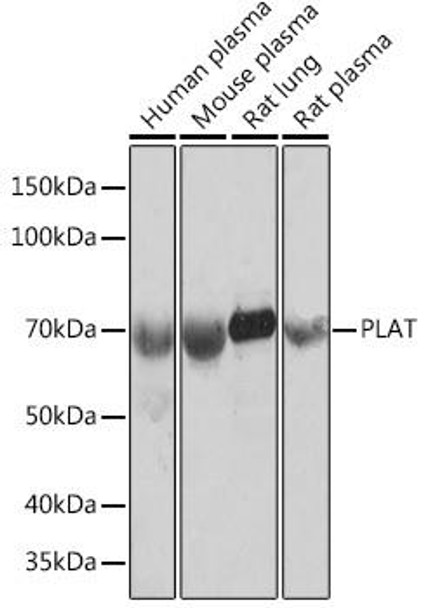
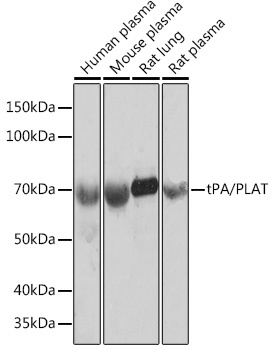
Human plasma, Mouse plasma, Rat lung, Rat plasma
Cellular Localization:
Secreted, Extracellular Space.
Calculated MW:
63kDa
Observed MW:
70kDa
This gene encodes tissue-type plasminogen activator, a secreted serine protease that converts the proenzyme plasminogen to plasmin, a fibrinolytic enzyme. The encoded preproprotein is proteolytically processed by plasmin or trypsin to generate heavy and light chains. These chains associate via disulfide linkages to form the heterodimeric enzyme. This enzyme plays a role in cell migration and tissue remodeling. Increased enzymatic activity causes hyperfibrinolysis, which manifests as excessive bleeding, while decreased activity leads to hypofibrinolysis, which can result in thrombosis or embolism. Alternative splicing of this gene results in multiple transcript variants, at least one of which encodes an isoform that is proteolytically processed.
Purification Method
Affinity purification
Gene ID
5327
RRID
AB_2863209
Buffer Information
Store at -20℃. Avoid freeze / thaw cycles. Buffer: PBS containing 50% glycerol and 0.05% BSA, preserved with proclin300 or sodium azide, pH 7.3.
Western blot analysis of various lysates using tPA/tPA/PLAT Rabbit mAb (CAB4210) at 1:1000 dilution. Secondary antibody: HRP-conjugated Goat anti-Rabbit IgG (H+L) (AS014) at 1:10000 dilution. Lysates/proteins: 25μg per lane. Blocking buffer: 3% nonfat dry milk in TBST. Detection: ECL Basic Kit (AbGn00020). Exposure time: 10s.
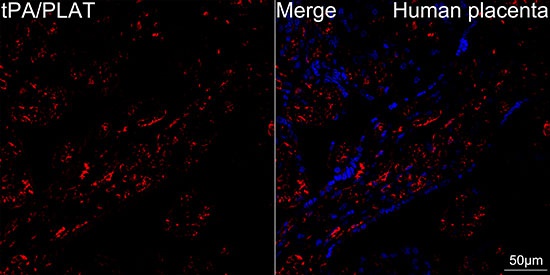
Confocal imaging of human placenta using tPA/PLAT Rabbit mAb (CAB4210,at dilution of 1:100) (Red). DAPI was used for nuclear staining (blue). Objective: 40x. Perform high pressure antigen retrieval with 10 mM citrate buffer pH 6.0 before commencing with IF staining protocol.