Description
PLG Antibody (CAB3320)
The PLG Antibody (CAB3320) is a high-quality antibody developed for reliable detection and analysis of target proteins. This antibody, generated in rabbits, is highly specific for human samples and is suitable for use in Western blot applications.Plasminogen is a precursor to the enzyme plasmin, which plays a crucial role in breaking down blood clots and promoting tissue remodeling. Dysregulation of the plasminogen system has been implicated in various diseases, including thrombotic disorders and certain cancers. By targeting plasminogen with this antibody, researchers can gain insights into its expression levels and activity in different cell types, aiding in the investigation of its role in disease pathology.
This antibody is validated for use in WB, ELISA applications and has demonstrated reactivity against Human, Mouse, Rat samples.
| Product Name: | PLG Antibody |
| SKU: | CAB3320 |
| Size: | 20μL, 100μL |
| Reactivity: | Human, Mouse, Rat |
| Conjugate: | Unconjugated |
| Immunogen: | Recombinant protein (or fragment).This information is considered to be commercially sensitive. | ||||
| Sequence: | EPLD DYVN TQGA SLFS VTKK QLGA GSIE ECAA KCEE DEEF TCRA FQYH SKEQ QCVI MAEN RKSS IIIR MRDV VLFE KKVY LSEC KTGN GKNY RGTM SKTK NGIT CQKW SSTS PHRP RFSP ATHP SEGL EENY CRNP DNDP QGPW CYTT DPEK RYDY CDIL ECEE ECMH CSGE NYDG KISK TMSG LECQ AWDS QSPH AHGY IPSK FPNK NLKK NYCR NPDR ELRP WCFT TDPN KRWE LCDI PRCT TPPP SSGP TYQC LKGT GENY RGNV AVTV SGHT CQHW S | ||||
| Tested Applications: | WB ELISA | ||||
| Recommended Dilution: |
| ||||
| Synonyms: | HAE4, PLG |
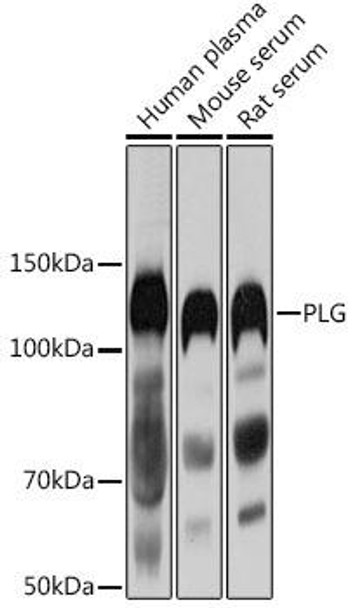
| Positive Sample: | Human plasma, Mouse serum, Rat serum |
| Cellular Localization: | Secreted. |
| Calculated MW: | 91kDa |
| Observed MW: | 125kDa |
The plasminogen protein encoded by this gene is a serine protease that circulates in blood plasma as an inactive zymogen and is converted to the active protease, plasmin, by several plasminogen activators such as tissue plasminogen activator (tPA), urokinase plasminogen activator (uPA), kallikrein, and factor XII (Hageman factor). The conversion of plasminogen to plasmin involves the cleavage of the peptide bond between Arg-561 and Val-562. Plasmin cleavage also releases the angiostatin protein which inhibits angiogenesis. Plasmin degrades many blood plasma proteins, including fibrin-containing blood clots. As a serine protease, plasmin cleaves many products in addition to fibrin such as fibronectin, thrombospondin, laminin, and von Willebrand factor. Plasmin is inactivated by proteins such as alpha-2-macroglobulin and alpha-2-antiplasmin in addition to inhibitors of the various plasminogen activators. Plasminogen also interacts with plasminogen receptors which results in the retention of plasmin on cell surfaces and in plasmin-induced cell signaling. The localization of plasminogen on cell surfaces plays a role in the degradation of extracellular matrices, cell migration, inflamation, wound healing, oncogenesis, metastasis, myogenesis, muscle regeneration, neurite outgrowth, and fibrinolysis. This protein may also play a role in acute respiratory distress syndrome (ARDS) which, in part, is caused by enhanced clot formation and the suppression of fibrinolysis. Compared to other mammals, the cluster of plasminogen-like genes to which this gene belongs has been rearranged in catarrhine primates.
| Purification Method | Affinity purification |
| Gene ID | 5340 |
| RRID | AB_2765048 |
| Buffer Information | Store at -20℃. Avoid freeze / thaw cycles. Buffer: PBS containing 50% glycerol, preserved with proclin300 or sodium azide, pH 7.3. |
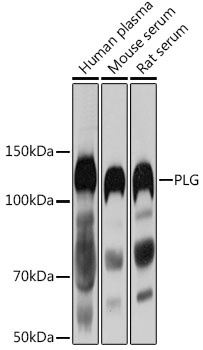 | Western blot analysis of various lysates using PLG Rabbit pAb (CAB3320) at 1:1000 dilution. Secondary antibody: HRP-conjugated Goat anti-Rabbit IgG (H+L) (CABS014) at 1:10000 dilution. Lysates/proteins: 25μg per lane. Blocking buffer: 3% nonfat dry milk in TBST. Detection: ECL Basic Kit (AbGn00020). Exposure time: 1s. |