Description
PTPRF Antibody (CAB5444)
The PTPRF Antibody (CAB5444) is a high-quality antibody developed for reliable detection and analysis of target proteins. This antibody, produced in rabbits, is highly specific for human samples and has been validated for use in Western blot applications. By binding to the PTPRF protein, this antibody enables precise detection and analysis in a variety of cell types, making it ideal for investigations in the fields of cell biology and signal transduction.
This antibody is validated for use in WB, ELISA applications and has demonstrated reactivity against Human, Mouse samples.
| Product Name: | PTPRF Antibody |
| SKU: | CAB5444 |
| Size: | 20μL, 100μL |
| Reactivity: | Human, Mouse |
| Conjugate: | Unconjugated |
| Immunogen: | Recombinant protein (or fragment).This information is considered to be commercially sensitive. | ||||
| Sequence: | KNFR VAAA MKTS VLLS WEVP DSYK SAVP FKIL YNGQ SVEV DGHS MRKL IADL QPNT EYSF VLMN RGSS AGGL QHLV SIRT APDL LPHK PLPA SAYI EDGR FDLS MPHV QDPS LVRW FYIV VVPI DRVG GSML TPRW STPE ELEL DELL EAIE QGGE EQRR RRRQ AERL KPYV AAQL DVLP ETFT LGDK KNYR GFYN RPLS PDLS YQCF VLAS LKEP MDQK RYAS SPYS DEIV VQV | ||||
| Tested Applications: | WB ELISA | ||||
| Recommended Dilution: |
| ||||
| Synonyms: | LAR, BNAH2, PTPRF |
| Positive Sample: | bewo |
| Cellular Localization: | Membrane, Single-Pass Type I Membrane Protein. |
| Calculated MW: | 213kDa |
| Observed MW: | 150kDa |
The protein encoded by this gene is a member of the protein tyrosine phosphatase (PTP) family. PTPs are known to be signaling molecules that regulate a variety of cellular processes including cell growth, differentiation, mitotic cycle, and oncogenic transformation. This PTP possesses an extracellular region, a single transmembrane region, and two tandem intracytoplasmic catalytic domains, and thus represents a receptor-type PTP. The extracellular region contains three Ig-like domains, and nine non-Ig like domains similar to that of neural-cell adhesion molecule. This PTP was shown to function in the regulation of epithelial cell-cell contacts at adherents junctions, as well as in the control of beta-catenin signaling. An increased expression level of this protein was found in the insulin-responsive tissue of obese, insulin-resistant individuals, and may contribute to the pathogenesis of insulin resistance. Two alternatively spliced transcript variants of this gene, which encode distinct proteins, have been reported.
| Purification Method | Affinity purification |
| Gene ID | 5792 |
| RRID | AB_2766246 |
| Buffer Information | Store at -20℃. Avoid freeze / thaw cycles. Buffer: PBS containing 50% glycerol, preserved with proclin300 or sodium azide, pH 7.3. |
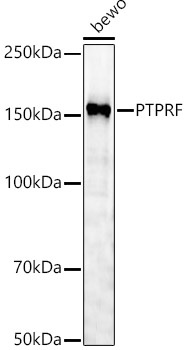 | Western blot analysis of lysates from bewo cells, using PTPRF Rabbit pAb (CAB5444) at 1:2000 dilution. Secondary antibody: HRP-conjugated Goat anti-Rabbit IgG (H+L) (CABS014) at 1:10000 dilution. Lysates/proteins: 25μg per lane. Blocking buffer: 3% nonfat dry milk in TBST. Detection: ECL Enhanced Kit (AbGn00021). Exposure time: 90s. |