The Ran Monoclonal Antibody (CAB4374) is a high-quality antibody developed for reliable detection and analysis of target proteins. This antibody, developed using advanced monoclonal antibody technology in rabbits, displays high specificity and sensitivity for RAN in human samples, making it an excellent choice for a wide range of applications in molecular biology and cell biology research.RAN is a small GTPase involved in the transport of proteins and RNA through the nuclear pore complex, as well as in the regulation of mitotic spindle assembly during cell division. Dysregulation of RAN has been implicated in various diseases, including cancer and neurodegenerative disorders, underscoring the importance of studying this critical protein.
This antibody is validated for use in WB, ELISA applications and has demonstrated reactivity against Human, Mouse, Rat samples.
Product Name:
Ran Monoclonal Antibody
SKU:
CAB4374
Size:
20μL, 100μL
Reactivity:
Human, Mouse, Rat
Clone Number:
ARC0986
Conjugate:
Unconjugated
Immunogen:
Synthetic peptide. This information is considered to be commercially sensitive.
Recommended starting concentration is 1 μg/mL. Please optimize the concentration based on your specific assay requirements.
Synonyms:
TC4, Gsp1, ARA24, Ran
Positive Sample:
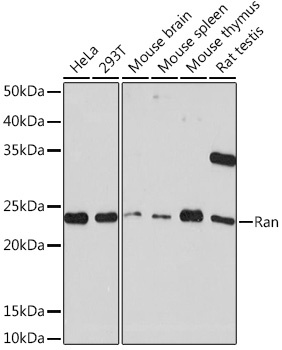
HeLa, 293T, Mouse brain, Mouse spleen, Mouse thymus, Rat testis
Cellular Localization:
Cytoplasm, Melanosome, Nucleus, Nucleus Envelope.
Calculated MW:
24kDa
Observed MW:
24kDa
RAN (ras-related nuclear protein) is a small GTP binding protein belonging to the RAS superfamily that is essential for the translocation of RNA and proteins through the nuclear pore complex. The RAN protein is also involved in control of DNA synthesis and cell cycle progression. Nuclear localization of RAN requires the presence of regulator of chromosome condensation 1 (RCC1). Mutations in RAN disrupt DNA synthesis. Because of its many functions, it is likely that RAN interacts with several other proteins. RAN regulates formation and organization of the microtubule network independently of its role in the nucleus-cytosol exchange of macromolecules. RAN could be a key signaling molecule regulating microtubule polymerization during mitosis. RCC1 generates a high local concentration of RAN-GTP around chromatin which, in turn, induces the local nucleation of microtubules. RAN is an androgen receptor (AR) coactivator that binds differentially with different lengths of polyglutamine within the androgen receptor. Polyglutamine repeat expansion in the AR is linked to Kennedy's disease (X-linked spinal and bulbar muscular atrophy). RAN coactivation of the AR diminishes with polyglutamine expansion within the AR, and this weak coactivation may lead to partial androgen insensitivity during the development of Kennedy's disease.
Purification Method
Affinity purification
Gene ID
5901
RRID
AB_2863253
Buffer Information
Store at -20℃. Avoid freeze / thaw cycles. Buffer: PBS containing 50% glycerol and 0.05% BSA, preserved with proclin300 or sodium azide, pH 7.3.
Western blot analysis of various lysates using Ran Rabbit mAb (CAB4374) at 1:1000 dilution. Secondary antibody: HRP-conjugated Goat anti-Rabbit IgG (H+L) (CABS014) at 1:10000 dilution. Lysates/proteins: 25μg per lane. Blocking buffer: 3% nonfat dry milk in TBST. Detection: ECL Basic Kit (AbGn00020). Exposure time: 10s.