Tamm Horsfall Glycoprotein Polyclonal Antibody (CAB22544)
The Tamm Horsfall Glycoprotein Polyclonal Antibody (CAB22544) is a high-quality antibody developed for reliable detection and analysis of target proteins. This antibody, generated in rabbits, exhibits high sensitivity and specificity when detecting THP in human samples, making it an essential tool for researchers investigating kidney diseases, urinary tract infections, and related conditions.The Tamm-Horsfall Glycoprotein Polyclonal Antibody is validated for use in Western blot applications, enabling researchers to accurately detect and quantify THP levels in various biological samples. By targeting the THP protein, this antibody allows for detailed analysis of its expression, localization, and function in different cell types and tissues, providing valuable insights into the mechanisms underlying kidney function and urinary tract physiology.
This antibody is validated for use in WB, ELISA, IF-P applications and has demonstrated reactivity against Human, Mouse, Rat samples.
Product Name:
Tamm Horsfall Glycoprotein Polyclonal Antibody
SKU:
CAB22544
Size:
20μL, 100μL
Reactivity:
Human, Mouse, Rat
Conjugate:
Unconjugated
Immunogen:
Recombinant protein (or fragment).This information is considered to be commercially sensitive.
The protein encoded by this gene is the most abundant protein in mammalian urine under physiological conditions. Its excretion in urine follows proteolytic cleavage of the ectodomain of its glycosyl phosphatidylinosital-anchored counterpart that is situated on the luminal cell surface of the loop of Henle. This protein may act as a constitutive inhibitor of calcium crystallization in renal fluids. Excretion of this protein in urine may provide defense against urinary tract infections caused by uropathogenic bacteria. Defects in this gene are associated with the renal disorders medullary cystic kidney disease-2 (MCKD2), glomerulocystic kidney disease with hyperuricemia and isosthenuria (GCKDHI), and familial juvenile hyperuricemic nephropathy (FJHN). Alternative splicing of this gene results in multiple transcript variants.
Purification Method
Affinity purification
Gene ID
7369
Buffer Information
Store at -20℃. Avoid freeze / thaw cycles. Buffer: PBS containing 50% glycerol, preserved with proclin300 or sodium azide, pH 7.3.
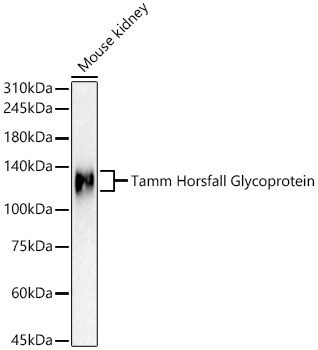
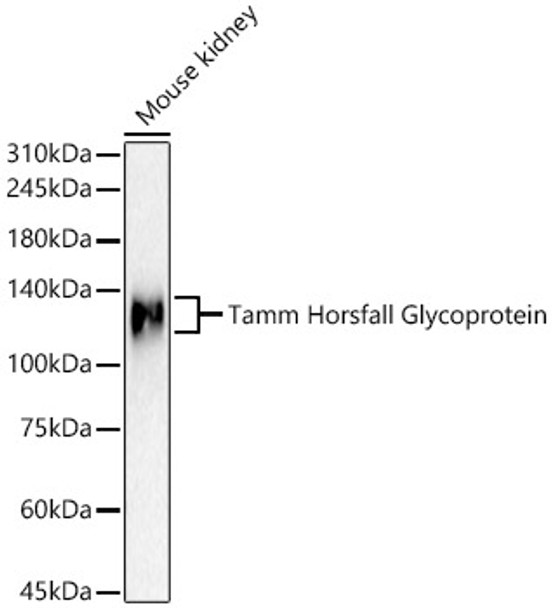
Western blot analysis of lysates from Mouse kidney, using Tamm Horsfall Glycoprotein Rabbit pAb (CAB22544) at 1:400 dilution. Secondary antibody: HRP-conjugated Goat anti-Rabbit IgG (H+L) (CABS014) at 1:10000 dilution. Lysates/proteins: 25μg per lane. Blocking buffer: 3% nonfat dry milk in TBST. Detection: ECL Basic Kit (AbGn00020). Exposure time: 60s.
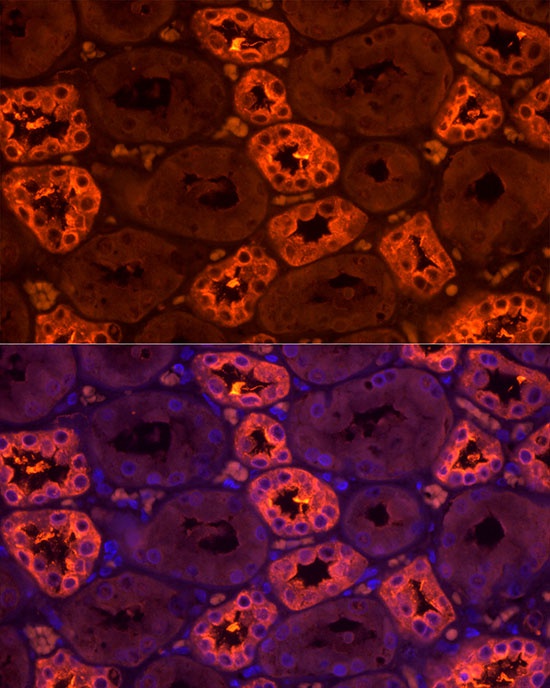
Immunofluorescence analysis of paraffin-embedded Human kidney using Tamm Horsfall Glycoprotein Rabbit pAb (CAB22544) at dilution of 1:20 (40x lens). Secondary antibody: Cy3-conjugated Goat anti-Rabbit IgG (H+L) (CABS007) at 1:500 dilution. Blue: DAPI for nuclear staining.
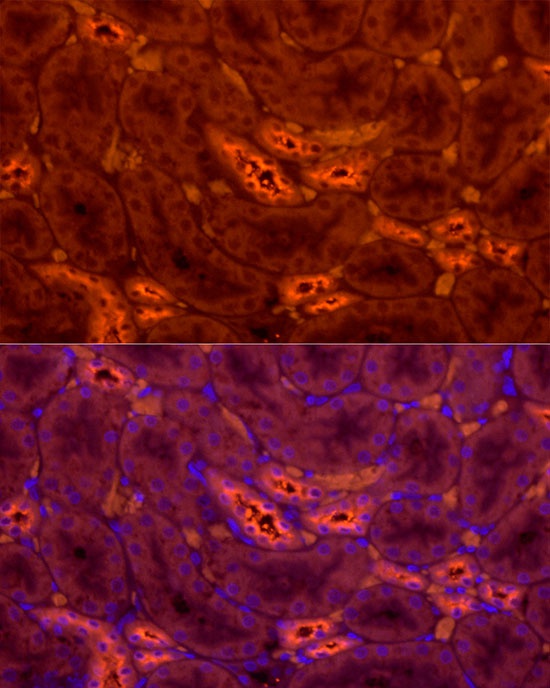
Immunofluorescence analysis of paraffin-embedded Rat Kidney using Tamm Horsfall Glycoprotein Rabbit pAb (CAB22544) at dilution of 1:20 (40x lens). Secondary antibody: Cy3-conjugated Goat anti-Rabbit IgG (H+L) (CABS007) at 1:500 dilution. Blue: DAPI for nuclear staining.