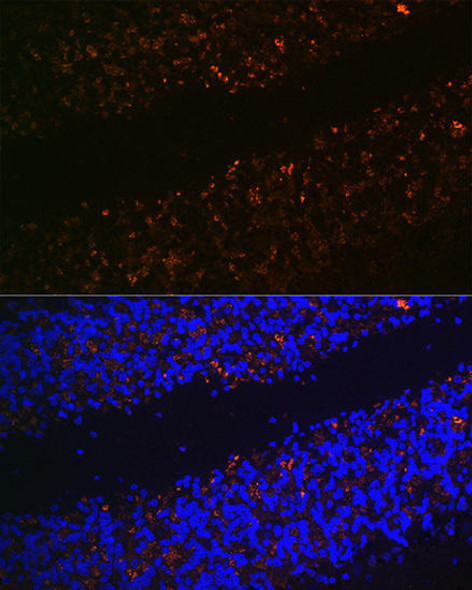
The VNN1 Antibody (CAB3347) is a high-quality antibody developed for reliable detection and analysis of target proteins. This gene encodes a member of the vanin family of proteins, which share extensive sequence similarity with each other, and also with biotinidase. The family includes secreted and membrane-associated proteins, a few of which have been reported to participate in hematopoietic cell trafficking. No biotinidase activity has been demonstrated for any of the vanin proteins, however, they possess pantetheinase activity, which may play a role in oxidative-stress response. This protein, like its mouse homolog, is likely a GPI-anchored cell surface molecule. The mouse protein is expressed by the perivascular thymic stromal cells and regulates migration of T-cell progenitors to the thymus. This gene lies in close proximity to, and in the same transcriptional orientation as, two other vanin genes on chromosome 6q23-q24.
This antibody is validated for use in WB, ELISA applications and has demonstrated reactivity against Human, Mouse samples.
Product Name:
VNN1 Antibody
SKU:
CAB3347
Size:
100μL, 20μL
Reactivity:
Human, Mouse
Conjugate:
Unconjugated
Immunogen:
Recombinant protein (or fragment).This information is considered to be commercially sensitive.
Tested Applications:
WBELISA
Recommended Dilution:
WB
1:500 - 1:2000
ELISA
Recommended starting concentration is 1 μg/mL. Please optimize the concentration based on your specific assay requirements.
Synonyms:
HDLCQ8, Tiff66, VNN1
Positive Sample:
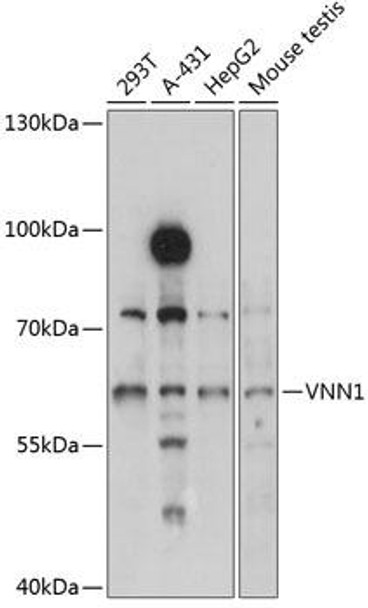
293T, A-431, HepG2, Mouse testis
Cellular Localization:
Cell Membrane, Gpi-Anchor, Lipid-Anchor.
Calculated MW:
57kDa
Observed MW:
60kDa
This gene encodes a member of the vanin family of proteins, which share extensive sequence similarity with each other, and also with biotinidase. The family includes secreted and membrane-associated proteins, a few of which have been reported to participate in hematopoietic cell trafficking. No biotinidase activity has been demonstrated for any of the vanin proteins, however, they possess pantetheinase activity, which may play a role in oxidative-stress response. This protein, like its mouse homolog, is likely a GPI-anchored cell surface molecule. The mouse protein is expressed by the perivascular thymic stromal cells and regulates migration of T-cell progenitors to the thymus. This gene lies in close proximity to, and in the same transcriptional orientation as, two other vanin genes on chromosome 6q23-q24.
Purification Method
Affinity purification
Gene ID
8876
RRID
AB_2765065
Buffer Information
Store at -20℃. Avoid freeze / thaw cycles. Buffer: PBS with 0.01% thimerosal,50% glycerol,pH7.3.
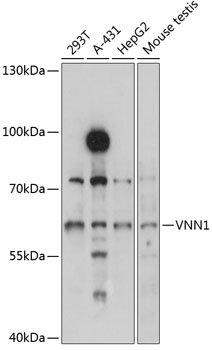
Western blot analysis of various lysates using VNN1 Rabbit pAb (CAB3347) at 1:3000 dilution. Secondary antibody: HRP-conjugated Goat anti-Rabbit IgG (H+L) (AS014) at 1:10000 dilution. Lysates/proteins: 25μg per lane. Blocking buffer: 3% nonfat dry milk in TBST. Detection: ECL Basic Kit (AbGn00020). Exposure time: 5s.