The 14-3-3 epsilon Antibody (CAB1058) is a high-quality antibody developed for reliable detection and analysis of target proteins. This gene product belongs to the 14-3-3 family of proteins which mediate signal transduction by binding to phosphoserine-containing proteins. This highly conserved protein family is found in both plants and mammals, and this protein is 100% identical to the mouse ortholog. It interacts with CDC25 phosphatases, RAF1 and IRS1 proteins, suggesting its role in diverse biochemical activities related to signal transduction, such as cell division and regulation of insulin sensitivity. It has also been implicated in the pathogenesis of small cell lung cancer. Two transcript variants, one protein-coding and the other non-protein-coding, have been found for this gene.
This antibody is validated for use in WB, IF/ICC, ELISA applications and has demonstrated reactivity against Human, Mouse, Rat samples.
Product Name:
14-3-3 epsilon Antibody
SKU:
CAB1058
Size:
100μL, 20μL
Reactivity:
Human, Mouse, Rat
Conjugate:
Unconjugated
Immunogen:
Recombinant protein (or fragment).This information is considered to be commercially sensitive.
Tested Applications:
WBIF/ICCELISA
Recommended Dilution:
WB
1:500 - 1:2000
IF/ICC
1:50 - 1:200
ELISA
Recommended starting concentration is 1 μg/mL. Please optimize the concentration based on your specific assay requirements.
Synonyms:
MDS, HEL2, MDCR, KCIP-1, 14-3-3E, 14-3-3 epsilon
Positive Sample:
HeLa, 293T, U-251MG, Mouse brain, Mouse kidney, Mouse lung, Rat brain, Rat kidney, Rat lung
Cellular Localization:
Cytoplasm, Melanosome.
Calculated MW:
29kDa
Observed MW:
29-32Kda
This gene product belongs to the 14-3-3 family of proteins which mediate signal transduction by binding to phosphoserine-containing proteins. This highly conserved protein family is found in both plants and mammals, and this protein is 100% identical to the mouse ortholog. It interacts with CDC25 phosphatases, RAF1 and IRS1 proteins, suggesting its role in diverse biochemical activities related to signal transduction, such as cell division and regulation of insulin sensitivity. It has also been implicated in the pathogenesis of small cell lung cancer. Two transcript variants, one protein-coding and the other non-protein-coding, have been found for this gene.
Purification Method
Affinity purification
Gene ID
7531
RRID
AB_2758120
Buffer Information
Store at -20℃. Avoid freeze / thaw cycles. Buffer: PBS with 0.09% Sodium azide,50% glycerol,pH7.3.
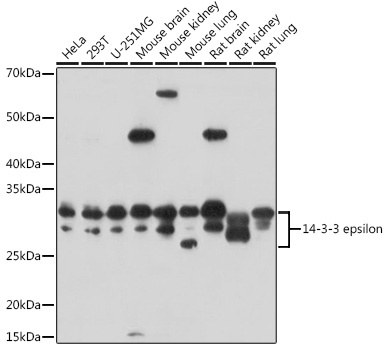
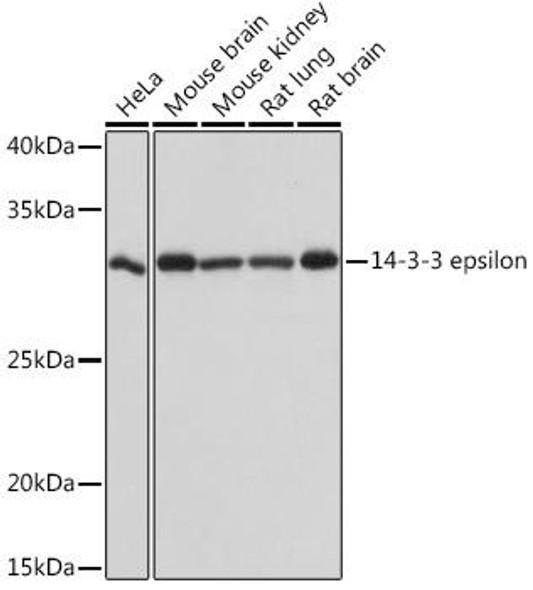
Western blot analysis of various lysates using 14-3-3 epsilon Rabbit pAb (CAB1058) at 1:3000 dilution. Secondary antibody: HRP-conjugated Goat anti-Rabbit IgG (H+L) (AS014) at 1:10000 dilution. Lysates/proteins: 25μg per lane. Blocking buffer: 3% nonfat dry milk in TBST. Detection: ECL Basic Kit (AbGn00020). Exposure time: 30s.
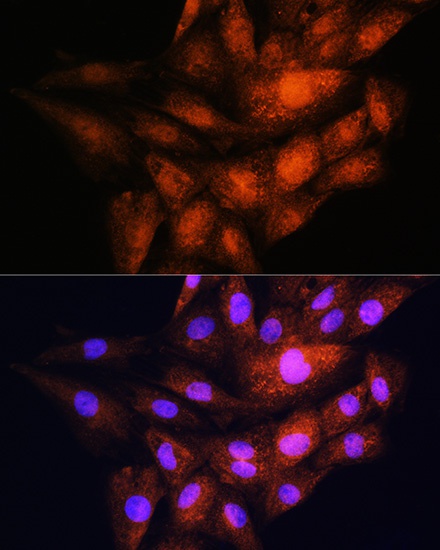
Immunofluorescence analysis of H9C2 cells using 14-3-3 epsilon Rabbit pAb (CAB1058) at dilution of 1:100. Blue: DAPI for nuclear staining.
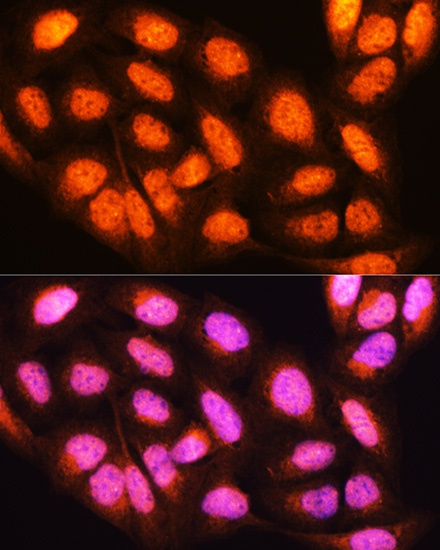
Immunofluorescence analysis of U2OS cells using 14-3-3 epsilon Rabbit pAb (CAB1058) at dilution of 1:100. Blue: DAPI for nuclear staining.