The Human IgA Monoclonal Antibody (CAB19704) is a high-quality antibody developed for reliable detection and analysis of target proteins. This antibody, produced in rabbits, has high reactivity with human samples and is validated for use in various applications, including Western blotting. By binding specifically to the IgA antibody, this antibody allows for accurate detection and analysis in a variety of cell types, making it a valuable resource for studies in immunology, infectious diseases, and autoimmune disorders.IgA is the most abundant antibody in mucosal secretions and plays a crucial role in defending against pathogens at mucosal surfaces.
This antibody is validated for use in WB, ELISA applications and has demonstrated reactivity against Human samples.
Product Name:
Human IgA Monoclonal Antibody
SKU:
CAB19704
Size:
20μL, 100μL
Reactivity:
Human
Clone Number:
ARC2239
Conjugate:
Unconjugated
Immunogen:
Recombinant protein (or fragment).This information is considered to be commercially sensitive.
Recommended starting concentration is 1 μg/mL. Please optimize the concentration based on your specific assay requirements.
Synonyms:
IgA1, Human IgA
Positive Sample:
Human plasma
Cellular Localization:
Blood Microparticle, External Side Of Plasma Membrane, Extracellular Exosome, Extracellular Region, Extracellular Space, Immunoglobulin Complex, Circulating.
Calculated MW:
60kDa
Observed MW:
55kDa
Constant region of immunoglobulin heavy chains. Immunoglobulins, also known as antibodies, are membrane-bound or secreted glycoproteins produced by B lymphocytes. In the recognition phase of humoral immunity, the membrane-bound immunoglobulins serve as receptors which, upon binding of a specific antigen, trigger the clonal expansion and differentiation of B lymphocytes into immunoglobulins-secreting plasma cells. Secreted immunoglobulins mediate the effector phase of humoral immunity, which results in the elimination of bound antigens. The antigen binding site is formed by the variable domain of one heavy chain, together with that of its associated light chain. Thus, each immunoglobulin has two antigen binding sites with remarkable affinity for a particular antigen. The variable domains are assembled by a process called V-(D)-J rearrangement and can then be subjected to somatic hypermutations which, after exposure to antigen and selection, allow affinity maturation for a particular antigen. Ig alpha is the major immunoglobulin class in body secretions.
Purification Method
Affinity purification
Gene ID
3493 3494
Buffer Information
Store at -20℃. Avoid freeze / thaw cycles. Buffer: PBS containing 50% glycerol and 0.05% BSA, preserved with proclin300 or sodium azide, pH 7.3.
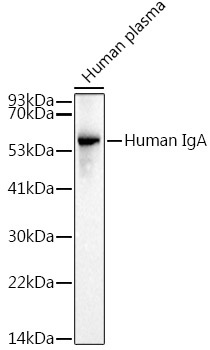
Western blot analysis of lysates from Human plasma, using Human IgA Rabbit mAb (CAB19704) at 1:1000 dilution. Secondary antibody: HRP-conjugated Goat anti-Rabbit IgG (H+L) (CABS014) at 1:10000 dilution. Lysates/proteins: 25μg per lane. Blocking buffer: 3% nonfat dry milk in TBST. Detection: ECL Basic Kit (AbGn00020). Exposure time: 1s.