The MEK3/MEK6 Monoclonal Antibody (CAB19830) is a high-quality antibody developed for reliable detection and analysis of target proteins. This antibody, raised in rabbits, is highly specific for human samples and has been validated for use in Western blot applications. By targeting MEK3 and MEK6, this antibody allows for the detection and analysis of these important proteins in a variety of cell types.MEK3 and MEK6 are crucial mediators of cell growth, differentiation, and survival, making them important targets for research in cancer and other diseases.
This antibody is validated for use in WB, ELISA applications and has demonstrated reactivity against Human, Mouse, Rat samples.
Product Name:
MEK3/MEK6 Monoclonal Antibody
SKU:
CAB19830
Size:
20μL, 100μL
Reactivity:
Human, Mouse, Rat
Clone Number:
ARC2356
Conjugate:
Unconjugated
Immunogen:
Synthetic peptide. This information is considered to be commercially sensitive.
HeLa, HT-1080, NIH/3T3, RD, Mouse skeletal muscle, Mouse heart, Rat skeletal muscle, Rat heart
Cellular Localization:
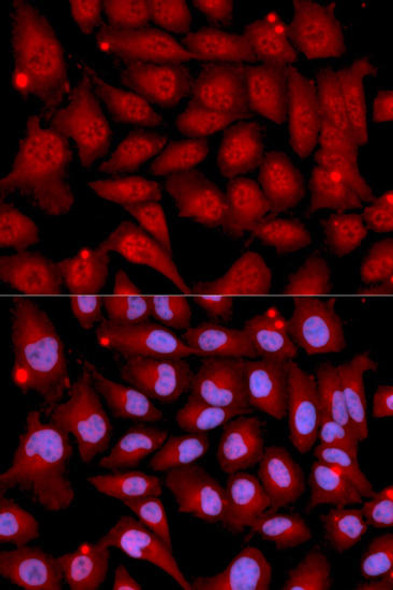
Cytosol, Nucleoplasm.
Calculated MW:
39,37kDa
Observed MW:
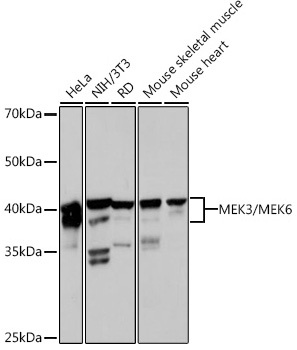
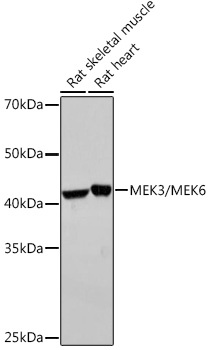
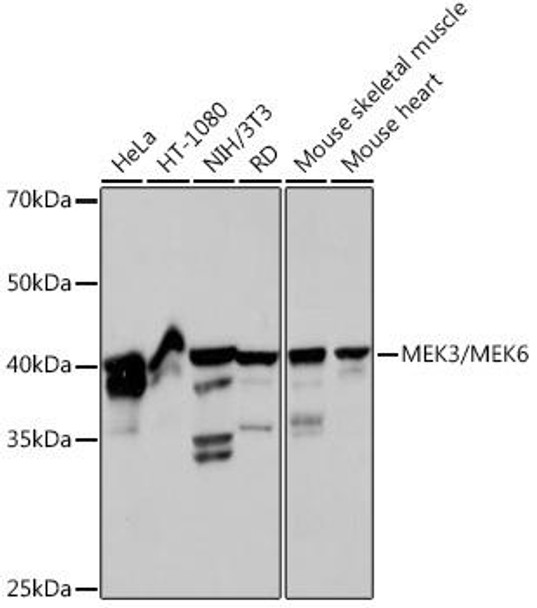
34-40kDa
The protein encoded by this gene is a dual specificity protein kinase that belongs to the MAP kinase kinase family. This kinase is activated by mitogenic and environmental stress, and participates in the MAP kinase-mediated signaling cascade. It phosphorylates and thus activates MAPK14/p38-MAPK. This kinase can be activated by insulin, and is necessary for the expression of glucose transporter. Expression of RAS oncogene is found to result in the accumulation of the active form of this kinase, which thus leads to the constitutive activation of MAPK14, and confers oncogenic transformation of primary cells. The inhibition of this kinase is involved in the pathogenesis of Yersina pseudotuberculosis. Multiple alternatively spliced transcript variants that encode distinct isoforms have been reported for this gene. [provided by RefSeq, Jul 2008]
Purification Method
Affinity purification
Gene ID
5606 5608
RRID
AB_2895227
Buffer Information
Store at -20℃. Avoid freeze / thaw cycles. Buffer: PBS containing 50% glycerol and 0.05% BSA, preserved with proclin300 or sodium azide, pH 7.3.
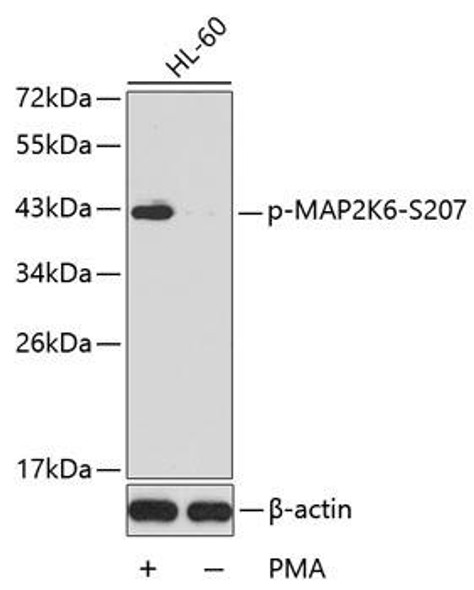
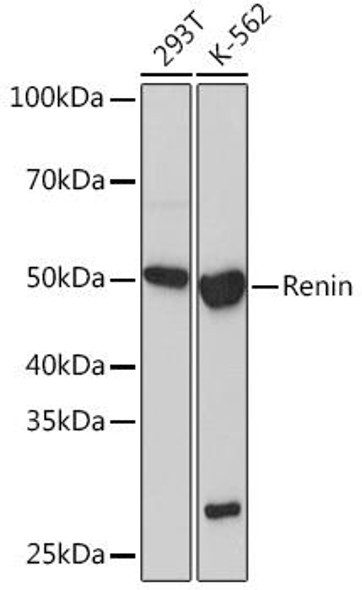
Western blot analysis of various lysates using MEK3/MEK6 Rabbit mAb (CAB19830) at 1:1000 dilution. Secondary antibody: HRP-conjugated Goat anti-Rabbit IgG (H+L) (CABS014) at 1:10000 dilution. Lysates/proteins: 25μg per lane. Blocking buffer: 3% nonfat dry milk in TBST. Detection: ECL Basic Kit (AbGn00020). Exposure time: 10s.
Western blot analysis of various lysates using MEK3/MEK6 Rabbit mAb (CAB19830) at 1:1000 dilution. Secondary antibody: HRP-conjugated Goat anti-Rabbit IgG (H+L) (CABS014) at 1:10000 dilution. Lysates/proteins: 25μg per lane. Blocking buffer: 3% nonfat dry milk in TBST. Detection: ECL Basic Kit (AbGn00020). Exposure time: 30s.