The ApoB Antibody (CAB1330) is a high-quality antibody developed for reliable detection and analysis of target proteins. This antibody, produced in rabbits, is highly specific to human samples and is optimized for use in Western blot applications.APOB is a key component of lipoproteins, serving as the structural protein for chylomicrons, VLDL, IDL, and LDL particles. Dysregulation of APOB levels can lead to conditions such as hypercholesterolemia and atherosclerosis, making it an important target for therapeutic intervention.
This antibody is validated for use in WB, IF/ICC, ELISA applications and has demonstrated reactivity against Human, Mouse, Rat samples.
Product Name:
ApoB Antibody
SKU:
CAB1330
Size:
20μL, 100μL
Reactivity:
Human, Mouse, Rat
Conjugate:
Unconjugated
Immunogen:
Recombinant protein (or fragment).This information is considered to be commercially sensitive.
Recommended starting concentration is 1 μg/mL. Please optimize the concentration based on your specific assay requirements.
Synonyms:
FLDB, FCHL2, LDLCQ4, apoB-48, apoB-100, ApoB
Positive Sample:
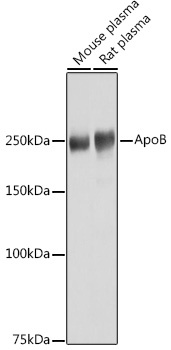
Mouse plasma, Rat plasma,
Cellular Localization:
Cytoplasm, Secreted.
Calculated MW:
516kDa
Observed MW:
250kDa
This gene product is the main apolipoprotein of chylomicrons and low density lipoproteins (LDL), and is the ligand for the LDL receptor. It occurs in plasma as two main isoforms, apoB-48 and apoB-100: the former is synthesized exclusively in the gut and the latter in the liver. The intestinal and the hepatic forms of apoB are encoded by a single gene from a single, very long mRNA. The two isoforms share a common N-terminal sequence. The shorter apoB-48 protein is produced after RNA editing of the apoB-100 transcript at residue 2180 (CAA->UAA), resulting in the creation of a stop codon, and early translation termination. Mutations in this gene or its regulatory region cause hypobetalipoproteinemia, normotriglyceridemic hypobetalipoproteinemia, and hypercholesterolemia due to ligand-defective apoB, diseases affecting plasma cholesterol and apoB levels.
Purification Method
Affinity purification
Gene ID
338
RRID
AB_2760159
Buffer Information
Store at -20℃. Avoid freeze / thaw cycles. Buffer: PBS containing 50% glycerol, preserved with proclin300 or sodium azide, pH 7.3.
Western blot analysis of various lysates using ApoB Rabbit pAb (CAB1330) at 1:1000 dilution. Secondary antibody: HRP-conjugated Goat anti-Rabbit IgG (H+L) (CABS014) at 1:10000 dilution. Lysates / proteins: 25 μg per lane. Blocking buffer: 3 % nonfat dry milk in TBST. Detection: ECL Basic Kit (AbGn00020). Exposure time: 1s.
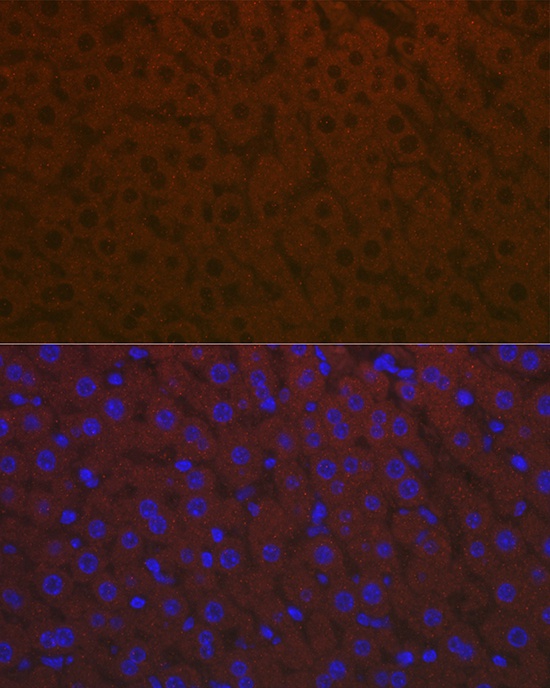
Immunofluorescence analysis of mouse liver cells using ApoB Rabbit pAb (CAB1330) at dilution of 1:100 (40x lens). Secondary antibody: Cy3-conjugated Goat anti-Rabbit IgG (H+L) (CABS007) at 1:500 dilution. Blue: DAPI for nuclear staining.