The CD40 Monoclonal Antibody (CAB22714) is a high-quality antibody developed for reliable detection and analysis of target proteins. This antibody, produced through monoclonal technology, exhibits high specificity and sensitivity for human samples, making it an ideal choice for a variety of research applications, including Western blotting and immunohistochemistry.CD40 is a key player in the regulation of immune responses, acting as a co-stimulatory molecule that enhances the activation of immune cells such as B cells, dendritic cells, and macrophages.
This antibody is validated for use in WB, ELISA applications and has demonstrated reactivity against Human samples.
Product Name:
CD40 Monoclonal Antibody
SKU:
CAB22714
Size:
20μL, 100μL
Reactivity:
Human
Clone Number:
ARC57627
Conjugate:
Unconjugated
Immunogen:
Recombinant protein (or fragment).This information is considered to be commercially sensitive.
Tested Applications:
WBELISA
Recommended Dilution:
WB
1:500 - 1:1000
ELISA
Recommended starting concentration is 1 μg/mL. Please optimize the concentration based on your specific assay requirements.
Synonyms:
p50, Bp50, CDW40, TNFRSF5, CD40
Positive Sample:
U2OS, Daudi, Raji
Cellular Localization:
Cell Membrane, Secreted, Single-Pass Type I Membrane Protein.
Calculated MW:
31kDa
Observed MW:
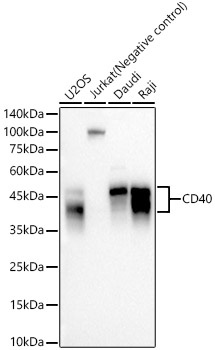
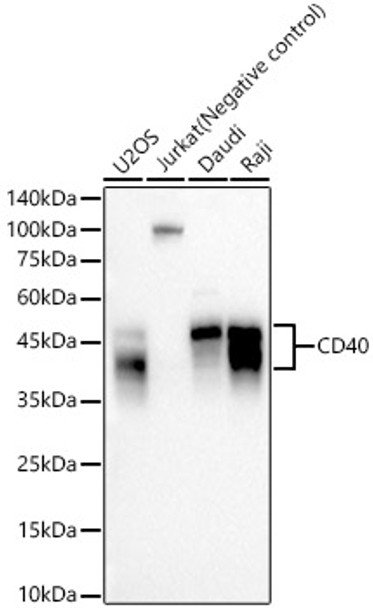
40-45kDa
This gene is a member of the TNF-receptor superfamily. The encoded protein is a receptor on antigen-presenting cells of the immune system and is essential for mediating a broad variety of immune and inflammatory responses including T cell-dependent immunoglobulin class switching, memory B cell development, and germinal center formation. AT-hook transcription factor AKNA is reported to coordinately regulate the expression of this receptor and its ligand, which may be important for homotypic cell interactions. Adaptor protein TNFR2 interacts with this receptor and serves as a mediator of the signal transduction. The interaction of this receptor and its ligand is found to be necessary for amyloid-beta-induced microglial activation, and thus is thought to be an early event in Alzheimer disease pathogenesis. Mutations affecting this gene are the cause of autosomal recessive hyper-IgM immunodeficiency type 3 (HIGM3). Multiple alternatively spliced transcript variants of this gene encoding distinct isoforms have been reported.
Purification Method
Affinity purification
Gene ID
958
Buffer Information
Store at -20℃. Avoid freeze / thaw cycles. Buffer: PBS containing 50% glycerol and 0.05% BSA, preserved with proclin300 or sodium azide, pH 7.3.
Western blot analysis of various lysates, using CD40 Rabbit mAb (CAB22714) at 1:1500 dilution. Secondary antibody: HRP-conjugated Goat anti-Rabbit IgG (H+L) (CABS014) at 1:10000 dilution. Lysates/proteins: 25 μg per lane. Blocking buffer: 3% nonfat dry milk in TBST. Detection: ECL Basic Kit (AbGn00020). Negative control (NC):Jurkat. Exposure time: 60 s.