The GPX8 Antibody (CAB20390) is a high-quality antibody developed for reliable detection and analysis of target proteins. This antibody, raised in rabbits, is highly reactive with human samples and has been validated for use in Western blot applications. It binds specifically to the GPX8 protein, allowing for its detection and analysis in a variety of cell types, making it an ideal tool for studies in oxidative stress, cancer research, and cellular defense mechanisms.GPX8, also known as glutathione peroxidase 8, plays a key role in protecting cells from oxidative damage by catalyzing the reduction of hydrogen peroxide and lipid hydroperoxides using glutathione as a cofactor.
This antibody is validated for use in WB, ELISA applications and has demonstrated reactivity against Human, Mouse, Rat samples.
Product Name:
GPX8 Antibody
SKU:
CAB20390
Size:
20μL, 100μL
Reactivity:
Human, Mouse, Rat
Conjugate:
Unconjugated
Immunogen:
Recombinant protein (or fragment).This information is considered to be commercially sensitive.
Recommended starting concentration is 1 μg/mL. Please optimize the concentration based on your specific assay requirements.
Synonyms:
GPx-8, UNQ847, EPLA847, GSHPx-8, GPX8
Positive Sample:
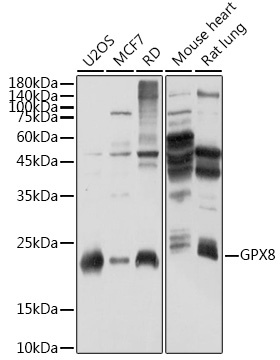
U2OS, MCF7, RD, Mouse heart, Rat lung
Cellular Localization:
Endoplasmic Reticulum Lumen.
Calculated MW:
24kDa
Observed MW:
24kDa
Enables peroxidase activity. Predicted to be involved in cellular response to oxidative stress. Predicted to be located in endoplasmic reticulum lumen.
Purification Method
Affinity purification
Gene ID
493869
Buffer Information
Store at -20℃. Avoid freeze / thaw cycles. Buffer: PBS containing 50% glycerol, preserved with proclin300 or sodium azide, pH 7.3.
Western blot analysis of various lysates using GPX8 Rabbit pAb (CAB20390) at 1:1000 dilution. Secondary antibody: HRP-conjugated Goat anti-Rabbit IgG (H+L) (CABS014) at 1:10000 dilution. Lysates/proteins: 25μg per lane. Blocking buffer: 3% nonfat dry milk in TBST. Detection: ECL Basic Kit (AbGn00020). Exposure time: 10s.
McGrath et al.
Understanding the Role of MicroRNA-31 in Regulating Cellular Sensitivity to Chemoradiotherapy in Pancreatic Ductal Adenocarcinoma
I had some tight deadlines to meet, and this antibody didn’t let me down. It was reliable, gave consistent and reproducible results across experiments, and worked exactly as expected. No issues at all. Really pleased with the performance.