Description
HRH1 Antibody (CAB1422)
The HRH1 Antibody (CAB1422) is a high-quality antibody developed for reliable detection and analysis of target proteins. This antibody, produced in rabbits, is highly specific for human samples and has been validated for use in a variety of applications, including Western blotting.The histamine H1 receptor, also known as HRH1, plays a significant role in mediating the effects of histamine in the body, such as promoting vasodilation, bronchoconstriction, and increasing vascular permeability.
This antibody is validated for use in WB, ELISA applications and has demonstrated reactivity against Human samples.
| Product Name: | HRH1 Antibody |
| SKU: | CAB1422 |
| Size: | 20μL, 100μL |
| Reactivity: | Human |
| Conjugate: | Unconjugated |
| Immunogen: | Recombinant protein (or fragment).This information is considered to be commercially sensitive. | ||||
| Sequence: | KPGK ESPW EVLK RKPK DAGG GSVL KSPS QTPK EMKS PVVF SQED DREV DKLY CFPL DIVH MQAA AEGS SRDY VAVN RSHG QLKT DEQG LNT | ||||
| Tested Applications: | WB ELISA | ||||
| Recommended Dilution: |
| ||||
| Synonyms: | H1R, H1-R, HH1R, hisH1, HRH1 |
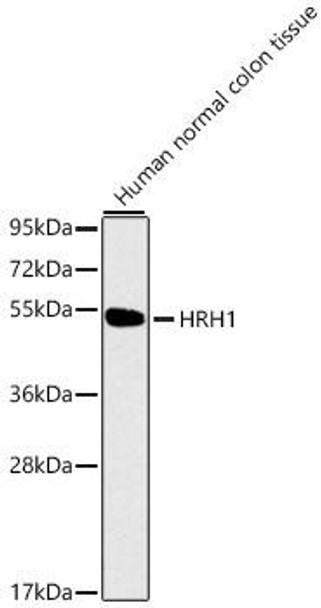
| Positive Sample: | Human normal colon tissue |
| Cellular Localization: | Cell Membrane, Multi-Pass Membrane Protein. |
| Calculated MW: | 56kDa |
| Observed MW: | 56kDa |
Histamine is a ubiquitous messenger molecule released from mast cells, enterochromaffin-like cells, and neurons. Its various actions are mediated by histamine receptors H1, H2, H3 and H4. The protein encoded by this gene is an integral membrane protein and belongs to the G protein-coupled receptor superfamily. It mediates the contraction of smooth muscles, the increase in capillary permeability due to contraction of terminal venules, the release of catecholamine from adrenal medulla, and neurotransmission in the central nervous system. It has been associated with multiple processes, including memory and learning, circadian rhythm, and thermoregulation. It is also known to contribute to the pathophysiology of allergic diseases such as atopic dermatitis, asthma, anaphylaxis and allergic rhinitis. Multiple alternatively spliced variants, encoding the same protein, have been identified.
| Purification Method | Affinity purification |
| Gene ID | 3269 |
| RRID | AB_2761080 |
| Buffer Information | Store at -20℃. Avoid freeze / thaw cycles. Buffer: PBS with 0.01% thimerosal,50% glycerol,pH7.3. |
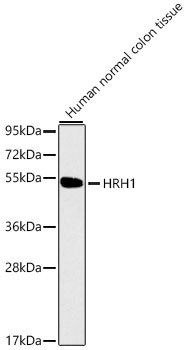 | Western blot analysis of lysates from Human normal colon tissue, using HRH1 Rabbit pAb (CAB1422). Secondary antibody: HRP-conjugated Goat anti-Rabbit IgG (H+L) (CABS014) at 1:10000 dilution. Lysates/proteins: 25μg per lane. Blocking buffer: 3% nonfat dry milk in TBST. |