Description
| Product Name: | Human CXCL2 ELISA Kit |
| Product Code: | SBRS6068 |
| Size: | 96 Assays |
| Target: | Human CXCL2 |
| Alias: | C-X-C motif chemokine ligand 2 (CXCL2), GRO-beta, MIP-2, MIP-2-alpha (MIP2-a), CINC-3, SCYB2 |
| Reactivity: | Human |
| Detection Method: | Sandwich ELISA |
| Sensitivity: | 3.4 pg/ml |
| Range: | 3.4-1000 pg/ml |
| Storage: | 4°C for 6 months |
| Note: | For Research Use Only |
| Recovery: | Matrices listed below were spiked with certain levels of human CXCL2, and the recovery rates were calculated by comparing the measured value to the expected amount of CXCL2 in samples. | ||||||||||||||||||||
| |||||||||||||||||||||
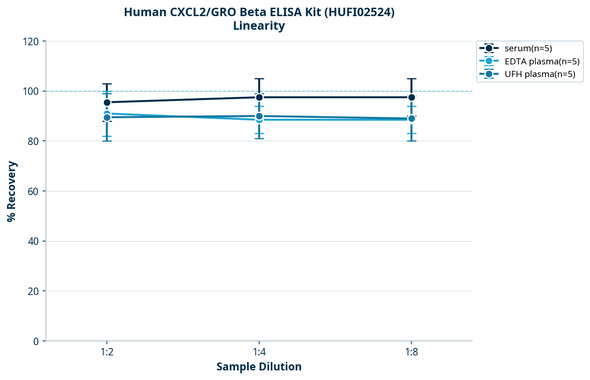
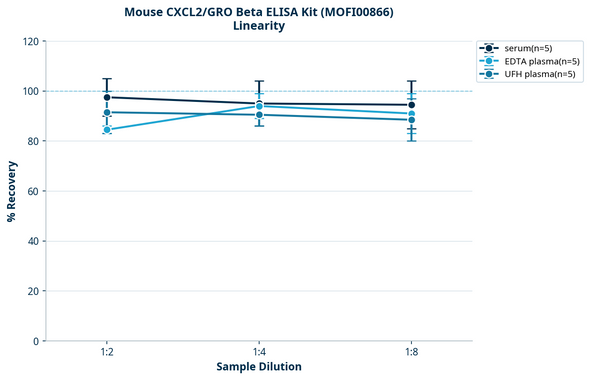
| Linearity: | The linearity of the kit was assayed by testing samples spiked with appropriate concentrations of human CXCL2 and their serial dilutions. The results were demonstrated by the percentage of calculated concentration to the expected. | ||||||||||||||||||||
| |||||||||||||||||||||
| Intra-Assay: | CV <10% | ||||||||||||||||||||
| Inter-Assay: | CV <12% |
- Preparation: Bring all reagents and samples to room temperature (18-25°C) before use. It is recommended that all standards and samples be run in duplicate to ensure accuracy.
- Plate Setup: Label the removable 8-well strips according to your experimental design.
- Standard and Sample Addition: Add 100 µL of each standard and sample into the appropriate wells. Cover the plate and incubate for 2.5 hours at room temperature with gentle shaking.
- Washing: Discard the solution from the wells. Wash the wells 4 times with 300 µL of 1X Wash Buffer using a multi-channel pipette or autowasher. Complete removal of the liquid after each wash is essential for good performance. After the final wash, remove any residual Wash Buffer by aspirating or decanting. Invert the plate and blot it against clean paper towels.
- Biotinylated Antibody Addition: Add 100 µL of 1X prepared biotinylated anti-CXCL2 detection antibody to each well. Incubate for 1 hour at room temperature with gentle shaking.
- Second Wash: Discard the solution and repeat the wash process as described in step 4.
- Streptavidin Solution Addition: Add 100 µL of prepared HRP-Streptavidin solution to each well. Incubate for 45 minutes at room temperature with gentle shaking.
- Third Wash: Discard the solution and repeat the wash process as described in step 4.
- TMB Substrate Addition: Add 100 µL of TMB One-Step Substrate Reagent to each well. Incubate for 30 minutes at room temperature in the dark with gentle shaking.
- Stop Solution Addition and Reading: Add 50 µL of Stop Solution to each well. Read the absorbance at 450 nm immediately.
When carrying out an ELISA assay, it is important to prepare your samples to achieve the best results. Below are the procedures for sample preparation.
| Sample Type | Protocol |
| Serum: | If using serum separator tubes, allow samples to clot for 30 minutes. Centrifuge for 10 minutes at 1,000x g. Collect the serum fraction and assay promptly or store at -80°C. If serum separator tubes are not used, allow samples to clot overnight at 2-8°C. Centrifuge for 10 minutes and store samples at -80°C. |
| Plasma: | Collect plasma using EDTA or heparin as an anti-coagulant. Centrifuge samples at 4°C for 15 minutes at 1000 × g within 30 minutes. Store at -80°C. |
| Cell Culture Supernatants: | Collect the cell culture media by pipette, followed by centrifugation at 4°C for 20 minutes at 1,000 x g. Collect the clear supernatant and assay immediately. Or you can aliquot the supernatant and store it at -80°C for future assays. |
| Other Sample Types: | Follow appropriate protocols for the specific sample type. Store prepared samples at -20°C or -80°C. |