The [KO Validated] MC1 Receptor Monoclonal Antibody (CAB11594) is a high-quality antibody developed for reliable detection and analysis of target proteins. The antibody is meticulously produced using advanced technology and validated for knockout (KO) samples, ensuring accurate and reliable results in immunohistochemistry, immunofluorescence, and flow cytometry applications.With its high specificity and sensitivity, this monoclonal antibody enables precise detection and visualization of the MC1 receptor in different tissue types and cell lines, making it an invaluable tool for researchers studying melanoma, skin disorders, and other conditions involving MC1 receptor dysregulation.
This antibody is validated for use in WB, ELISA applications and has demonstrated reactivity against Human, Mouse, Rat samples.
Product Name:
[KO Validated] MC1 Receptor Monoclonal Antibody
SKU:
CAB11594
Size:
20μL, 100μL
Reactivity:
Human, Mouse, Rat
Clone Number:
ARC0638
Conjugate:
Unconjugated
Immunogen:
Synthetic peptide. This information is considered to be commercially sensitive.
Recommended starting concentration is 1 μg/mL. Please optimize the concentration based on your specific assay requirements.
Synonyms:
CMM5, MSH-R, SHEP2, MC1 Receptor
Positive Sample:
A549, A375, C6, MCF7, Mouse kidney
Cellular Localization:
Cell Membrane.
Calculated MW:
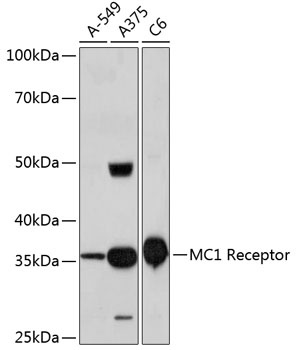
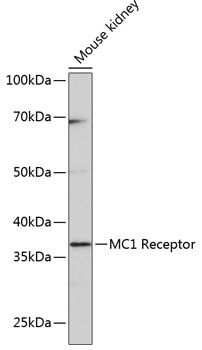
35kDa
Observed MW:
35kDa
This intronless gene encodes the receptor protein for melanocyte-stimulating hormone (MSH). The encoded protein, a seven pass transmembrane G protein coupled receptor, controls melanogenesis. Two types of melanin exist: red pheomelanin and black eumelanin. Gene mutations that lead to a loss in function are associated with increased pheomelanin production, which leads to lighter skin and hair color. Eumelanin is photoprotective but pheomelanin may contribute to UV-induced skin damage by generating free radicals upon UV radiation. Binding of MSH to its receptor activates the receptor and stimulates eumelanin synthesis. This receptor is a major determining factor in sun sensitivity and is a genetic risk factor for melanoma and non-melanoma skin cancer. Over 30 variant alleles have been identified which correlate with skin and hair color, providing evidence that this gene is an important component in determining normal human pigment variation.
Purification Method
Affinity purification
Gene ID
4157
RRID
AB_2861603
Buffer Information
Store at -20℃. Avoid freeze / thaw cycles. Buffer: PBS containing 50% glycerol and 0.05% BSA, preserved with proclin300 or sodium azide, pH 7.3.
Western blot analysis of various lysates using MC1 Receptor Rabbit mAb (CAB11594) at 1:1000 dilution. Secondary antibody: HRP-conjugated Goat anti-Rabbit IgG (H+L) (CABS014) at 1:10000 dilution. Lysates/proteins: 25μg per lane. Blocking buffer: 3% nonfat dry milk in TBST. Detection: ECL Basic Kit (AbGn00020). Exposure time: 3min.
Western blot analysis of lysates from Mouse kidney, using MC1 Receptor Rabbit mAb (CAB11594) at 1:1000 dilution. Secondary antibody: HRP-conjugated Goat anti-Rabbit IgG (H+L) (CABS014) at 1:10000 dilution. Lysates/proteins: 25μg per lane. Blocking buffer: 3% nonfat dry milk in TBST. Detection: ECL Enhanced Kit (AbGn00021). Exposure time: 3min.