The [KO Validated] Smad2 Monoclonal Antibody (CAB19114) is a high-quality antibody developed for reliable detection and analysis of target proteins. This antibody, manufactured by Assay Genie, is specifically raised in rabbits and has been extensively validated for use in various applications, including Western blotting and immunofluorescence.SMAD2 is a critical mediator in the transforming growth factor-beta (TGF-β) signaling pathway, which plays a crucial role in cell proliferation, differentiation, and apoptosis. Dysregulation of SMAD2 signaling has been implicated in a variety of diseases, including cancer, fibrosis, and developmental disorders.
This antibody is validated for use in WB, IF/ICC, IP, ELISA applications and has demonstrated reactivity against Human, Mouse, Rat samples.
Product Name:
[KO Validated] Smad2 Monoclonal Antibody
SKU:
CAB19114
Size:
20μL, 100μL
Reactivity:
Human, Mouse, Rat
Clone Number:
ARC0343
Conjugate:
Unconjugated
Immunogen:
Synthetic peptide. This information is considered to be commercially sensitive.
The protein encoded by this gene belongs to the SMAD, a family of proteins similar to the gene products of the Drosophila gene 'mothers against decapentaplegic' (Mad) and the C. elegans gene Sma. SMAD proteins are signal transducers and transcriptional modulators that mediate multiple signaling pathways. This protein mediates the signal of the transforming growth factor (TGF)-beta, and thus regulates multiple cellular processes, such as cell proliferation, apoptosis, and differentiation. This protein is recruited to the TGF-beta receptors through its interaction with the SMAD anchor for receptor activation (SARA) protein. In response to TGF-beta signal, this protein is phosphorylated by the TGF-beta receptors. The phosphorylation induces the dissociation of this protein with SARA and the association with the family member SMAD4. The association with SMAD4 is important for the translocation of this protein into the nucleus, where it binds to target promoters and forms a transcription repressor complex with other cofactors. This protein can also be phosphorylated by activin type 1 receptor kinase, and mediates the signal from the activin. Alternatively spliced transcript variants have been observed for this gene.
Purification Method
Affinity purification
Gene ID
4087
RRID
AB_2862607
Buffer Information
Store at -20℃. Avoid freeze / thaw cycles. Buffer: PBS containing 50% glycerol and 0.05% BSA, preserved with proclin300 or sodium azide, pH 7.3.
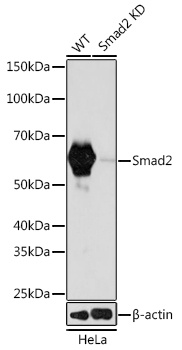
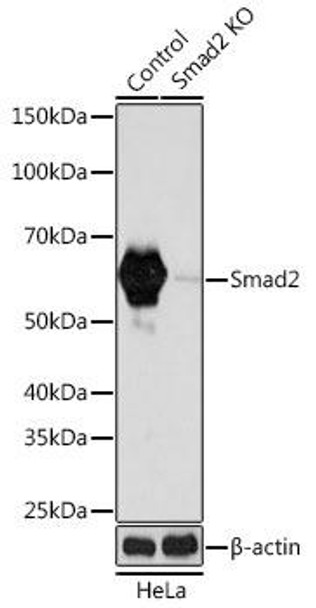
Western blot analysis of lysates from wild type (WT) and Smad2 knockdown (KD) HeLa cells using [KD Validated] Smad2 Rabbit mAb (CAB19114) at 1:1000 dilution incubated overnight at 4℃. Secondary antibody: HRP-conjugated Goat anti-Rabbit IgG (H+L) (CABS014) at 1:10000 dilution. Lysates/proteins: 25μg per lane. Blocking buffer: 3% nonfat dry milk in TBST. Detection: ECL Basic Kit (AbGn00020). Exposure time: 60s.
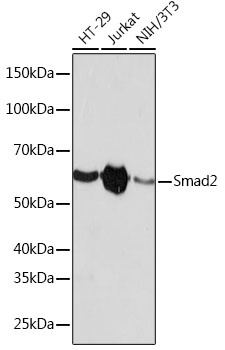
Western blot analysis of various lysates using [KD Validated] Smad2 Rabbit mAb (CAB19114) at 1:1000 dilution incubated overnight at 4℃. Secondary antibody: HRP-conjugated Goat anti-Rabbit IgG (H+L) (CABS014) at 1:10000 dilution. Lysates/proteins: 25μg per lane. Blocking buffer: 3% nonfat dry milk in TBST. Detection: ECL Basic Kit (AbGn00020). Exposure time: 90s.
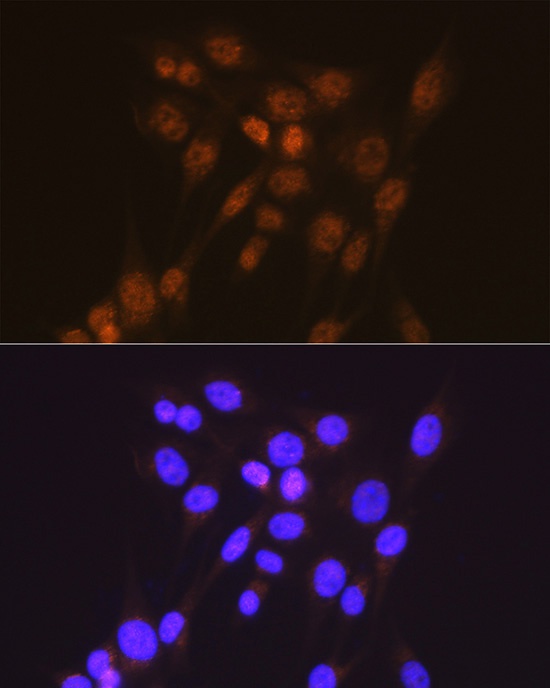
Immunofluorescence analysis of NIH/3T3 cells using [KD Validated] Smad2 Rabbit mAb (CAB19114) at a dilution of 1:100 (40x lens). Secondary antibody: Cy3 Goat anti-Rabbit IgG (H+L) (CABS007) at 1:500 dilution. Blue: DAPI for nuclear staining.
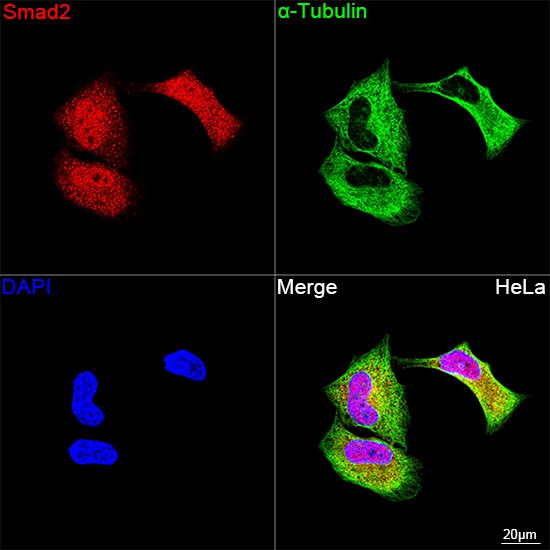
Confocal imaging of HeLa cells using [KD Validated] Smad2 Rabbit mAb (CAB19114, dilution 1:100) followed by a further incubation with Cy3 Goat Anti-Rabbit IgG (H+L) (CABS007,dilution 1:500) (Red). The cells were counterstained with α-Tubulin Mouse mAb (AC012, dilution 1:400) followed by incubation with ABflo® 488-conjugated Goat Anti-Mouse IgG (H+L) Ab (CABS076, dilution 1:500) (Green). DAPI was used for nuclear staining (Blue). Objective: 100x.