

Description
HLA-A Monoclonal Antibody (CAB11406)
The HLA-A Monoclonal Antibody (CAB11406) is a high-quality antibody developed for reliable detection and analysis of target proteins. This monoclonal antibody, generated in rabbits, is highly specific and sensitive for detecting MHC class I in various samples, particularly in Western blot applications.The MHC Class 1 Rabbit Monoclonal Antibody binds specifically to MHC class I molecules, facilitating their visualization and analysis in different cell types and tissues.
This antibody is validated for use in WB, IHC-P, ELISA applications and has demonstrated reactivity against Human samples.
| Product Name: | HLA-A Monoclonal Antibody |
| SKU: | CAB11406 |
| Size: | 20μL, 100μL |
| Reactivity: | Human |
| Clone Number: | ARC0588 |
| Conjugate: | Unconjugated |
| Immunogen: | Synthetic peptide. This information is considered to be commercially sensitive. | ||||||
| Sequence: | MAVM APRT LLLL LSGA LALT QTWA GSHS MRYF FTSV SRPG RGEP RFIA VGYV DDTQ FVRF DSDA ASQR MEPR APWI EQEG PEYW DQET RNVK AQSQ TDRV | ||||||
| Tested Applications: | WB IHC-P ELISA | ||||||
| Recommended Dilution: |
| ||||||
| Synonyms: | HLAA, HLA-A |
| Positive Sample: | HeLa, HepG2, A-549 |
| Cellular Localization: | Cell Membrane, Single-Pass Type I Membrane Protein, Endoplasmic Reticulum Membrane. |
| Calculated MW: | 41kDa |
| Observed MW: | 41kDa |
HLA-A belongs to the HLA class I heavy chain paralogues. This class I molecule is a heterodimer consisting of a heavy chain and a light chain (beta-2 microglobulin). The heavy chain is anchored in the membrane. Class I molecules play a central role in the immune system by presenting peptides derived from the endoplasmic reticulum lumen so that they can be recognized by cytotoxic T cells. They are expressed in nearly all cells. The heavy chain is approximately 45 kDa and its gene contains 8 exons. Exon 1 encodes the leader peptide, exons 2 and 3 encode the alpha1 and alpha2 domains, which both bind the peptide, exon 4 encodes the alpha3 domain, exon 5 encodes the transmembrane region, and exons 6 and 7 encode the cytoplasmic tail. Polymorphisms within exon 2 and exon 3 are responsible for the peptide binding specificity of each class one molecule. Typing for these polymorphisms is routinely done for bone marrow and kidney transplantation. More than 6000 HLA-A alleles have been described. The HLA system plays an important role in the occurrence and outcome of infectious diseases, including those caused by the malaria parasite, the human immunodeficiency virus (HIV), and the severe acute respiratory syndrome coronavirus (SARS-CoV). The structural spike and the nucleocapsid proteins of the novel coronavirus SARS-CoV-2, which causes coronavirus disease 2019 (COVID-19), are reported to contain multiple Class I epitopes with predicted HLA restrictions. Individual HLA genetic variation may help explain different immune responses to a virus across a population.
| Purification Method | Affinity purification |
| Gene ID | 3105 |
| RRID | AB_2861560 |
| Buffer Information | Store at -20℃. Avoid freeze / thaw cycles. Buffer: PBS containing 50% glycerol and 0.05% BSA, preserved with proclin300 or sodium azide, pH 7.3. |
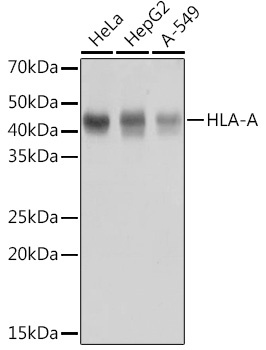 | Western blot analysis of various lysates using HLA-A Rabbit mAb (CAB11406) at 1:1000 dilution. Secondary antibody: HRP-conjugated Goat anti-Rabbit IgG (H+L) (CABS014) at 1:10000 dilution. Lysates/proteins: 25μg per lane. Blocking buffer: 3% nonfat dry milk in TBST. Detection: ECL Basic Kit (AbGn00020). Exposure time: 1s. |
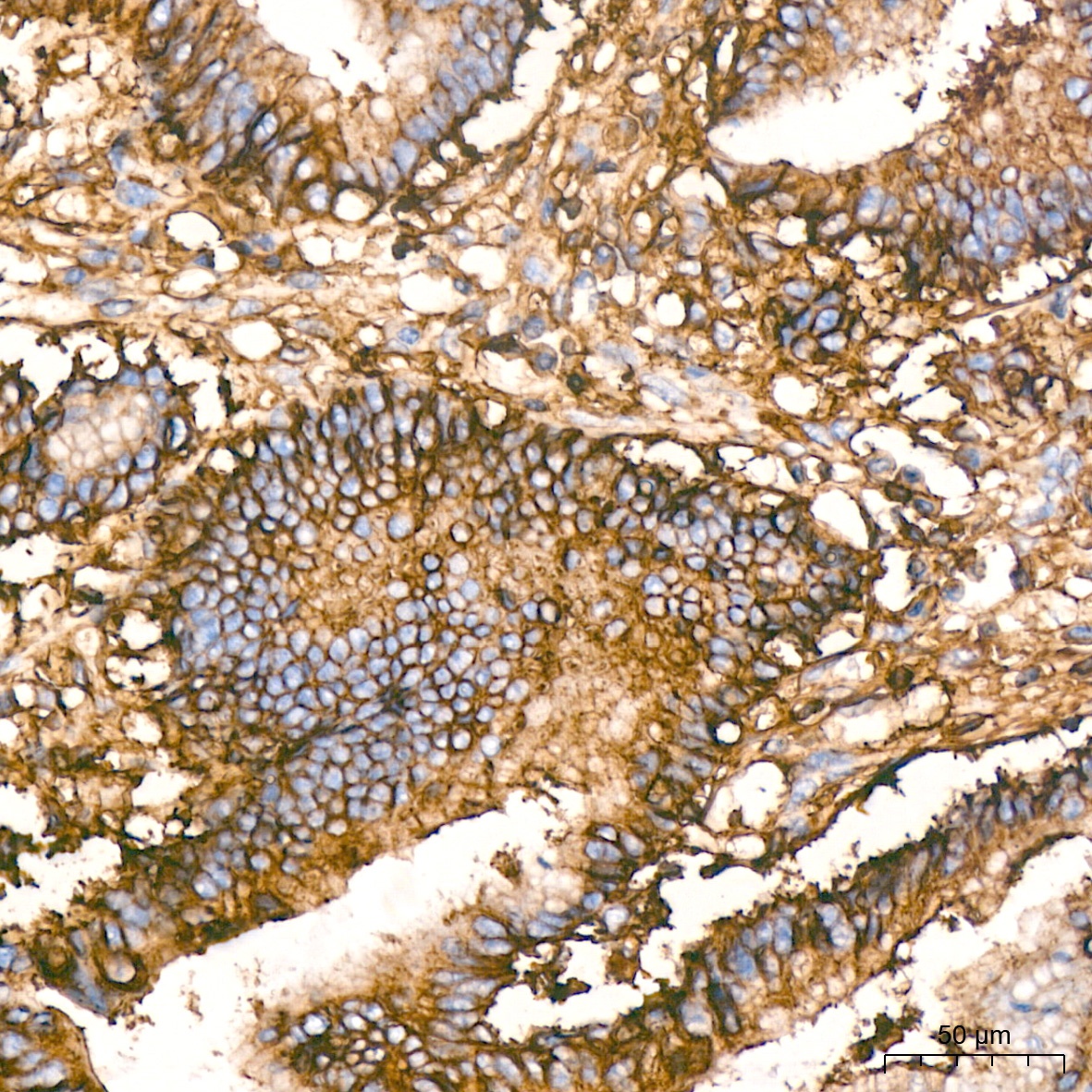 | Immunohistochemistry analysis of paraffin-embedded Human colon carcinoma tissue using HLA-A Rabbit mAb (CAB11406) at a dilution of 1:200 (40x lens). High pressure antigen retrieval was performed with 0.01 M citrate buffer (pH 6.0) prior to IHC staining. |
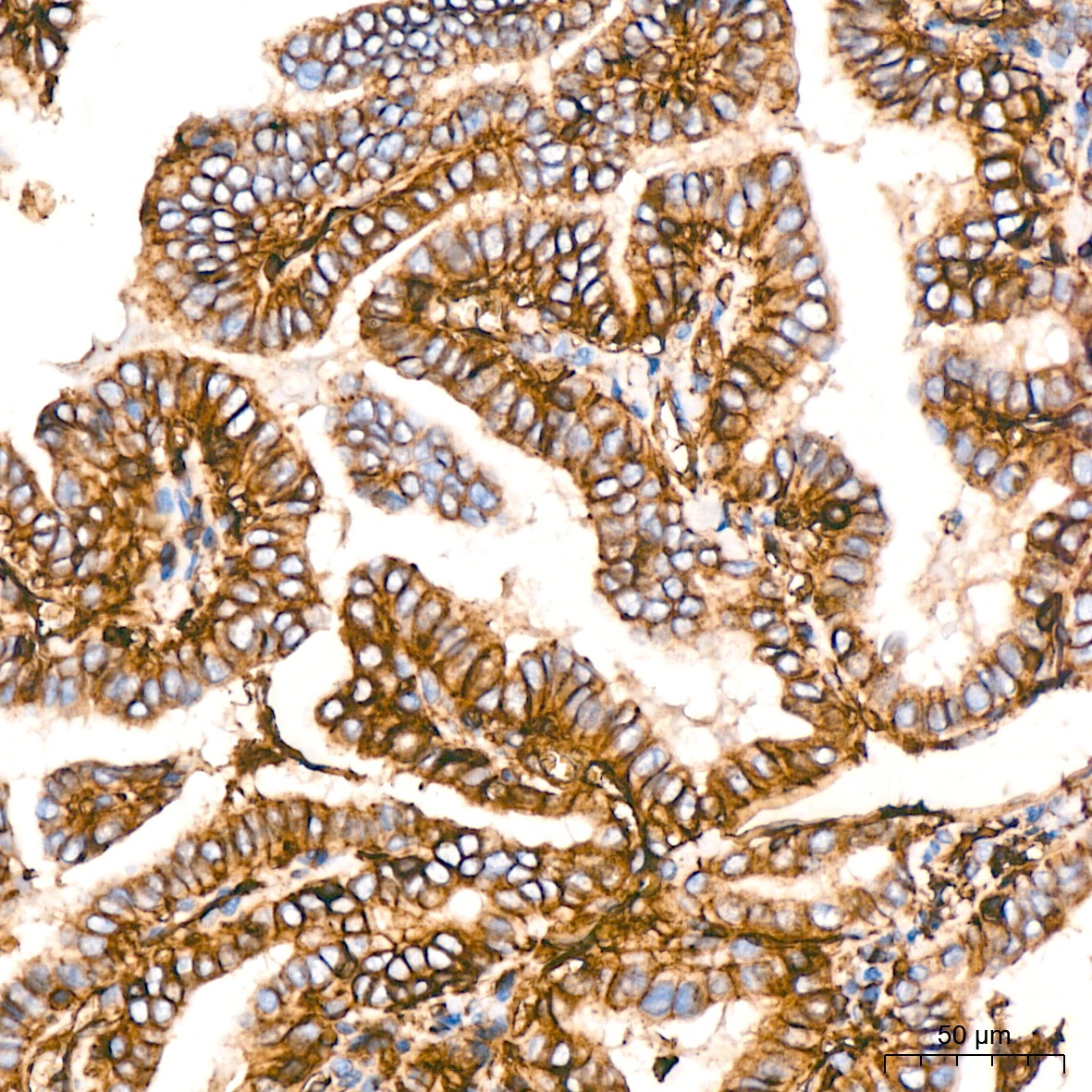 | Immunohistochemistry analysis of paraffin-embedded Human thyroid cancer tissue using HLA-A Rabbit mAb (CAB11406) at a dilution of 1:200 (40x lens). High pressure antigen retrieval was performed with 0.01 M citrate buffer (pH 6.0) prior to IHC staining. |
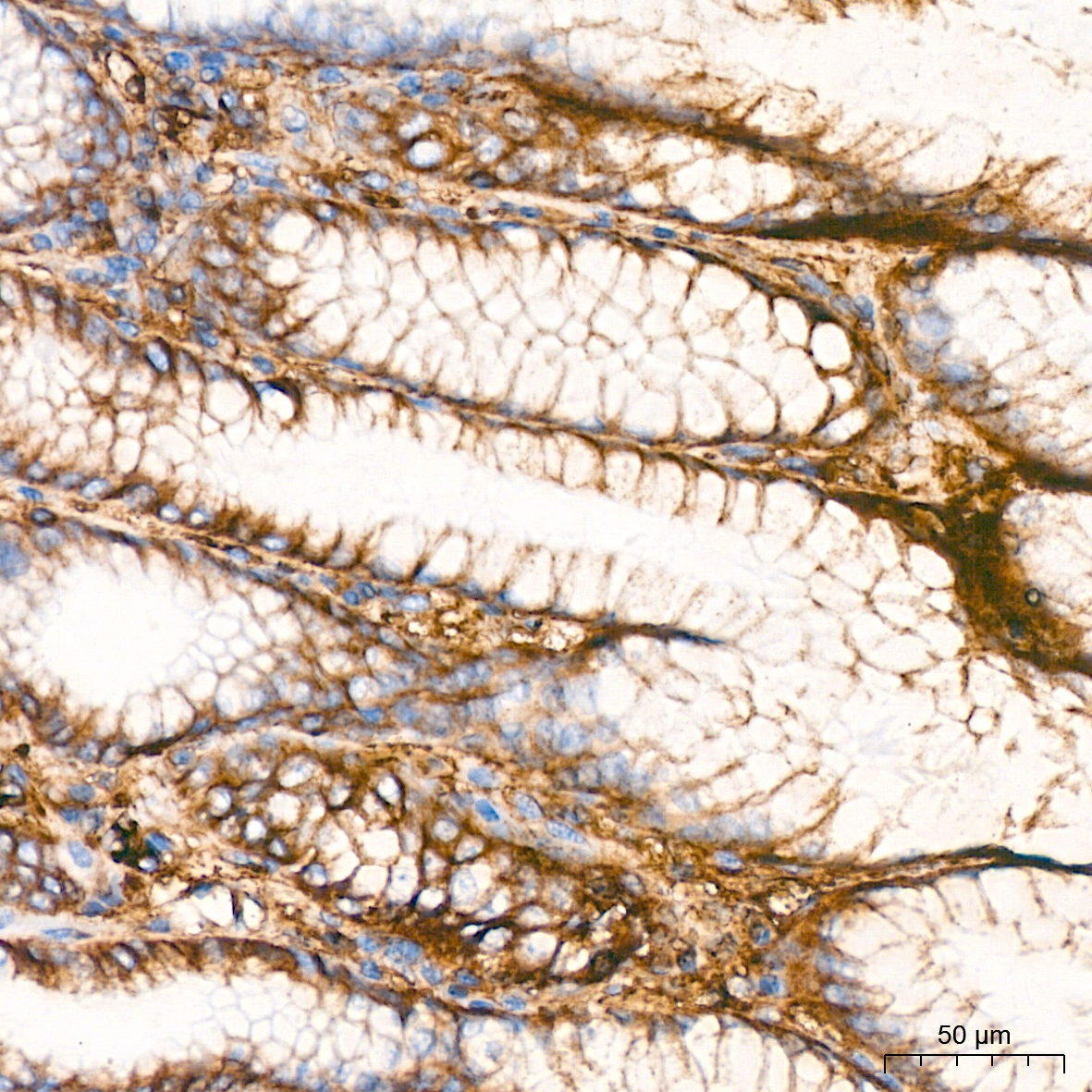 | Immunohistochemistry analysis of paraffin-embedded Human stomach tissue using HLA-A Rabbit mAb (CAB11406) at a dilution of 1:200 (40x lens). High pressure antigen retrieval was performed with 0.01 M citrate buffer (pH 6.0) prior to IHC staining. |


