The MYOC Antibody (CAB1589) is a high-quality antibody developed for reliable detection and analysis of target proteins. This antibody, produced in rabbits, is highly specific to human myocilin and has been validated for use in a variety of applications, including Western blotting and immunohistochemistry.Myocilin plays a crucial role in the regulation of intraocular pressure and abnormalities in its function have been linked to glaucoma, a leading cause of blindness worldwide. By using the Myocilin Polyclonal Antibody, researchers can investigate the expression levels and localization of myocilin in eye tissues, providing valuable insights into the underlying mechanisms of glaucoma and potential therapeutic targets.
This antibody is validated for use in WB, ELISA applications and has demonstrated reactivity against Human, Mouse samples.
Product Name:
MYOC Antibody
SKU:
CAB1589
Size:
20μL, 100μL
Reactivity:
Human, Mouse
Conjugate:
Unconjugated
Immunogen:
Recombinant protein (or fragment).This information is considered to be commercially sensitive.
MYOC encodes the protein myocilin, which is believed to have a role in cytoskeletal function. MYOC is expressed in many occular tissues, including the trabecular meshwork, and was revealed to be the trabecular meshwork glucocorticoid-inducible response protein (TIGR). The trabecular meshwork is a specialized eye tissue essential in regulating intraocular pressure, and mutations in MYOC have been identified as the cause of hereditary juvenile-onset open-angle glaucoma.
Purification Method
Affinity purification
Gene ID
4653
RRID
AB_2763320
Buffer Information
Store at -20℃. Avoid freeze / thaw cycles. Buffer: PBS containing 50% glycerol, preserved with proclin300 or sodium azide, pH 7.3.
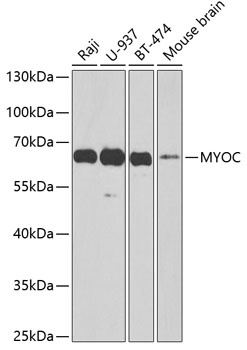
Western blot analysis of various lysates using MYOC Rabbit pAb (CAB1589) at 1:1000 dilution. Secondary antibody: HRP-conjugated Goat anti-Rabbit IgG (H+L) (CABS014) at 1:10000 dilution. Lysates/proteins: 25μg per lane. Blocking buffer: 3% nonfat dry milk in TBST. Detection: ECL Basic Kit (AbGn00020). Exposure time: 60s.