The Phospho-ERK1-T202/Y204 + ERK2-T185/Y187 Polyclonal Antibody (CABP0472) is a high-quality antibody developed for reliable detection and analysis of target proteins. This antibody, raised in rabbits, is highly specific to phosphorylated ERK1 (T202/Y204) and ERK2 (T185/Y187) and is validated for use in Western blot applications. It enables detection and quantification of phosphorylated ERK1 and ERK2, allowing for the analysis of pathway activation in various cell types and tissues.The MAPK/ERK pathway is a crucial signaling cascade involved in regulating cell proliferation, differentiation, and survival.
This antibody is validated for use in WB, IF/ICC, ELISA applications and has demonstrated reactivity against Human, Mouse, Rat samples.
Caveola, Cytoplasm, Cytoskeleton, Cytosol, Early Endosome, Endoplasmic Reticulum Lumen, Extracellular Region, Focal Adhesion, Golgi Apparatus, Late Endosome, Microtubule Organizing Center, Mitochondrion, Mitotic Spindle, Nucleoplasm, Nucleus, Plasma Membrane.
Calculated MW:
36kDa/41kDa/38kDa/40kDa/43kDa
Observed MW:
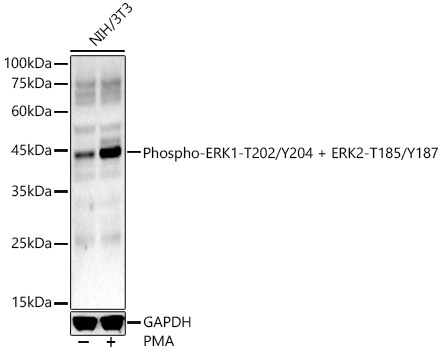
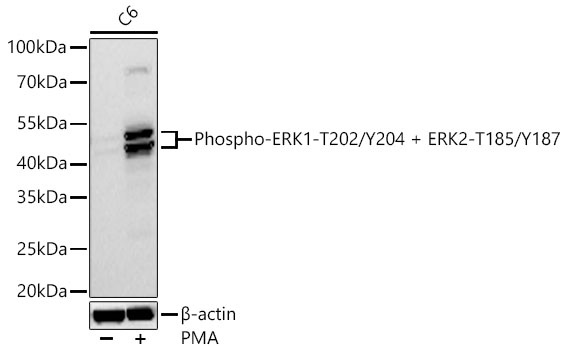
44kDa/42kDa
This gene encodes a member of the MAP kinase family. MAP kinases, also known as extracellular signal-regulated kinases (ERKs), act as an integration point for multiple biochemical signals, and are involved in a wide variety of cellular processes such as proliferation, differentiation, transcription regulation and development. The activation of this kinase requires its phosphorylation by upstream kinases. Upon activation, this kinase translocates to the nucleus of the stimulated cells, where it phosphorylates nuclear targets. One study also suggests that this protein acts as a transcriptional repressor independent of its kinase activity. The encoded protein has been identified as a moonlighting protein based on its ability to perform mechanistically distinct functions. Two alternatively spliced transcript variants encoding the same protein, but differing in the UTRs, have been reported for this gene. [provided by RefSeq, Jan 2014]
Purification Method
Affinity purification
Gene ID
5594 5595
RRID
AB_2756833
Buffer Information
Store at -20℃. Avoid freeze / thaw cycles. Buffer: PBS containing 50% glycerol, preserved with proclin300 or sodium azide, pH 7.3.
Western blot analysis of lysates from NIH/3T3 cells using Phospho-ERK1-T202/Y204 + ERK2-T185/Y187 Rabbit pAb (CABP0472) at 1:1000 dilution. NIH/3T3 cells were treated with PMA/TPA (200 nM) at 37℃ for 30 minutes after serum-starvation overnight. Secondary antibody: HRP-conjugated Goat anti-Rabbit IgG (H+L) (CABS014) at 1:10000 dilution. Lysates/proteins: 25 μg per lane. Blocking buffer: 3% nonfat dry milk in TBST. Detection: ECL Basic Kit (AbGn00020). Exposure time: 180s.
Western blot analysis of lysates from C6 cells using Phospho-ERK1-T202/Y204 + ERK2-T185/Y187 Rabbit pAb (CABP0472) at 1:1000 dilution incubated overnight at 4℃. C6 cells were treated with PMA(200 nM) at 37℃ for 10 minutes after serum-starvation overnight. Secondary antibody: HRP-conjugated Goat anti-Rabbit IgG (H+L) (CABS014) at 1:10000 dilution. Lysates/proteins: 30 μg per lane. Blocking buffer: 3 % nonfat dry milk in TBST. Detection: ECL Basic Kit (AbGn00020). Exposure time: 45s.