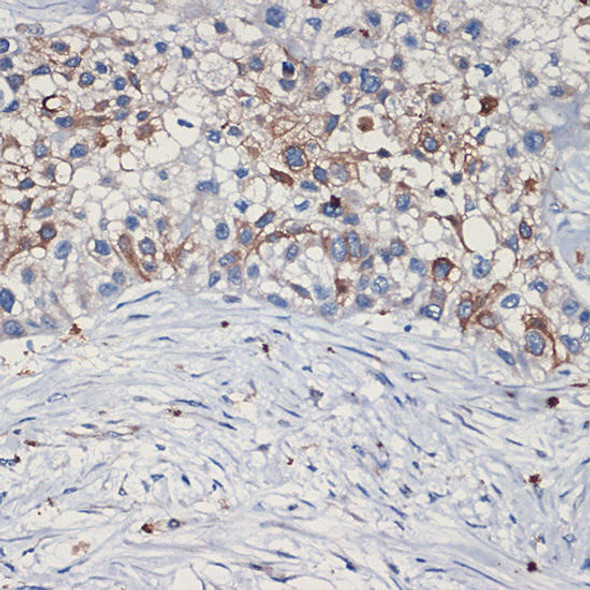
The MET Antibody (CAB0040) is a high-quality antibody developed for reliable detection and analysis of target proteins. This antibody is produced in rabbits and has been validated for use in various applications, including Western blot and immunohistochemistry.MET, also known as hepatocyte growth factor receptor, plays a critical role in various cellular processes, such as cell proliferation, migration, and differentiation. Dysregulation of MET signaling has been implicated in various cancers, making it a promising target for cancer therapy.The MET Polyclonal Antibody binds specifically to the MET protein, allowing for accurate detection and analysis in different cell types.
This antibody is validated for use in WB, ELISA applications and has demonstrated reactivity against Human, Rat samples.
Product Name:
MET Antibody
SKU:
CAB0040
Size:
20μL, 100μL
Reactivity:
Human, Rat
Conjugate:
Unconjugated
Immunogen:
Recombinant protein (or fragment).This information is considered to be commercially sensitive.
Recommended starting concentration is 1 μg/mL. Please optimize the concentration based on your specific assay requirements.
Synonyms:
DA11, HGFR, AUTS9, RCCP2, c-Met, DFNB97, MET
Positive Sample:
Rat kidney
Cellular Localization:
Membrane, Secreted, Single-Pass Type I Membrane Protein.
Calculated MW:
156kDa
Observed MW:
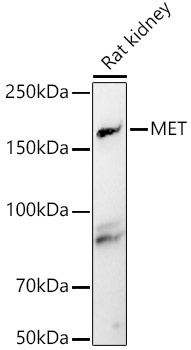
140kDa/170kDa
This gene encodes a member of the receptor tyrosine kinase family of proteins and the product of the proto-oncogene MET. The encoded preproprotein is proteolytically processed to generate alpha and beta subunits that are linked via disulfide bonds to form the mature receptor. Further processing of the beta subunit results in the formation of the M10 peptide, which has been shown to reduce lung fibrosis. Binding of its ligand, hepatocyte growth factor, induces dimerization and activation of the receptor, which plays a role in cellular survival, embryogenesis, and cellular migration and invasion. Mutations in this gene are associated with papillary renal cell carcinoma, hepatocellular carcinoma, and various head and neck cancers. Amplification and overexpression of this gene are also associated with multiple human cancers.
Purification Method
Affinity purification
Gene ID
4233
RRID
AB_2756909
Buffer Information
Store at -20℃. Avoid freeze / thaw cycles. Buffer: PBS containing 50% glycerol, preserved with proclin300 or sodium azide, pH 7.3.
Western blot analysis of lysates from Rat kidney, using MET Rabbit pAb (CAB0040) at 1:500 dilution. Secondary antibody: HRP-conjugated Goat anti-Rabbit IgG (H+L) (CABS014) at 1:10000 dilution. Lysates/proteins: 25μg per lane. Blocking buffer: 3% nonfat dry milk in TBST. Detection: ECL Basic Kit (AbGn00020). Exposure time: 60s.