The Phospho-p53-S392 Antibody (CABP0860) is a high-quality antibody developed for reliable detection and analysis of target proteins. This antibody, raised in rabbits, is highly specific to phosphorylated TP53 at serine 392 and is validated for use in Western blot applications. It enables detection and analysis of TP53 phosphorylation in various cell types, providing important insights into the role of this protein in cancer biology.TP53 is a key player in maintaining genomic stability and preventing the proliferation of damaged cells. Phosphorylation at serine 392 is known to impact TP53 stability and function, influencing its ability to induce cell cycle arrest or apoptosis in response to cellular stress.
This antibody is validated for use in WB, ELISA applications and has demonstrated reactivity against Human, Mouse, Rat samples.
Product Name:
Phospho-p53-S392 Antibody
SKU:
CABP0860
Size:
20μL, 100μL
Reactivity:
Human, Mouse, Rat
Conjugate:
Unconjugated
Immunogen:
Synthetic peptide. This information is considered to be commercially sensitive.
Sequence:
GPDS D
Tested Applications:
WBELISA
Recommended Dilution:
WB
1:500 - 1:2000
ELISA
Recommended starting concentration is 1 μg/mL. Please optimize the concentration based on your specific assay requirements.
Synonyms:
P53, BCC7, LFS1, BMFS5, TRP53, Phospho-p53-S392
Positive Sample:
HeLa treated with Paclitaxel, HeLa treated with Hydroxyurea, NIH/3T3 treated with Paclitaxel, NIH/3T3 treated with Hydroxyurea, C6 treated with Paclitaxel, C6 treated with Hydroxyurea
This gene encodes a tumor suppressor protein containing transcriptional activation, DNA binding, and oligomerization domains. The encoded protein responds to diverse cellular stresses to regulate expression of target genes, thereby inducing cell cycle arrest, apoptosis, senescence, DNA repair, or changes in metabolism. Mutations in this gene are associated with a variety of human cancers, including hereditary cancers such as Li-Fraumeni syndrome. Alternative splicing of this gene and the use of alternate promoters result in multiple transcript variants and isoforms. Additional isoforms have also been shown to result from the use of alternate translation initiation codons from identical transcript variants (PMIDs: 12032546, 20937277).
Purification Method
Affinity purification
Gene ID
7157
RRID
AB_2771622
Buffer Information
Store at -20℃. Avoid freeze / thaw cycles. Buffer: PBS with 0.01% thimerosal,50% glycerol,pH7.3.
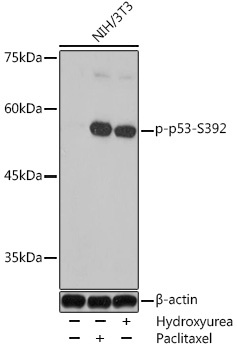
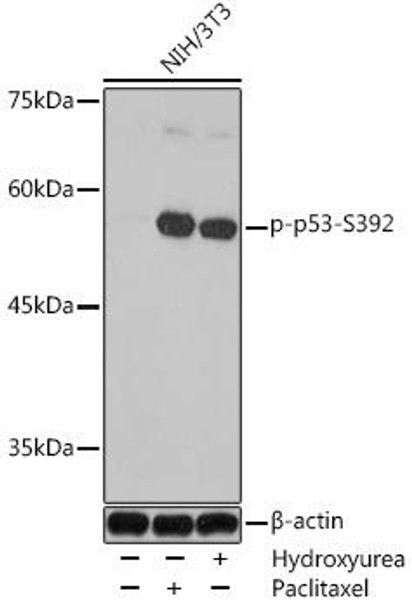
Western blot analysis of lysates from NIH/3T3 cells, using Phospho-p53-S392 Rabbit pAb (CABP0860) at 1:1000 dilution. NIH/3T3 cells were treated with Paclitaxel (100 nM/ml) at 37℃ for 20 hours. NIH/3T3 cells were treated with Hydroxyurea (4 mM) at 37℃ for 20 hours. Secondary antibody: HRP-conjugated Goat anti-Rabbit IgG (H+L) (CABS014) at 1:10000 dilution. Lysates/proteins: 25μg per lane. Blocking buffer: 3% BSA. Detection: ECL Enhanced Kit (AbGn00021). Exposure time: 1s.
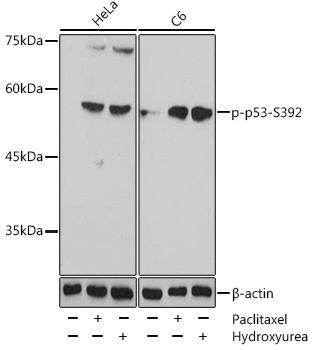
Western blot analysis of various lysates using Phospho-p53-S392 Rabbit pAb (CABP0860) at 1:1000 dilution. HeLa cells were treated with Paclitaxel (100 nM/ml) at 37℃ for 20 hours. HeLa cells were treated with Hydroxyurea (4 mM) at 37℃ for 20 hours. C6 cells were treated with Paclitaxel (100 nM) at 37℃ for 20 hours. C6 cells were treated with Hydroxyurea (4 mM) at 37℃ for 20 hours. Secondary antibody: HRP-conjugated Goat anti-Rabbit IgG (H+L) (CABS014) at 1:10000 dilution. Lysates/proteins: 25μg per lane. Blocking buffer: 3% BSA. Detection: ECL Enhanced Kit (). Exposure time: 20s.