The GNRH2 Antibody (CAB8424) is a high-quality antibody developed for reliable detection and analysis of target proteins. This antibody, produced in rabbits, exhibits high reactivity with human samples and has been validated for use in Western blotting applications. By specifically binding to Progonadoliberin-2 protein, this antibody allows for the precise detection and analysis of Progonadoliberin-2 in a variety of cell types, making it ideal for investigations in the fields of endocrinology and reproductive biology.
This antibody is validated for use in WB, ELISA applications and has demonstrated reactivity against Human, Mouse, Rat samples.
Product Name:
GNRH2 Antibody
SKU:
CAB8424
Size:
20μL, 100μL
Reactivity:
Human, Mouse, Rat
Conjugate:
Unconjugated
Immunogen:
Recombinant protein (or fragment).This information is considered to be commercially sensitive.
Sequence:
QHWS HGWY PGGK RALS SAQD PQNA LRPP GRAL DTAA GSPV QTAH GLPS DALA PLDD SMPW EGRT TAQW SLHR KRHL ARTL LTAA REPR PAPP SSNK V
Tested Applications:
WBELISA
Recommended Dilution:
WB
1:500 - 1:2000
ELISA
Recommended starting concentration is 1 μg/mL. Please optimize the concentration based on your specific assay requirements.
Synonyms:
GnRH-II, LH-RHII, GNRH2
Positive Sample:
293T
Cellular Localization:
Secreted.
Calculated MW:
13kDa
Observed MW:
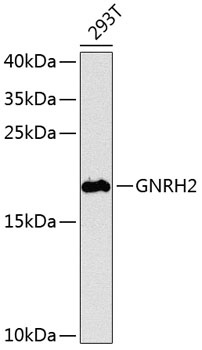
20kDa
This gene is a member of the gonadotropin-releasing hormone (GnRH) gene family. Proteins encoded by members of this gene family are proteolytically cleaved to form neuropeptides which, in part, regulate reproductive functions by stimulating the production and release of the gonadotropins follicle-stimulating hormone (FSH) and luteinizing hormone (LH). The human GNRH2 gene is predicted to encode a preproprotein from which a mature neuropeptide of 10 amino acids is cleaved. However, while the human genome retains the sequence for a functional GNRH2 decapeptide, translation of the human GNRH2 gene has not yet been demonstrated and the GNRH2 gene of chimpanzees, gorilla, and Sumatran orangutan have a premature stop at codon eight of the decapeptide sequence which suggests GNRH2 was a pseudogene in the hominid lineage. The GNRH2 gene is also believed to be a pseudogene in many other mammalian species such as mouse and cow. The receptor for this gene (GNRHR2) is predicted to be a pseudogene in human as well as many other mammalian species. The closely related GNRH1 and GNRHR1 genes are functional in human and other mammals and are generally functional in vertebrates.
Purification Method
Affinity purification
Gene ID
2797
RRID
AB_2769648
Buffer Information
Store at -20℃. Avoid freeze / thaw cycles. Buffer: PBS containing 50% glycerol, preserved with proclin300 or sodium azide, pH 7.3.
Western blot analysis of lysates from 293T cells, using GNRH2 Rabbit pAb (CAB8424) at 1:1000 dilution. Secondary antibody: HRP-conjugated Goat anti-Rabbit IgG (H+L) (CABS014) at 1:10000 dilution. Lysates/proteins: 25μg per lane. Blocking buffer: 3% nonfat dry milk in TBST. Detection: ECL Basic Kit (AbGn00020). Exposure time: 90s.