

Description
| SKU: | RPCB2210 |
| Size: | 10 μg, 20 μg, 100 μg |
| Tag: | NO-Tag |
| Reactivity: | Human |
| Protein Description: | BMP-10 is critical for the proper development of the heart but is not expressed until after cardiac patterning or looping are completed. BMP-10 production appears at the onset of trabeculation and chamber formation and is restricted to the right atrium in the adult heart . Homozygous BMP-10 knockout mice die in utero due to arrested cardiac development. BMP-10 is required for the expression of the cardiogenic transcription factors NKX2.5 and MEF2C in developing myocardium and the growth of embryonic cardiomyocytes. NKX2.5 itself negatively regulates BMP-10 expression in cardiac myocytes. Multiple human congenital heart defects result from mutations in NKX2.5 and require BMP-10 expression . In mice, genetic knockout of ErbB leads to a similar phenotype but appears not to involve BMP-10, and knockout of the calcium channel subunit FKBP12 induces BMP-10 over-expression. BMP-10 in the postnatal heart promotes increased cardiomyocyte and heart size. BMP-10 has been shown to signal through ALK-1, BMPR-IA, BMPR-IB, and BMPR-II in transfectants and non-cardiac cell lines . A functional BMP-10 receptor in the heart has not yet been identified, although deletion of BMPR-IA causes similar cardiac morphogenetic abnormalities. In dermal endothelial cells, BMP-10 induces migration, proliferation, and gene expression typically associated with ALK-1. |
| Endotoxin: | < 1 EU/μg of the protein by LAL method. |
| Purity: | ≥ 90% as determined by reducing SDS-PAGE. |
| Formulation: | Lyophilized from 0.22μm filtered solution in 4mM HCl. |
| Gene ID: | 27302 |
| Storage: | Store at -20℃.Store the lyophilized protein at -20℃ to -80 ℃ up to 1 year from the date of receipt. After reconstitution, the protein solution is stable at -20℃ for 3 months, at 2-8℃ for up to 1 week. |
| Reconstitution: | Centrifuge the vial before opening. Reconstitute to a concentration of 0.1-0.5 mg/mL in sterile distilled water. Avoid vortex or vigorously pipetting the protein. For long term storage, it is recommended to add a carrier protein or stablizer (e.g. 0.1% BSA, 5% HSA, 10% FBS or 5% Trehalose), and aliquot the reconstituted protein solution to minimize free-thaw cycles. |
| Swiss-Prot: | NP_055297.1 |
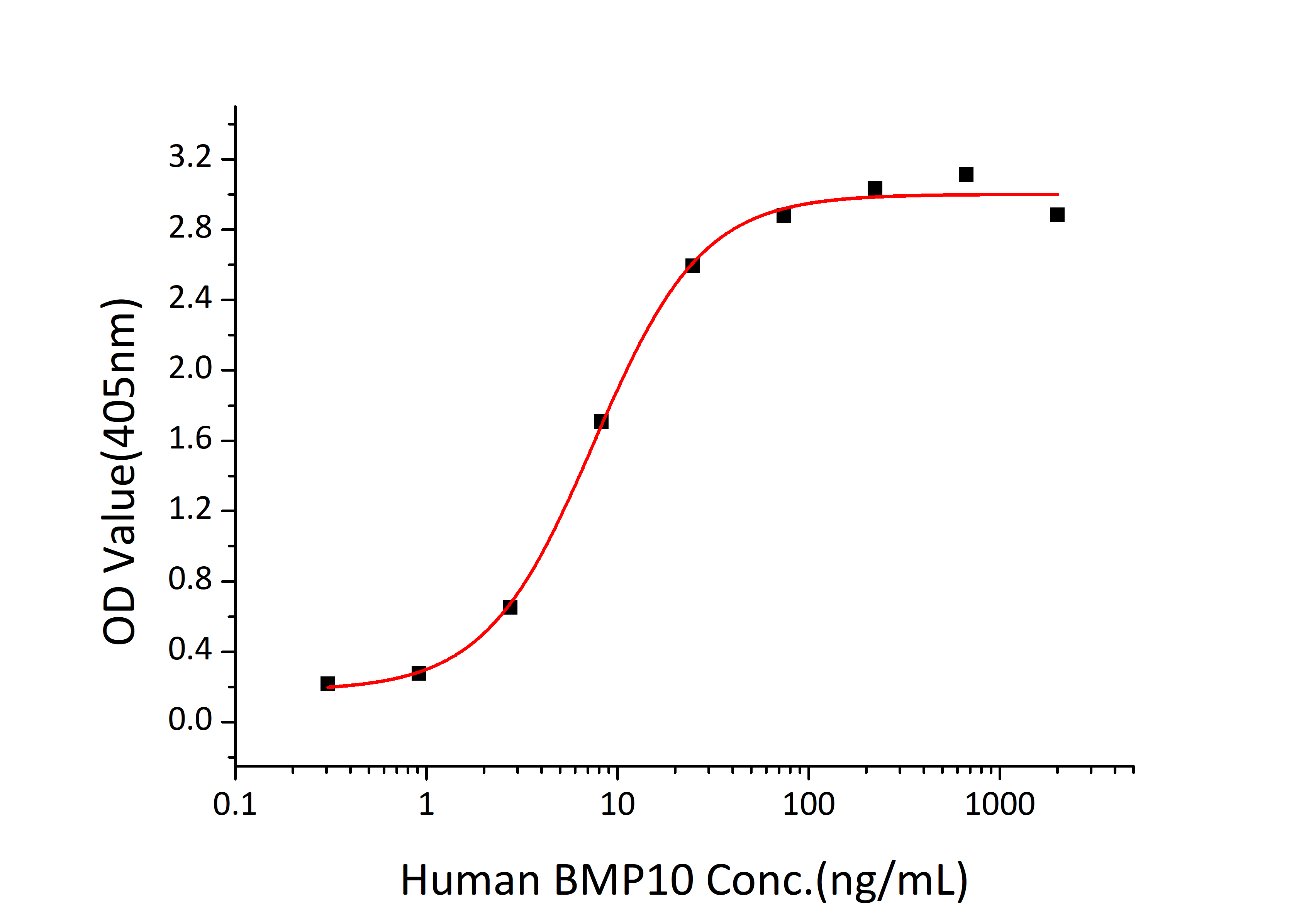 | Measured by its ability to induce alkaline phosphatase production by ATDC5 mouse chondrogenic cells. The ED50 for this effect is 3. 76-15.06 ng/mL, corresponding to a specific activity of 6. 64×10 4~2. 66×10 5 units/mg. |
